Education, as a lack of priority, has hindered the transformation of the economic model

Small countries like Albania can prosper by raising the population’s skills through development and reforms in education.
Countries such as Estonia and Slovenia show that investments in human capital, combined with the development of technology, scientific research and innovation, can be turned into one of the main engines of economic transformation.
Estonia, which began reforms in education as early as the 1990s, with the inclusion of technology in schools, has moved in parallel with the development of digital administration and the information technology industry. These reforms created an important basis for the development of the digital economy.
According to the OECD, the information and communication technology sector generates around 8.5% of value added in the Estonian economy, one of the highest shares among the organisation’s countries.
Estonia has also become an important centre of technology enterprises, showing that a small domestic market does not necessarily constitute an obstacle to the development of industries that compete internationally.
Another example comes from Slovenia, which has built an economy with a strong industrial base, supported by professional qualification, scientific research and innovation.
In 2024, spending on research and development in Slovenia alone reached around 2.1% of GDP, or 1.44 billion euros. Around 69% of research activity was carried out by the business sector, which shows the importance innovation has in the activity of enterprises and its link with the productive economy.
The experiences of Estonia and Slovenia show that small economies can create competitive advantages by investing in knowledge, technical skills and technology. In Albania, by contrast, education has remained underfunded for a long period, while results in learning achievement have taken steps backwards.
In 2015, public spending on education represented 3.1% of Gross Domestic Product, while ten years later this indicator stands almost still, at around 3.2%. The problem lies not only in the level of funds, but also in the lack of a strong link between the education system, the needs of the labour market and policies for economic development.
In the last ten years, the structure of the Albanian economy has undergone important changes, with a gradual shift from productive sectors towards services, tourism and construction. Agriculture has lost weight in the economy, while industry, after a period of expansion, has entered a declining cycle.
According to INSTAT data, the weight of industry in GDP fell to 10.07% in 2025, the lowest level since 2009. Agriculture also continued to shrink, marking the fifth consecutive year of falling production. By contrast, construction and activities linked to tourism have become important drivers of the economy.
Compared with 2015, the economic model is oriented more towards activities that rely on consumption, real estate and tourist flows, while the productive base remains weak. This shift raises questions about the long-term sustainability and competitiveness of the Albanian economy.
Wage differences also show the potential of sectors that require a more qualified workforce. According to INSTAT, in the first quarter of 2026, the average gross wage in the economy reached 90,119 lek, where the largest increase came for elementary professions.
Insufficient financing of education limits the development of these skills, while the current structure of the economy does not create sufficient demand for employees with high qualifications.
For decades a vicious circle has been created, where little investment in education limits the development of human capital, while the lack of high-productivity sectors reduces the opportunities to use this capital within the country. / B.Hoxha
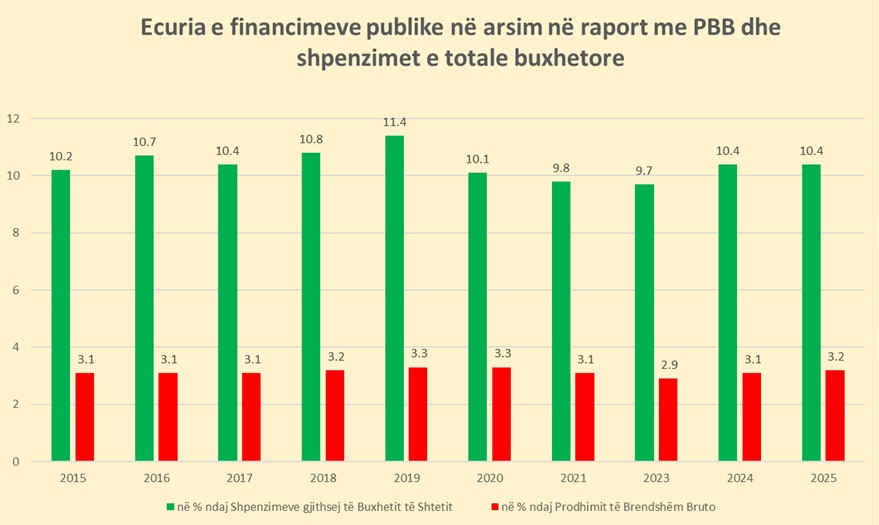
Source data: INSTAT, Ministry of Finance

Komentet
Bëhu i pari që komenton!
Lini një Koment të Ri
Për t'u përgjigjur një komenti specifik, kliko butonin 💬 Përgjigju poshtë atij komenti.