Fetoshi raises the alarm over the Serbs’ scheme involving Trump’s consultants in Republika Srpska
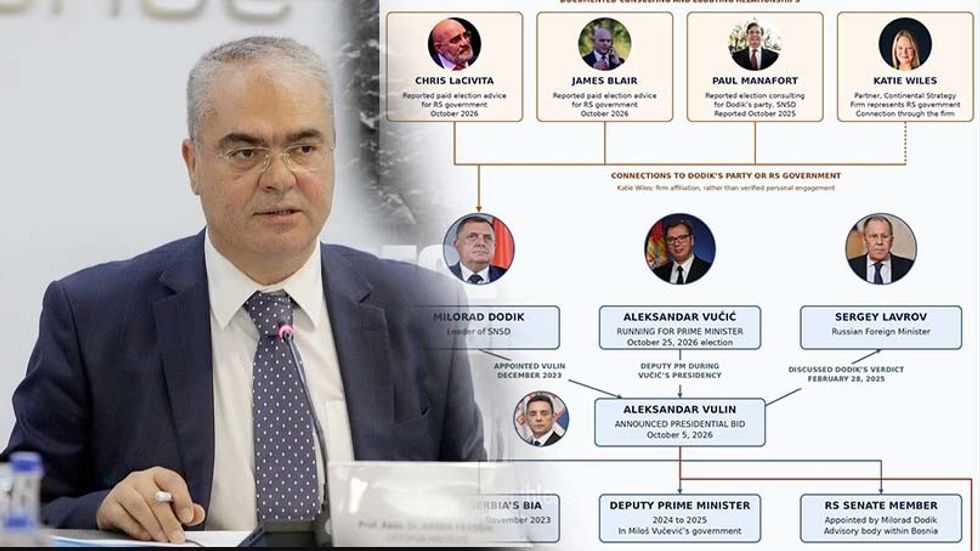
The director of the OCTOPUS Institute, Arben Fetoshi, has analysed that the engagement by Republika Srpska of American consultants with ties to U.S. President Donald Trump should be seen in the framework of Serbian hybrid influence operations in the Western Balkans.
In his analysis regarding the engagement of Chris LaCivita and James Blair by the authorities of Republika Srpska, Fetoshi has raised concerns about the impact this engagement may have on the perception of American policy towards the region.
According to American reports cited by Fetoshi, LaCivita and Blair advised the authorities of Republika Srpska before the elections and were paid hundreds of thousands of dollars.
Fetoshi says the issue should not be seen only from the point of view of a possible conflict of interest, but also through the way the consultants’ ties to figures close to the American administration can be used to create the perception of U.S. support for Republika Srpska’s political agendas.
He further wrote that lobbying contracts and consultancies by figures linked to President Trump can be exploited as strategic elements in hybrid influence operations.
He refers to President Trump’s statement that LaCivita and Blair are outside advisers and that he “saw no conflict of interest”, while also mentioning the reaction of Albanian-American activist Evi Kokalari, who has raised accusations of possible links between this engagement and Russian agendas and figures close to Russian President Vladimir Putin.
Kokalari, according to Fetoshi, in a post on the X network presented a scheme of Milorad Dodik’s links in the U.S. and with Moscow’s network, where she mentioned Aleksandar Vulin, Aleksandar Vučić and Sergei Lavrov.
Fetoshi stresses that the claims of a coordinated Russian operation remain to be verified, but considers that the debate has highlighted the way private consultancy can be used to create the perception of support from the American administration.
“The more fog there is in the relationship between the consultants’ private engagement and the official position of the United States of America, the more influence and manipulation of public perception,” Fetoshi writes.
According to him, this can serve to normalise and legitimise the political agendas of Serbia and Republika Srpska.
Fetoshi argues that the main question should not be only whether a conflict of interest exists, but also whether contracting figures close to the American administration can be used to influence American perception and stance towards the Western Balkans.
He says that promoting Dodik’s closeness to the U.S. does not serve only to improve his international image, but may also influence the creation of a narrative that his political aims are not in contradiction with American interests.
The analysis also mentions Evi Kokalari’s reaction to a statement by a member of LaCivita’s team, according to which “the Serb Republic supports conservatives and the ‘America First’ approach”. Kokalari opposed that statement and raised other claims of links with political networks in Moscow.
Fetoshi links this debate to what he calls the use of closeness to the U.S. as a source of political credibility in the Balkans. He also mentions Serbian President Aleksandar Vučić’s appearance at the UN General Assembly on 23 September 2026, arguing that Vučić had criticised American policy towards Serbia in the past, while expressing expectations of a different approach from the Trump administration.
Fetoshi also considers “permanent victimisation” as part of a political narrative that, according to him, can be used to camouflage hybrid operations and to legitimise Serbian political projects in the region.
“Therefore, the engagement of American consultants by the Serb Republic deserves special attention in the analysis of hybrid threats,” Fetoshi wrote.

Komentet
Bëhu i pari që komenton!
Lini një Koment të Ri
Për t'u përgjigjur një komenti specifik, kliko butonin 💬 Përgjigju poshtë atij komenti.