
Germany’s great treasure mystery: 934 silver coins unearthed
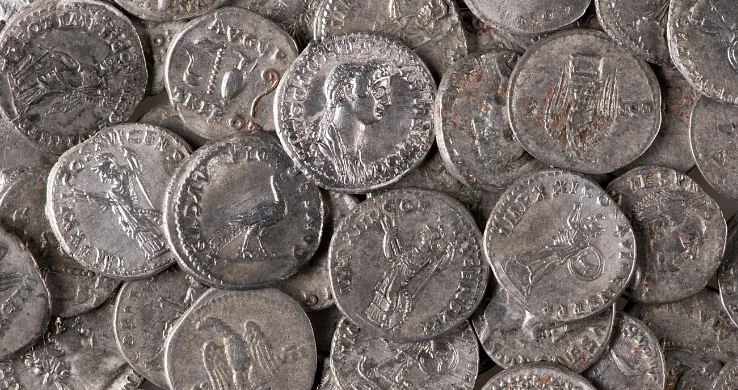
In the autumn of 2025, a father from Rhineland had only meant to briefly clear a field near Wesseling, south of Cologne, with his metal detector. Then the detector beeped and he discovered a Roman silver coin — and it was not the only one.
It was probably the find of his life: the amateur treasure hunter, a family father from Rhineland, expected nothing special that day when, suddenly, his metal detector sounded. He located a Roman silver coin, then more. When he reached 15 pieces and the device kept signaling, he summed it up: “This is something big.”
What archaeologists subsequently unearthed exceeded all expectations: 934 Roman denarii, with a total weight of 3.1 kilograms. The Landschaftsverband Rheinland (LVR) calls the discovery the largest known numismatic treasure from the time of Emperor Hadrian in the territory of present-day Germany. Worldwide, only four Roman coin hoards of this period are known to be larger.
The find site is located south of Cologne, in a region that played an important role during the Roman imperial period. Nearby was Colonia Claudia Ara Agrippinensium, today’s Cologne, which at the time was an important political, military and economic center on the banks of the Rhine.
A fortune most likely inherited generation after generation
Particularly fascinating is the time span covered by the coins. The oldest dates to 148 BC, in the Roman Republic period. The newest coin was minted in 124/125 AD. More than 270 years lie between them.
When the treasure was buried, most likely in the second quarter of the second century AD, the oldest coin was already more than two and a half centuries old and, apparently, was still valid as a means of payment. The discovery thus shows how long old coins could remain in circulation in the Roman monetary system.
The treasure’s value is hard to translate into today’s monetary terms. One reference point is a Roman legionary’s pay: an ordinary soldier earned about 300 denarii a year at the time, of which roughly half was withheld for food and equipment. To save a sum comparable to the treasure, he would have had to set aside all his disposable income for about six years.
Why was the treasure never found?
Archaeologists believe the coins were deliberately hidden, with the aim of keeping them in a safe place. Most likely, the person who hid them died before telling anyone where the treasure was.
The way the treasure was found offers at least some clues. Some of the coins were transported, together with a compact block of soil, to the restoration laboratory of the LVR-Landesmuseum Bonn. There, X-rays revealed, among other things, fragments of a ceramic vessel and straw remains.
Everything indicates that someone had once placed the coins in a vessel wrapped or filled with straw to protect them.
All evidence suggests the fortune had been accumulated around 100 AD, but was buried only decades later, during the reign of Emperor Hadrian.
Emperor Hadrian and the time the treasure was hidden
Emperor Hadrian (76–138 AD) ruled the Roman Empire from 117 until his death at the age of 62. He is considered one of the so-called “five good emperors” and focused on securing and consolidating the vast Roman Empire.
Hadrian traveled across large areas of the empire’s territory, ordered the expansion of roads, temples and cities, and is particularly known for Hadrian’s Wall in Britain, built to protect the Roman frontier from northern tribes.
However, his reign was not peaceful. Between 132 and 135 AD, in the Roman province of Judea, which stretched across parts of today’s Israel and the Palestinian territories, an uprising broke out against Rome’s rule.
Led by Simon Bar Kokhba, Jewish rebels fought against Roman troops. The uprising was suppressed by Rome with great harshness.
The silver coins found by this Rhineland resident now belong to the federal state of North Rhine-Westphalia, while the finder is expected to receive a reward.
Some of the coins were presented to the public for the first time in September in Bonn. In March 2027, the treasure is expected to be displayed in the permanent archaeological exhibition of the LVR-LandesMuseum Bonn.



Komentet
Bëhu i pari që komenton!
Lini një Koment të Ri
Për t'u përgjigjur një komenti specifik, kliko butonin 💬 Përgjigju poshtë atij komenti.