IMF: Albania has not used its growth potential, the economy could have moved closer to the EU
Although Albania has recorded average economic growth of around 4.4% per year during the period 2000–2024, the Albanian economy has not fully used its potential to narrow the development gap with the European Union.
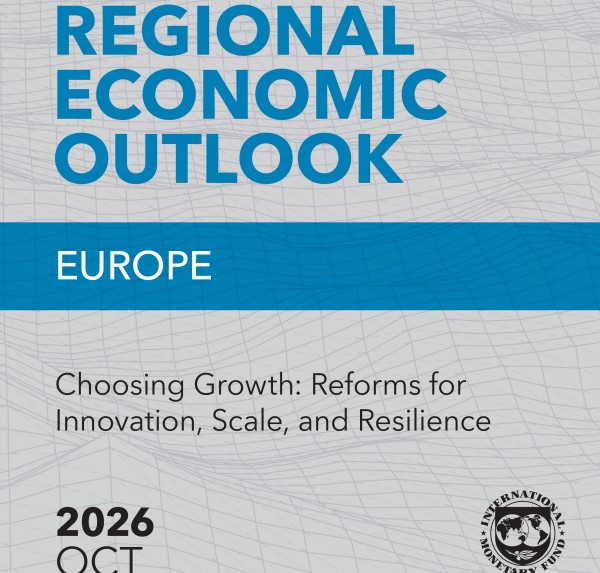
In the October 2026 report, “Regional Economic Outlook: Europe – Choosing Growth: Reforms for Innovation, Expansion and Sustainability”, the International Monetary Fund (IMF) notes that the countries of the Western Balkans, including Albania, have considerable opportunities to accelerate economic convergence, especially through reforms that increase productivity and through the benefits of European integration.
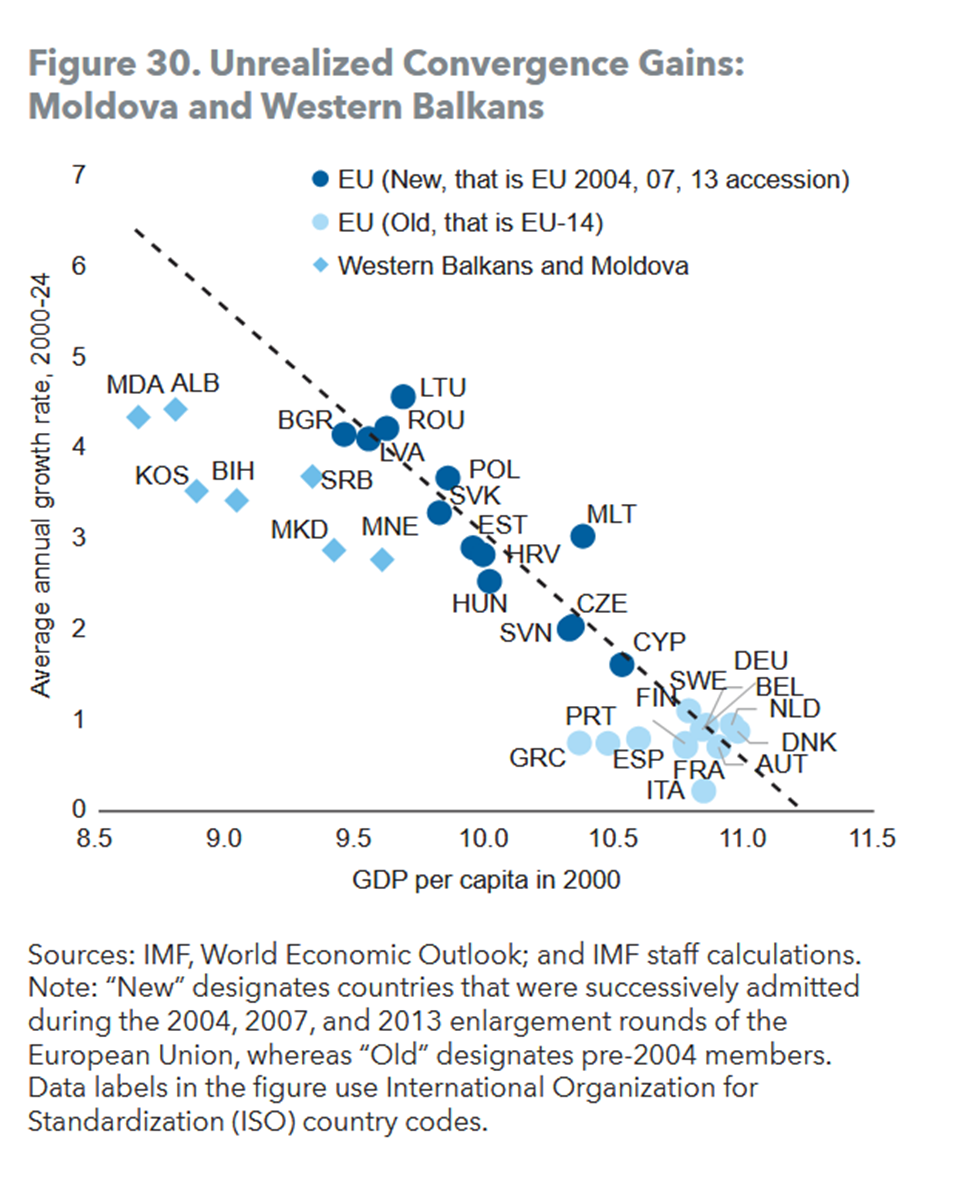
In the chart titled “Unrealised benefits from convergence: Moldova and the Western Balkans”, the IMF compares the average annual growth of European economies during the years 2000–2024 with their initial level of Gross Domestic Product (GDP) per capita. The analysis is based on the principle of economic convergence, according to which countries with lower incomes have the opportunity to grow faster than developed economies, benefiting from the technology, capital and production practices that already exist in richer countries.
Albania ranks among the European economies with the lowest initial level of GDP per capita in the year 2000. Nevertheless, over the following 24 years, the pace of economic growth has not been high enough to fully realise the potential of moving closer to the more developed countries. According to the chart, Albania is positioned below the line representing the relationship between the initial level of income and average economic growth. This suggests that, considering the low level from which it started, the Albanian economy could have recorded faster growth.
The comparison with the countries of Central and Eastern Europe is particularly significant. Lithuania, which had a higher GDP per capita than Albania in 2000, achieved average annual growth of around 4.6%, exceeding Albania’s pace of 4.4%. Romania and Bulgaria, which joined the European Union in 2007, also recorded high growth rates, of around 4.2% and 4.1% per year respectively, despite having a higher initial level of development than Albania.
In the Western Balkans, Albania has had one of the highest growth rates during the analysed period. Serbia recorded an average of around 3.7% per year, Kosovo 3.5%, Bosnia and Herzegovina 3.4%, North Macedonia 2.9% and Montenegro 2.8%. Nevertheless, Albania’s relatively better performance compared to the countries of the region has not been enough to compensate for the large development difference with the EU economies. This is one of the findings illustrated by the IMF chart, where the countries of the Western Balkans and Moldova are generally positioned below the expected relationship between the initial level of income and economic growth.
In the Regional Economic Outlook: Europe report, the IMF stresses that the growth model of Central, Eastern and South-Eastern Europe has benefited significantly from European integration, increased productivity and capital accumulation. But the sustainability of this model is being tested by the weakening of industrial exports, wages rising faster than productivity, the appreciation of the real effective exchange rate, the decline in foreign direct investment and stronger international competition. According to the IMF, these developments are appearing not only in Central Europe and the Baltic countries, but also in the Western Balkans.
To revive the convergence process, the economies of the region must rely less on the advantage of low costs and external factors, orienting themselves towards innovation and increased productivity. Maintaining competitiveness requires more reliable institutions, a more qualified workforce, larger private investments and a shift towards activities with higher added value. The IMF also warns that expansionary fiscal policies, pursued for a long time in some countries, must be adjusted to guarantee the sustainability of public finances.
The IMF revises its forecast for the Albanian economy upwards, and lowers the one for inflation.



Komentet
Bëhu i pari që komenton!
Lini një Koment të Ri
Për t'u përgjigjur një komenti specifik, kliko butonin 💬 Përgjigju poshtë atij komenti.