Maqedonci: We have asked the US to discuss the purchase of helicopters
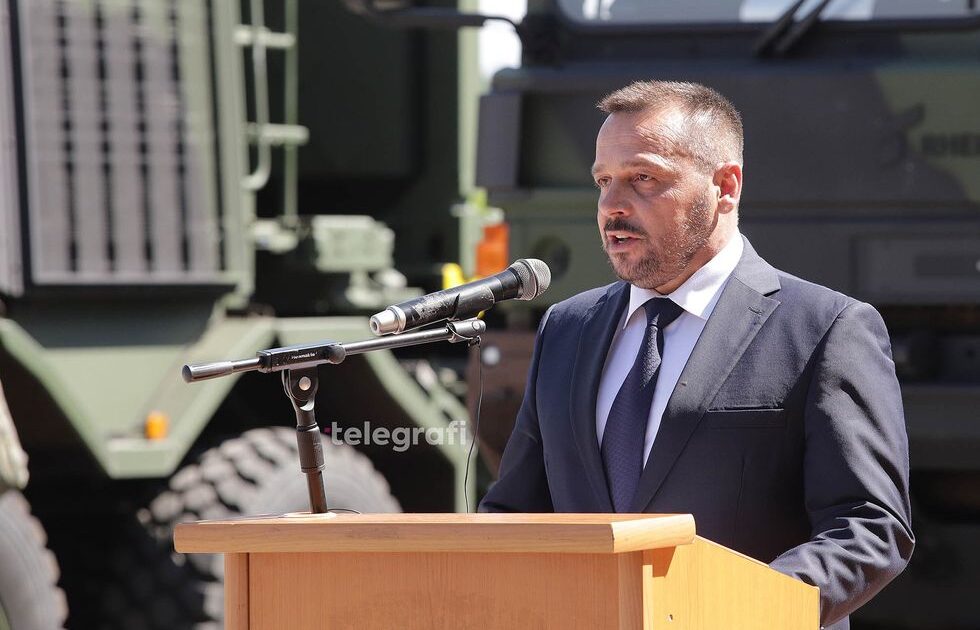
Kosovo has addressed a request to the United States of America to discuss the purchase of helicopters for the Kosovo Security Force (KSF), while air defence will also be a priority in the development of defence capacities.
This was announced in an interview for Ekonomia Online by the Minister of Defence, Ejup Maqedonci, who also spoke about the threats that, according to him, Serbia presents for the security of Kosovo and the region.
Maqedonci said that the request for helicopters was addressed by the KSF commander and that the procedures for their purchase are carried out through the American FMS programme, which involves the US Department of War.
“We have also procured the drones, that is, the unmanned aircraft, of which we currently have three types in the Kosovo Security Force. Our focus going forward will be air defence, that is, defence against possible air attacks, the protection of Kosovo’s airspace, and on this issue we are coordinating and cooperating with our American partners. Also air support, which includes this part about helicopters, for which the KSF commander has already addressed the request to the US, to discuss this issue, because this purchase is made by applying the FMS programme, which means we send the request to the Department of War, and all the procedures of negotiation, procurement and the other procedures for the purchase are carried out by the American Department of War,” Maqedonci said.
The Minister of Defence also spoke about the armaments purchased in recent years, emphasising that the KSF has increased the types of weapons systems and that further development of military capacities is being aimed for.
“We have made various purchases during these phases, especially during the last three to four years; we have procured very important weapons systems. It is known that some have been made public, some have also been seen during exercises, and some we have also emphasised in our publications. We currently have four types of anti-tank systems, types of different mortars, for firing at different distances, types of different vehicles; we have also procured mobile artillery systems,” he said.
Maqedonci announced that Kosovo is also working on the development of new units and on adapting defence capacities to the current security situation.
“So, these changes that we are making together with the commander of the Kosovo Security Force — here, the increase in the number of weapons, I mean the multiplication of the types of weapons, the increase of new units, because we have two new units that are already very operational, such as the special operations unit and the unmanned aircraft unit, which are units that were not planned in the comprehensive transition plan; they were made by analysing the current situation and the needs that Kosovo has for defence,” he added.
He said that the development of the KSF is being done in accordance with the current needs for defence, since the comprehensive transition plan was drawn up based on a risk analysis from 2014.
“So, two years earlier we are filling the Kosovo Security Force with the necessary personnel. We are then also working on the aspect of recruiting the reserve, I mean the active reserve. Also, as a result of the continuous support we have received from the prime minister and the government, we have managed to multiply the types of armament; we have very many types of armament, as had been planned with that comprehensive transition plan, but besides having very many types, we also have very many quantities, as had been planned with the comprehensive transition plan.
And this was not done simply to fill the depots with armaments and ammunition, but to fill the need that Kosovo has for defence. The comprehensive transition plan is a plan that was made in the year, was approved in 2018, by the Assembly of Kosovo. Normally, there are many classified elements in that plan that cannot be made public, but it should be emphasised that that plan was drafted based on an analysis that was made in 2014, when the risks and threats were different,” he stressed.
The minister said that the aim is for the KSF to be prepared for the defence of the territory by 2028, but stressed that the development of defence capacities will continue after that year as well.
“I assess that 2028 will find us with a Kosovo Security Force prepared and ready to defend the territory. Normally, the development of the army does not end in 2028. We are working to have a long-term plan for the development of our defence capacities, and moreover, the comprehensive defence programme has also been approved in the Government of Kosovo, which will gradually turn Kosovo into a country with a defence system where we will have a professional army, which is the Kosovo Security Force, with all the necessary military capacities, and alongside it an engagement of a voluntary reserve from civil society, but also an engagement of institutions for our defence system,” the minister emphasised.
He added that alongside the professional force, the aim is to include citizens and institutions in the comprehensive defence system, including preparation for crisis situations and natural disasters.
“So, the Kosovo Security Force will continue to be shaped as a professional force; on the other hand, we are building a comprehensive defence system, of all citizens and all institutions. So, citizens will have the opportunity to be trained, prepared, to have their role within our defence system, and to continue normally with everyday life, with the work they perform on a daily basis, and they will be called when the country needs it, not only in case of war, but also in case of crises and in case of natural disasters,” he said.
Maqedonci announced that the KSF is also recruiting 530 members, who are completing their training in Ferizaj, in order to reach the number of 5,000 active members.
“We have continuously, during these years, made investments in the field of defence; the fact should be emphasised that the budget for the Kosovo Army was quadrupled during the government’s previous mandate. We have taken great steps in strengthening our military capacities. We have achieved many of the objectives at much earlier stages than had been planned in the comprehensive transition plan. Currently, we are also recruiting 530 members of the Kosovo Security Force, who are already completing the training in Ferizaj, at the Doctrine and Training Command, in order to fulfil that number of 5,000 active members required according to the comprehensive transition plan,” the minister said.
Regarding the security situation, the minister assessed that it is stable, while mentioning the work of the Kosovo Police, the Kosovo Intelligence Agency and the cooperation with international partners.
“I believe that currently the security situation in Kosovo is very stable; with the expulsion of terrorist groups from Kosovo, with the defeat of these groups by the specialised units of the Kosovo Police, with the blow that the Kosovo Intelligence Agency is continuously delivering — I mean to Serbia’s espionage activities in Kosovo — with the development and strengthening of the Kosovo Security Force and coordination with our partners, we have managed to truly create a calm environment in Kosovo, a stable environment, a steady environment, and especially this during the last two to three years. And this has also been assessed by NATO; NATO has assessed that Kosovo is moving towards a stable and secure environment. Besides this, we are witnesses that Kosovo is also turning into a country contributing to security and peace in the world; we are not only engaging in the security of our country, but also in global, regional and European security,” he said.
As for Serbia’s military capacities, Maqedonci said that the deployment of troops and bases near the border with Kosovo is a concern for the country’s institutions. According to him, Serbia has 48 forward operating bases along the border line.
“And this issue of the 48 forward operating bases of the Serbian army and gendarmerie has been emphasised many times, and we have also notified NATO and our partners throughout the discussions, that for Kosovo it constitutes a threat that Serbia has placed 48 bases along the border with the Republic of Kosovo. Recently, we have also had information about the withdrawal of some units from some bases, but as long as the base is there, the withdrawal of personnel and the return of personnel is more of an operational matter than a withdrawal of bases; according to the information we have had and continue to have, there are 48 existing bases that are at a distance of 500 metres to 5 km from Kosovo’s border line, on the territory of Serbia, and they are along the entire border line,” he said. He added that Serbia has deployed three of its four military brigades in the southern part of its territory, and has also purchased advanced armaments from China.
“And besides this, Serbia has deployed, stationed in the south of its territory, three of its four military brigades; Serbia as a whole, the Serbian Army has four brigades, three of them are deployed in the south of Serbia’s territory, which are support for these forward operating bases. One is in Rashka, one brigade is in Nish, and another is in Vranje; so it has a large concentration of military troops in the south of its territory, not far from the border with Kosovo, or also with Montenegro and North Macedonia. And this, for us, constitutes a concern, because it is also being complemented by other worrying aspects, such as Serbia’s arming with various weapons, including here hypersonic missiles purchased from China,” he said.
Maqedonci assessed that Serbia’s policy towards its neighbours, according to him, remains the essence of the security concerns in the region.
“I said it earlier as well: this militarisation might not be so worrying if the essence of the Serbs’ policy did not continue to remain hegemonist and aggressive towards the neighbours. But, normally, this does not frighten us. Kosovo is an independent state, Kosovo is cooperating with partners to build its military capacities, and the Kosovo army and the other security institutions are more than determined to protect every part of the territory of the Republic of Kosovo and every life of a citizen of Kosovo from every threat and danger from whoever it may come,” he said.
The minister also spoke about what he described as Serbia’s hybrid approach towards neighbouring countries, mentioning the interaction of state institutions with criminal and terrorist groups, as well as the use of disinformation.
“This shows an approach of Serbia, a hybrid approach towards neighbouring countries. When we talk about hybrid warfare, this means the engagement of conventional institutions and organisations, such as the army, the police and the intelligence service, in interaction with non-conventional actors, such as terrorist groups, criminal groups, but also disinformation and other means. So, this hybrid approach is close to what the Russian Federation has continuously applied towards Ukraine and is also applying towards other countries of Eastern, but also Central, Europe, and this shows, we can say, a functioning that is the same, joint, coordinated, between the Russian Federation and Serbia, at least by sharing experiences with each other,” he said.
Maqedonci said that the sheltering of persons involved in criminal activities and the support for groups that have operated in the region are concerns that Kosovo has continuously raised with international partners, especially after the attack in Banjska.
“The Government of the Republic of Kosovo and all our institutions, many times during these years, especially after the attack in Banjska, have raised as a concern, before partner countries and before all the actors with whom we have communicated, the issue of sheltering the criminal and terrorist groups that attempted the annexation of our northern part to the Republic of Serbia, and moreover, the support that the government of Serbia and the security institutions in Serbia are giving to these groups. For us, this constitutes a concern; not only for us, it constitutes one for all the countries, at least of the Western Balkans, but also of Europe, because it continuously keeps Serbia in a state of a country, of a source of instability for security in the Western Balkans. By having inside the country terrorist groups that attempted the annexation of a part, of a territory, of another country, as was the case of the attack in Banjska, by having inside the territory, by sheltering also criminals who have carried out other criminal activities in the region, then normally this presents a threat and danger for the surrounding countries. But this policy of Serbia of preserving, sheltering criminals is continuing; it is not new — in other years Ratko Mladic and other criminals were sheltered precisely in Serbia. Unfortunately, in Serbia’s state institutions there have also been earlier reports of the sheltering of Radoicic, but also of other criminals, in bases and in state institutions,” he said.
The minister said that the statements of Serbian politicians and Belgrade’s approach towards neighbouring countries, according to his assessment, reflect aims for regional domination.
“I believe that these statements of Serbian politicians, which unfortunately continue to be of an ultra-chauvinist nature, are not new; they are a continuity that has been going on for a long time; these statements are not current statements, but I believe that the biggest problem, the essence of the whole problem, lies in the state approach of the Republic of Serbia towards neighbouring countries. It is a hegemonist approach, an aim to dominate the Balkans, which continues to be at the core of Serbian policy. Then every other action, such as militarisation, such as the support of terrorist groups, such as other activities carried out by different actors supported by Serbia, are only those that translate this approach, deeply rooted in Serbia’s policy, into implementation — the attempt to dominate the Western Balkans and beyond,” he said.
Komentet
Bëhu i pari që komenton!
Lini një Koment të Ri
Për t'u përgjigjur një komenti specifik, kliko butonin 💬 Përgjigju poshtë atij komenti.