What links Putin and Elon Musk? The same dream of immortality and the conquest of space
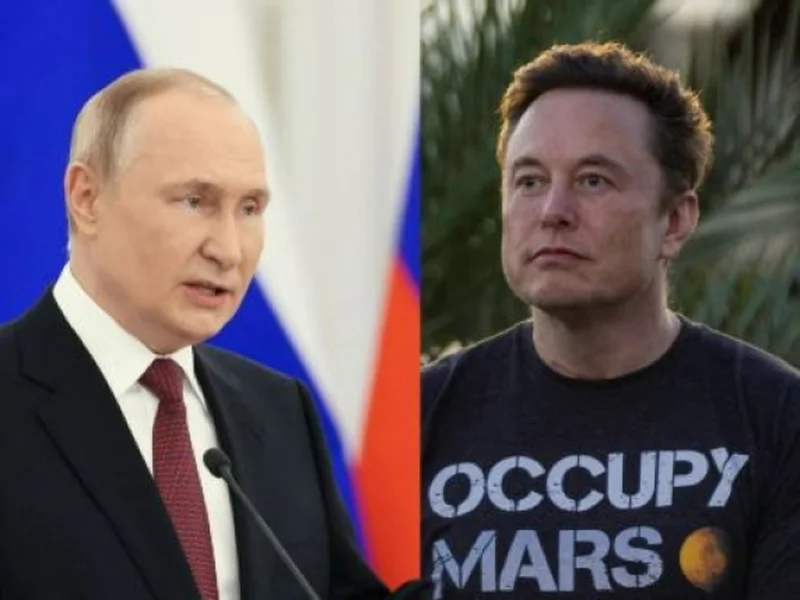
Vladimir Putin and Elon Musk are two figures who seem completely different, but they share a common interest: the conquest of space and the idea that one day man may even defeat death. The link between them comes from the theories of a Russian philosopher and scientist, Konstantin Tsiolkovsky, who more than a century ago dreamed that humanity would leave Earth and spread throughout the universe.
It all began in 2007, when Putin visited Tsiolkovsky’s house-museum in the city of Kaluga, southwest of Moscow. Tsiolkovsky was a self-taught teacher who became one of the pioneers of ideas about space travel and rocket design. He is also known for the influence he had on the development of Russian scientific thought about exploring the universe.
During the visit, Putin spoke about the importance of space and about how its exploration can improve people’s lives. He also quoted one of Tsiolkovsky’s best-known sayings: “Earth is the cradle of reason, but man cannot live forever in the cradle.”
A few months later, the Russian president signed a decree for the construction of a new rocket launch base, as Russia sought to have a cosmodrome on its own territory after the dissolution of the Soviet Union and the Baikonur base remaining in Kazakhstan.
In 2013, Putin visited the construction site of the Vostochny cosmodrome, in the Russian Far East. The project was seen as a symbol of the return of Russia’s power and prestige after the difficult period that followed the fall of the Soviet Union. At that time, Putin also presented space as a field where countries can cooperate and overcome tensions between them. The town built near the base took Tsiolkovsky’s name.
In the years that followed, Putin returned several times to the Russian philosopher’s ideas, including the possibility that people could live to 200 years, defeat death and influence their own biological evolution. However, Tsiolkovsky had gone even further. He believed that man could achieve immortality and that humanity would one day populate the entire universe.
It is precisely here that Elon Musk appears. In 2018, during an event dedicated to the series “Westworld”, the American entrepreneur spoke about his plans for the colonisation of Mars and referred extensively to Tsiolkovsky’s theories.
In 2021, Musk posted on Twitter, now X, the same Tsiolkovsky quote that Putin had cited in 2007. He described it as one of his favourite quotes, written by a great man.
According to scholar Michael Eltchaninoff, in his book “Lenin Walked on the Moon”, the thought of Russian cosmists and transhumanists has also influenced the way some technology entrepreneurs see the future of humanity.
In Silicon Valley, several billionaires are funding research to slow ageing and extend human life. Sergey Brin and Larry Page have supported scientific projects, while Peter Thiel has expressed interest in research aimed at challenging ageing. Jeff Bezos too invests both in space technologies and in longevity research.
Some scholars and entrepreneurs go even further, supporting ideas such as preserving the body at very low temperatures after death, in the hope that future science may make a return to life possible. All these efforts are linked to a common idea: extending human life and expanding the possibilities of living beyond Earth.
For Eltchaninoff, to understand some of today’s technology ambitions, we must go back to the Russian thinkers who put forward these ideas more than a century ago.
Thus, a philosopher unknown to many, from a provincial Russian city, has left a mark on the thinking of two important figures of our time. Putin and Musk may have different visions, but both have been inspired by the same idea: Earth may not be humanity’s final limit.

Komentet
Bëhu i pari që komenton!
Lini një Koment të Ri
Për t'u përgjigjur një komenti specifik, kliko butonin 💬 Përgjigju poshtë atij komenti.