Exports rise 14.8% in September on oil prices, but the garment sector is on the brink of bankruptcy, down 16.2%
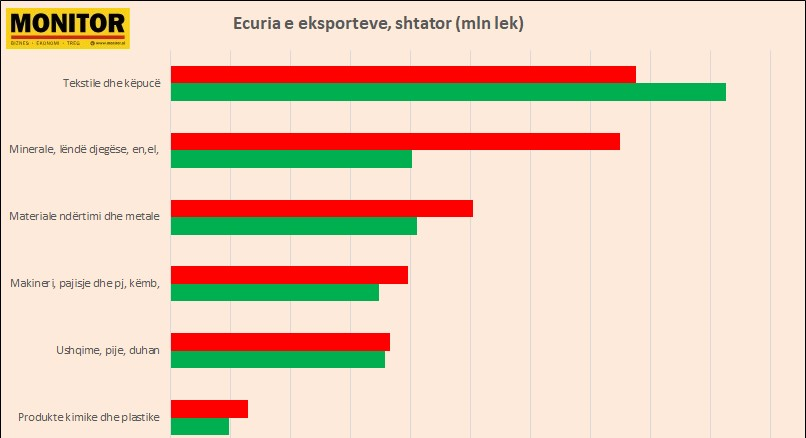
Exports returned to strong growth in September, driven mainly by favourable price conditions on international exchanges, while the main group, textiles and footwear, deepened its decline.
According to INSTAT data, in September 2026 goods exports reached 31.2 billion lek, rising by 14.8% compared with the same period a year earlier. The main impact came from the group “Minerals, fuels, electricity”, which almost doubled, with oil providing the main effect.
The group “Textiles and footwear”, which is the largest employer in industry with around 50,000 people, deepened its decline, shrinking by 16.2% in September.
According to INSTAT, in the 14.8% rise in exports in September 2026, the groups that contributed positively were: “Minerals, fuels, electricity” with +12.8 percentage points, “Construction materials and metals” with +3.4 percentage points, “Machinery, equipment and spare parts” with +1.8 percentage points, etc. While the groups that contributed negatively were: “Textiles and footwear” with -5.5 percentage points and “Leather and articles thereof” with -0.2 percentage points.
For the nine-month period, the trend remained positive. According to INSTAT, for the period January-September 2026, exports were 279 billion lek, up 7.2% year-on-year. For the nine months as well, the main positive impact was given by minerals, fuels and energy, construction materials and machinery and spare parts, while the most negative effect was from textiles and footwear.
The garment sector continues its sharp decline, on the brink of bankruptcy
Exports from the clothing and footwear industry have recorded consecutive months of decline, which keeps deepening. In September the fall was -16.2%, after a contraction of -12.4% in August and over -13% in July. For the whole nine-month period exports were 71.7 billion lek, shrinking by 9%, being the only major group with a negative trend.
Florjan Zekja, chair of the Manufacturing Association, says the contraction of over 16% in the sector is an alarm signal, with the sector on the brink of bankruptcy.
“We raised this alarm at the beginning of the year. The positive signs in some month did not reflect the reality of the sector. The fall of the euro and the rise in production costs are weakening competitiveness and pushing Albanian producers out of the market.
A sector is shrinking which, besides its great social importance, has also been one of the main locomotives of Albanian exports.
At a time when European countries such as Italy, Germany and Great Britain are reactivating the garment sector and encouraging domestic production to reduce dependence on distant markets, economic policies in Albania are not responding to the alarm over the bankruptcy of domestic production.
This is particularly worrying when we must prepare and transform ourselves to become part of the European common market. Without immediate measures, starting with the 2027 Fiscal Package, the consequences could be irreparable and endanger the existence of Albanian producers and exporters in the near future,” Zekja told Monitor.
Edvin Prence, chair of ProEksport Albania, told Monitor that the decline of the garment sector is no longer an alarm signal, but a direct indicator that Albania is losing production capacity and competitiveness. “It is not enough to talk about export growth when the industry that employs, produces and brings in foreign currency is shrinking. This requires immediate intervention, industrial policies, support for investment, technology and a shift to production with added value. If we lose the factories today, tomorrow we will have nothing to support,” he said.
Marked rise in the energy and fuels group on oil prices
While the garment sector has been negatively affected by the war, the opposite happened with fuel exports, which were favoured by rising prices on exchanges.
In September, this group almost doubled, rising by 86.4%, to reach 7.5 billion lek. Sources from Bankers Petroleum, the main operator in this group and the oil exporter, told Monitor that exports rose markedly in September, favoured by the high price of oil on international exchanges.
For the nine-month period, this group exported 61.8 billion lek, with annual expansion of 26%.
Construction materials and metals also rise
During September, the group “Construction materials and metals” continued to grow by 22.7%, although at slower rates than in July, when it expanded by over 70%. For the nine-month period, exports rose 21.6%, to 42.8 billion lek, remaining one of the groups with the most positive impact on export performance for the nine months, together with minerals, fuels and energy.
The automotive industry revives
The group “Machinery, equipment, spare parts” showed signs of revival in September, after stagnation in August. In September, exports rose by 14%, while for the nine-month period sales of this group reached 33.2 billion lek, up 12.3%. This group, where the automotive industry carries the main weight, has been recovering since the end of last year, when companies reported that orders were increasing. Some companies produce simple parts for work machinery and large transport vehicles, a segment that has performed steadily. Meanwhile, the EC decision to leave internal combustion vehicles beyond 2035 in hybrid form changed the picture for this year too, where orders are expected to rise. The main pressures this industry based in our country is going through are linked to the workforce, the continuous depreciation of the euro, as their contracts are fixed for several years, and thirdly the sudden rise of the minimum wage to 50,000 lek.
Food, beverages and tobacco, weak growth
“Food, beverages and tobacco”, one of the groups with the best performance in recent years, slowed in September, rising by only 2.4%. For the eight-month period, food sales abroad were 42.7 billion lek, with an increase of 3.3%.
In September 2026, goods exports reached 31.2 billion lek, rising by 14.8% compared with the same period a year earlier and by 52.1% compared with August 2026. Goods imports reached 78.6 billion lek, rising by 4.8% compared with a year earlier and by 4.0% compared with August 2026. This month’s trade deficit is 47.3 billion lek, down by 0.9% compared with a year earlier and by 13.9% compared with August 2026.
Goods trade performance by partner countries
In September 2026, the countries with which Albania had the largest increase in exports, compared with September 2025, are: Kosovo (22.5%), Greece (13.9%), etc. While the countries with which exports had the largest fall are: Italy (4.0%), Switzerland (3.8%), etc. In September 2026, the countries with which Albania had the largest increase in imports, compared with September 2025, are: Turkey (6.8%), Greece (3.8%), etc. While the countries with which imports had the largest fall are: Italy (14.1%), China (7.0%), etc. Trade exchanges with EU countries account for 54.6% of all trade. In September 2026, exports to EU countries account for 68.7% of total exports and imports from EU countries account for 48.9% of total imports, INSTAT reported.

Komentet
Bëhu i pari që komenton!
Lini një Koment të Ri
Për t'u përgjigjur një komenti specifik, kliko butonin 💬 Përgjigju poshtë atij komenti.