
“Smart barbed wire”: Ukraine’s new trap for drones
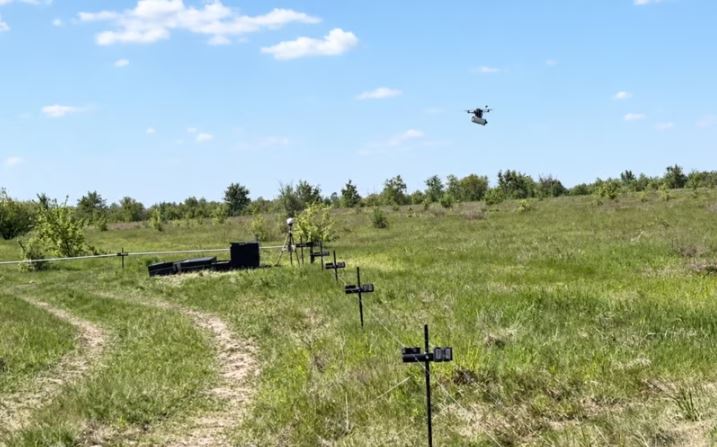
Ukraine has begun using a new device on the battlefield against fibre-optic drones.
It works by cutting the cables through which operators control the drones.
The technology comes at a time when armies around the world are looking for ways to defend themselves against these drones.
The Ukrainian device Chaharnyk (“bush”), presented in September, is designed to physically sever the fibre-optic cables used to control many FPV drones.
Unlike drones controlled through radio signals, fibre-optic drones cannot be stopped by jamming their electronic signal.
They have recently also been used in the conflict in Myanmar, as well as in deadly attacks against Israeli forces.
Their use has also prompted Israel to intensify its efforts to find effective ways to defend against them.
James Patton Rogers, co-director of the Future Threat Lab institute at King’s College London, compares the Chaharnyk to “smart barbed wire”.
He predicts the device could face considerable problems in an active war zone, including the risk that the system itself becomes a target of attacks.
Also, depending on where it is placed, it could hinder the movement of Ukrainian forces too, according to him.
Nevertheless, Rogers emphasises to Radio Free Europe that “if placed along the front line or around villages, inhabited areas and important military facilities, alongside other anti-drone technologies, it could offer vital protection against a threat that has not yet been neutralised”.
During demonstrations of the system, the fibre-optic cables trailed behind attacking FPV drones are caught in the Chaharnyk’s hooks and then pulled toward the cutting mechanism.
The company Logika claims the system manages to sever the cables in 95 percent of cases.
But cutting the cables does not necessarily neutralise the drone.
The head of the Ukrainian company Logika told Radio Free Europe that many Russian FPV drones, controlled via fibre optics, also have a backup radio link.
If the cable is cut, the drone switches to that alternative mode of communication.
“In that case, the electronic warfare systems placed in the area are activated,” he said, adding that “in most cases, the drone is shot down and explodes”.
A recent Chinese report on anti-drone technologies analysed an improvised obstacle, similar in principle to the Chaharnyk, which was filmed being used in Ukraine at the end of 2025.
According to the Chinese report, this improvised system had ‘clear’ limitations.
The pilot can steer the drone around the obstacle; cutting the fibre optics does not necessarily prevent the strike, as the drone can continue moving and crash into the target; while the placement of the obstacle itself can reveal the area where the defending forces operate.
“Can the opponent spot the Chaharnyk and bypass it? Yes, that is possible,” the head of the Logika company told Radio Free Europe.
“However, if a network of these systems is placed properly, taking into account the facility or area that must be protected, there will be no way to bypass it,” according to him.
These statements suggest that among the first positions where this technology may be deployed are the small Ukrainian points on the front line, which are regularly attacked by FPV drones.
The Logika chief added that the system can be camouflaged.
According to him, even the low-resolution images that drone operators see can make it difficult to distinguish the device from a distance.
“We are not claiming that the Chaharnyk will protect everyone, but we are convinced that it will improve protection against attacks by FPV drones controlled via fibre optics,” he said.



Komentet
Bëhu i pari që komenton!
Lini një Koment të Ri
Për t'u përgjigjur një komenti specifik, kliko butonin 💬 Përgjigju poshtë atij komenti.