
Berisha from Strasbourg asks the Appeals Court to review the convictions of the former KLA leaders
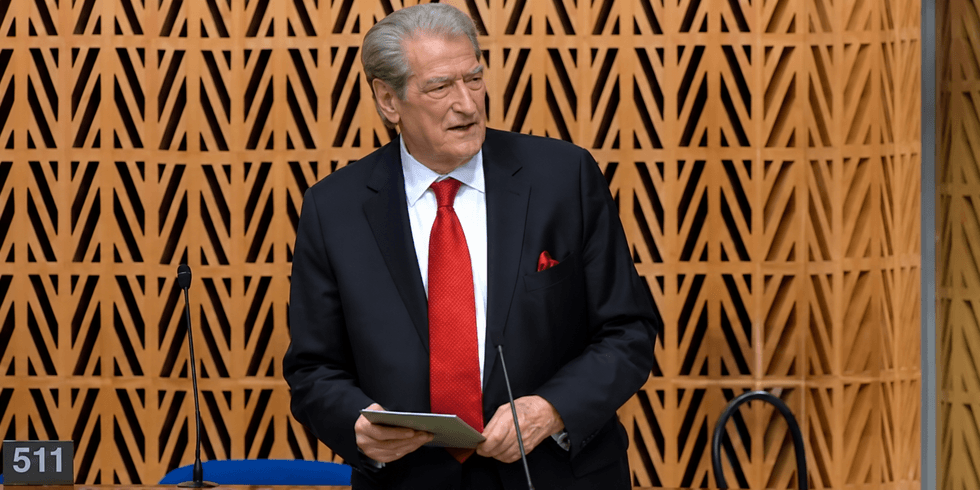
The chairman of Albania’s Democratic Party, Sali Berisha, has raised the issue of Kosovo and the convictions of the former leaders of the Kosovo Liberation Army during the work of the Parliamentary Assembly of the Council of Europe in Strasbourg.
In the published text of his intervention, Berisha expressed hope that the Court of Appeals will examine more objectively the cases against Hashim Thaçi, Kadri Veseli, Jakup Krasniqi and Rexhep Selimi. The process against the four former leaders has now entered the appeals-procedure phase, while on 22 September the Appeals Court Panel was also appointed.
Berisha said the Specialist Chambers’ recent decisions have prompted reactions and protests in Kosovo, claiming that public anger is also linked to what he described as a lack of clear evidence for concrete crimes and to the comparison of the sentences with other Kosovo war cases. The protests after the verdict and the objections to it have been widely reported, while on 28 September Kosovo’s Assembly unanimously adopted a declaration regarding the verdict.
The DP chairman also referred to the convictions of former senior Yugoslav military officials Vladimir Lazarević and Dragoljub Ojdanić by the Hague Tribunal, comparing them with the sentences handed down against the former KLA leaders.
According to Berisha, the way the sentences against the former KLA leaders were given raises questions about the treatment of the parties in the process.
“The sentences given by the Kosovo court in The Hague have followed, surprisingly, clear ethnic lines,” Berisha declared, claiming that the court “has prosecuted only the victim’s side and not the aggressor”. These are Berisha’s positions on the judicial process.
He then expressed his expectation from the appeals phase.
“Therefore, let us hope that the Court of Appeals will examine their cases more objectively,” Berisha said.
In his intervention, the DP chairman also spoke about political and institutional developments in Kosovo. He said the repeated parliamentary elections were held in accordance with international principles, but assessed that the frequency of elections because of the issue of electing the president should be avoided.
Berisha in this regard asked for the assistance of the Council of Europe and the Venice Commission to find a more workable formula for electing Kosovo’s president.
He also dwelled on Serbia and the Belgrade authorities’ relationship with the legacy of the wars of the 1990s, criticising what he presented as the political use of the figure of Ratko Mladić.
Berisha said European institutions should react to developments that, in his view, pose a risk to justice and stability in the region.
The Parliamentary Assembly of the Council of Europe is holding the fourth part of its 2026 session in Strasbourg from 28 September to 2 October, as Telegrafi reports.
Komentet
Bëhu i pari që komenton!
Lini një Koment të Ri
Për t'u përgjigjur një komenti specifik, kliko butonin 💬 Përgjigju poshtë atij komenti.