
Jaundice Doesn’t Just Affect the Eyes: It Can Also Change How You Perceive Color
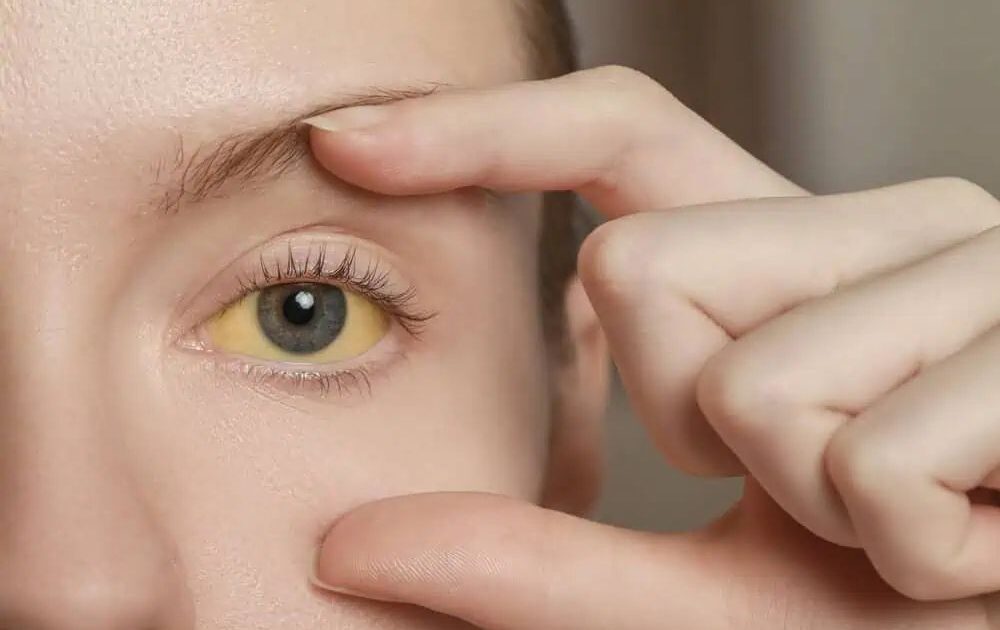
Jaundice, which occurs when the level of bilirubin in the blood rises and can cause yellowing of the skin and the whites of the eyes, may also be accompanied by changes in how some people distinguish colors.
A clinical study published in the scientific journal “Acta Ophthalmologica” examined the vision of 17 patients with jaundice, 14 of whom had bile duct obstruction and three had viral hepatitis with cholestasis.
The researchers used special color perception tests, including the “Farnsworth-Munsell 100 Hue” test (which measures how accurately a person can see and order subtle changes in color shades).
Initially, 12 of the 17 patients were classified as having an acquired color discrimination disorder.
The disorder was mostly of the tritan type, associated with difficulty distinguishing colors on the blue-yellow axis.
An important element of the study was that the patients had no other visible eye problems.
Visual acuity, visual field and eye examinations came back normal. Vitamin A levels were normal as well.
The researchers also noted that the change in color perception could be reversible.
Four patients who were re-examined after their jaundice had disappeared had fully recovered normal color perception.
According to the authors, the results suggested a link between color perception and bilirubin levels in the blood, rather than vitamin A deficiency.
Why is this linked to bilirubin?
Bilirubin is a yellow pigment created during the breakdown of red blood cells and processed mainly by the liver.
When it accumulates in the blood, it can cause jaundice, which is particularly visible in the skin and the whites of the eyes.
However, the idea that people with jaundice simply “see everything through a yellow filter” is too simplistic.
The study suggests there may be a functional change in the color perception system, since some patients recovered fully after bilirubin levels and jaundice normalized.
What about the color blue?
An important distinction must be made here. Bilirubin particularly absorbs light in the blue part of the spectrum, around 460 nanometers.
This very property is used in phototherapy for newborns with hyperbilirubinemia: blue or blue-green light helps convert bilirubin into forms the body can eliminate more easily.
But this does not mean that every person with jaundice sees the color blue differently.
The study in jaundiced patients showed a mostly tritan-type disorder, but it was a study of only 17 patients.
Therefore, it cannot be said that bilirubin universally changes the perception of blue in all people with jaundice.
Likewise, data on phototherapy does not show automatic vision damage.
It mainly shows that bilirubin reacts with blue and blue-green light — the reason those wavelengths are used to treat hyperbilirubinemia in newborns.



Komentet
Bëhu i pari që komenton!
Lini një Koment të Ri
Për t'u përgjigjur një komenti specifik, kliko butonin 💬 Përgjigju poshtë atij komenti.