
Latvian defence minister: Russia’s hybrid attacks are the main concern, not nuclear rhetoric
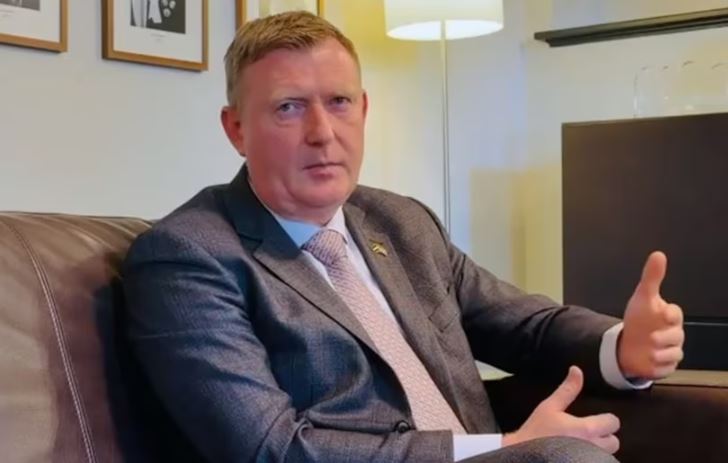
Latvia’s defence minister played down the immediate risk following Russia’s latest nuclear warning to the North Atlantic Treaty Organization (NATO) over Kaliningrad.
“For the moment, I see no imminent threat,” Raivis Melnis told Radio Free Europe in an interview in Washington on September 30, echoing NATO Secretary General Mark Rutte, who said he had not taken the Russian warning “so seriously.”
Russia warned NATO this week that it was ready to use its entire arsenal, including nuclear weapons, if the Western alliance tried to isolate Kaliningrad, its heavily militarised Baltic enclave, located between NATO member countries Poland and Lithuania.
In a diplomatic memorandum circulated to NATO member countries, Moscow said it had information that the alliance was preparing for an “air and naval blockade” of this territory.
The warning prompted Rutte to call on Russia to “stop the nuclear threats,” saying NATO is a defensive alliance and that “this is absolutely unnecessary and does not help.” He added that Russian President Vladimir Putin knows he cannot win a direct confrontation with NATO.
Melnis said Russia has repeatedly resorted to nuclear threats since the start of its full-scale invasion of Ukraine, arguing that Moscow uses such rhetoric to frighten Western populations, weaken support for Kyiv and test the cohesion of the NATO alliance.
“Russia will use every means to threaten us, to instil fear in our people, to support Ukraine, but also to break our unity and cohesion, and simply to test where those limits are,” he said.
Escalation risks?
The Russian warning has nevertheless raised concerns among arms control and security specialists, particularly because of Kaliningrad’s strategic position and the change in Russia’s nuclear doctrine.
Daryl Kimball, executive director of the Arms Control Association, a Washington-based non-profit and non-partisan organisation, told Radio Free Europe that the Russian threat should be taken seriously and condemned as unacceptable. He said the language used by Moscow reflects what he described as a reckless approach to the risks of using nuclear weapons.
Kimball noted that NATO does not appear to be preparing for any military action to isolate Kaliningrad. Even if such a confrontation were considered, he said, the use of nuclear weapons in a conflict involving another nuclear-armed state or alliance could provoke retaliation, escalation and potentially catastrophic consequences.
He argued that Moscow should address its concerns with NATO through diplomatic channels, saying that “instead of threatening a nuclear attack, the Kremlin should turn to NATO capitals to clarify whatever concerns Russia may have and to address them diplomatically and responsibly.”
Lynn Rusten, a senior fellow at the Center for European Policy Analysis and a former senior White House National Security Council official responsible for arms control and non-proliferation, told Radio Free Europe that Russia’s latest nuclear rhetoric seemed “deranged and hyperbolic” from a Western viewpoint.
But Rusten also warned of a dangerous combination of factors: Russian threats and provocative hybrid warfare, NATO and Russian forces operating close to each other, continued Western support for Ukraine and the absence of meaningful dialogue.
She said these conditions could increase the risk of a dangerous miscalculation, especially as Russia and NATO draw competing red lines while channels for managing tensions remain limited.
“The lack of meaningful dialogue and the growing differences in security perceptions pose a serious risk of further and potentially unintentional escalation and expansion of this conflict,” Rusten said.
Sylvia Mishra, director of nuclear policy at the Institute for Security and Technology, said nuclear escalation is nothing new for Moscow, but must nevertheless be taken seriously.
Kaliningrad, she noted, is the headquarters of Russia’s Baltic Fleet and has strategic importance, but is geographically exposed, as it is surrounded by NATO member countries Poland and Lithuania and is separated from the rest of Russia.
Mishra said NATO’s reported air operations around the enclave in mid-August, which involved aircraft with capabilities to disrupt communications, radars and navigation systems, may have increased Moscow’s sense of vulnerability.
She also referred to Russia’s revised 2024 nuclear doctrine, which officially lowered Moscow’s stated threshold for the possible use of nuclear weapons.
Mishra said the latest warning appears to be the first case in which Russia has issued a written diplomatic note clearly warning that it is ready to use nuclear weapons if the Western alliance tries to isolate Kaliningrad.
Hybrid attacks
For Melnis, however, the most immediate threat is neither nuclear nor a large-scale conventional Russian military attack on NATO, but an expanding campaign of hybrid activities — hostile actions carried out below the threshold of open war, including cyber attacks, sabotage and the instrumentalisation of migration.
He said Latvia and its allies are constantly reassessing the threat, monitoring Russia’s military capabilities, its losses in Ukraine, force generation and activities such as suspected attacks on military industry facilities and critical infrastructure.
“We are monitoring and working closely with Ukrainian partners and with our partners in NATO,” Melnis said, adding that Latvia’s threat assessment is an ongoing process and that hybrid activities are increasing.
Melnis said he did not believe Russia currently has the capacity to launch a conventional offensive against a NATO country while continuing the war in Ukraine.
“Russia was stopped in Ukraine, it is not achieving its goals,” he said, referring to Ukraine’s counteroffensive operations and arguing that Moscow would face great difficulties trying to conduct two large-scale military operations simultaneously.
He described cyber attacks, pressure through migration from Belarus — which Minsk has been accused of deliberately facilitating to destabilise its neighbours — and other hostile activities as part of the new security environment Latvia and its allies are facing.
Latvia is also strengthening its defences against drones. Melnis said the country has deployed additional jamming systems and radars along its borders with Russia and Belarus, relying heavily on lessons learned from Ukraine. NATO fighter jets provide another layer of defence, while Latvia is buying medium- and short-range air defence systems.
Melnis said Russian drone incursions could become an increasingly present feature of the Baltic security environment, referring to recent incidents involving Lithuania, Poland and Romania. Latvia, he said, is preparing for more such incidents.
The U.S. role in Europe’s defence
Melnis was in Washington to deepen defence cooperation with the U.S., including discussions with the Michigan National Guard, procurement programmes and capacity development.
He said he remains confident the U.S. will maintain its military presence in Europe, despite adjustments in deployments in particular countries. American forces, he said, continue to be present in Latvia and Washington continues to recognise the region’s strategic importance.
At the same time, Melnis said European allies must take on a larger share of the burden for their own defence. He praised U.S. President Donald Trump for pushing NATO member countries to increase defence spending, saying Latvia is obliged by law to spend at least 5 percent of Gross Domestic Product each year on security, starting next year.
NATO member countries agreed at the 2025 summit in The Hague to spend 5 percent of GDP each year by 2035 on defence and defence-related priorities, up from the alliance’s previous target of 2 percent. Latvia has moved faster, as its parliament has required national defence spending to be at least 5 percent of forecast GDP from 2027.
But Melnis said greater European responsibility will go hand in hand with continued U.S. support.
“The U.S. will provide [support]. They will be there. They will fight with us if necessary,” Melnis said, stressing that Europe must do more.
Komentet
Bëhu i pari që komenton!
Lini një Koment të Ri
Për t'u përgjigjur një komenti specifik, kliko butonin 💬 Përgjigju poshtë atij komenti.