
Letter from Washington: Cornered, Trump turns to Balkan tactics
By Jovana Djurovic

U.S. President Donald Trump. Photo: Wikipedia.
Greetings from the East Coast, where this month has been particularly busy — from the annual gathering of world leaders at the UN General Assembly in New York, where everyone gets a photo opportunity and their own stage to air grievances (for the audience back home), to Chinese President Xi Jinping’s official meeting with Donald Trump in Washington — a visit that, like the UNGA, was full of pomp and short on concrete results. On the domestic front, the midterm elections are approaching and the campaign is starting to look more and more like the ones we know from the Balkans. Trump is escalating his clash with critical media, while — as another war, the one in Iran, makes Trump even more unpopular — he is reaching for another Balkan political trick: when things get tough, hand out taxpayers’ money! Trump has promised that, if Republicans keep their majority in Congress, every adult American will receive $5,000. Such a measure would, however, need a green light on Capitol Hill, so it is far from certain that Americans will actually see the money — unlike in Serbia, where the outgoing president hands out money from the state budget ahead of elections, even though he has no authority to do so.
As Balkan-style tactics increasingly surface in American politics, the Trump administration continues to focus on advancing its own interests, turning a blind eye to the erosion of democracy and the return of the 1990s in the Balkans. This was confirmed to some extent by U.S. Secretary of State Marco Rubio in his remarks on the sidelines of the UN General Assembly, when he said that, although Serbia may be “involved in several potentially problematic and explosive issues” of international concern, the United States wants to deepen its strategic partnership with the Balkan country.
Silence on Dodik — and on Mladić
Earlier this month, Deputy Assistant Secretary of State Daniel Lawton briefed members of Congress on U.S. policy in the region during a hearing before the House Foreign Affairs Committee. While Lawton reiterated that the priorities are stability (disregarding internal instabilities), advancing U.S. trade interests and fighting organised crime, members of Congress raised several tough questions. Both parties seemed concerned about the same issues: Why did the U.S. launch a strategic dialogue with Serbia while Belgrade is strengthening ties with Russia and China? Why were sanctions lifted on former Bosnian Serb leader Milorad Dodik if he has not abandoned his separatist rhetoric? Would peace in Kosovo be at risk if the administration follows through on its plan to reduce the number of Americans in the NATO-led peacekeeping mission, KFOR? The answers were vague. Lawton said the U.S. wants to be Serbia’s “preferred partner,” even though the Serbian energy company NIS remains Russian-owned and Belgrade is buying Chinese weapons and technology. He avoided a direct answer on whether he would support reimposing sanctions on Dodik over his unchanged rhetoric and close ties to Moscow — an issue pressed insistently by Democratic Congressman William Keating. The congressman presented a report, “Pay for Play,” documenting how Dodik’s intensive lobbying with Trump-linked companies led to the lifting of sanctions against him, and how a company linked to the U.S. president won the contract to become the main operator of the Southern Interconnection gas pipeline in Bosnia. Lawton did not comment on these findings but reiterated that KFOR remains vital to preserving peace in Kosovo. Nothing new there.
Had it not been for this hearing, however, we might never have learned what the Trump administration thinks of the honours paid at the funeral of former Bosnian Serb commander Ratko Mladić, convicted of genocide in Srebrenica. The State Department has been silent on the matter, unlike a small group of congressmen who described the Serbian authorities’ conduct at the funeral as “deeply disturbing.” Asked by a Democratic congresswoman from Nevada, Lawton insisted that the U.S. also opposes the glorification of war criminals and that the tragedies and crimes of the 1990s must not be turned into political theatre. Given the situation on the ground, with both Serbia and Bosnia and Herzegovina immersed in election campaigns, such a statement from Washington was long overdue. The silence has favoured the outgoing Serbian president, Aleksandar Vučić, who told CNN he did not attend Mladić’s funeral but that it was the biggest funeral of the last 50 years. In other words, he, Vučić, remains the West’s safest bet.
The reaction to the Hague ruling that convicted former Kosovo president Hashim Thaçi, found guilty of war crimes, was immediate. That same day, the State Department issued a statement saying the U.S. respects the decision of the Kosovo Specialist Chambers and calling for restraint in rhetoric.
Contradictions over the Thaçi verdict
But Washington’s stance on this issue contains a visible contradiction. Richard Grenell, Trump’s special envoy for special missions (and former envoy for the Kosovo-Serbia dialogue process), called the verdict “outrageous” and described the judges and prosecutors as “leftist lunatics.” Grenell has long defended Thaçi and sharply criticised prosecutor Jack Smith, who brought the indictment against the former Kosovo president. Grenell claims that, in doing so, Smith destroyed a potential diplomatic victory for Trump, since, according to him, Thaçi had been headed to Washington in June 2020 to sign a normalisation agreement with Serbia but turned straight back to Kosovo once the indictment became public. Smith is also in the crosshairs because, after being appointed special counsel at the U.S. Department of Justice, he brought two indictments against Trump — which were dropped after Trump was re-elected. Grenell knows well that Trump does not forget those who have crossed him in the past, and that public attacks on the president’s opponents are a good way to prove loyalty — something Trump particularly values.
Although the Trump administration has never once reacted to domestic developments in Serbia since taking office, the issue came into focus thanks to Congressman Joe Wilson of South Carolina, who introduced the “Supporting the Rule of Law, Building Institutional Justice, and Accountability” act (“SRBIJA”). Despite being a Republican with Trump’s backing for his re-election this November, Wilson is challenging the administration’s policy with the bill, which would require the U.S. to suspend the strategic dialogue unless issues related to free and fair elections, as well as strengthening ties with Russia, China and Iran, are addressed. The proposal enjoys bipartisan support, suggesting broader agreement on the strategic objective: a country America works with should be Western-oriented and have a legitimately elected government. Wilson did not stop at the bill. He has continued to criticise President Vučić almost daily and has hinted he will meddle in Serbia’s snap elections on October 25, using models applied by Russian President Vladimir Putin. The executive branch, however, appears unbothered by these accusations, while the State Department has said it is “closely monitoring preparations for the elections.” After Serbia’s last parliamentary elections in December 2023, which international observers said were marred by irregularities, the U.S. and the EU jointly called on Belgrade to work on implementing the recommendations of the OSCE Office for Democratic Institutions and Human Rights observation mission. It is hard to imagine Washington sending a similar message this time.
Meanwhile, the Senate held a confirmation hearing for the ambassador nominees to Serbia and Bosnia and Herzegovina. Law professor Michael Young, nominated for Serbia, and retired General Ronald Johnson, nominated for Bosnia, presented their visions for the respective missions and answered senators’ questions. Both confirmed they would work on the Trump administration’s known priorities in the region and indicated they aim to serve the president satisfactorily. Democratic Senator Chris Murphy asked an awkward question: Would they help a member of Trump’s family promote his private investment if that investment would bring direct financial benefit to the president’s family? Both Young and Johnson replied that they considered it their duty to promote all American investments while serving as ambassadors. At the end of this exchange, Murphy, somewhat irritated, said: “Gentlemen, the answer is no! It is not appropriate for an ambassador to lobby in favour of projects that would enrich the president or his family. That’s a simple answer!”
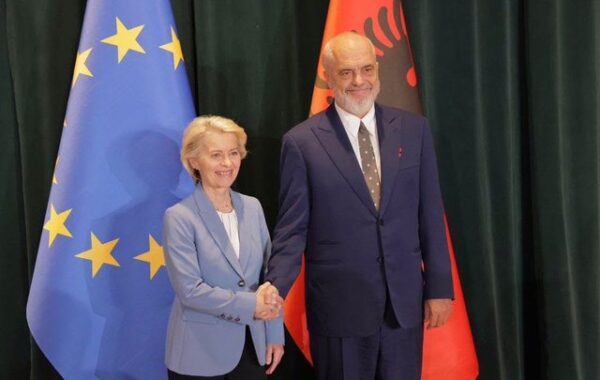
Speaking of Trump family projects in the region, protests against the construction of a luxury tourist complex by Trump’s son-in-law, Jared Kushner, have continued in Albania. But Albanian Prime Minister Edi Rama, whose resignation the protesters are demanding, continues to defend Kushner and claims the resort will bring benefits to Albanian citizens. American investments were also discussed by Albanian Foreign Minister Ferit Hoxha and Trump’s special envoy for Global Partnerships, Paolo Zampolli, who visited Tirana this month. Zampolli is considered an unofficial broker for Trump administration deals. He once boasted that he had sold Uzbekistan “20 billion dollars’ worth of Boeing aircraft in 20 minutes.” Most recently, he posted on Instagram that he is “selling astronauts” and that signatory countries of the Artemis Accords will have the chance to send their astronauts into space alongside American counterparts. Albania recently signed the Artemis Accords. Previously, Serbia was the only other Balkan country to have signed the agreement. It is still unclear how much this will cost.
While selling joint space projects, here on Earth Washington is cutting aid even to countries that have begun “strategic dialogue” processes with the U.S. North Macedonia was among four European countries for which the U.S. plans to cut military aid by a total of $52 million, redirecting the money to conservative-oriented countries in Latin America.
As Republicans fight to keep their majority in Congress in the midterm elections and Trump’s low approval ratings are not helping, it is clear that Washington will not hesitate to step on the toes of even its own allies from time to time.
Jovana Djurovic is a Washington-based journalist. The opinions expressed are those of the author alone and do not necessarily reflect the views of BIRN.
Komentet
Bëhu i pari që komenton!
Lini një Koment të Ri
Për t'u përgjigjur një komenti specifik, kliko butonin 💬 Përgjigju poshtë atij komenti.