
Monographic study “Usta Josifi and the saze ensembles of Përmet” by Niko Mihali promoted
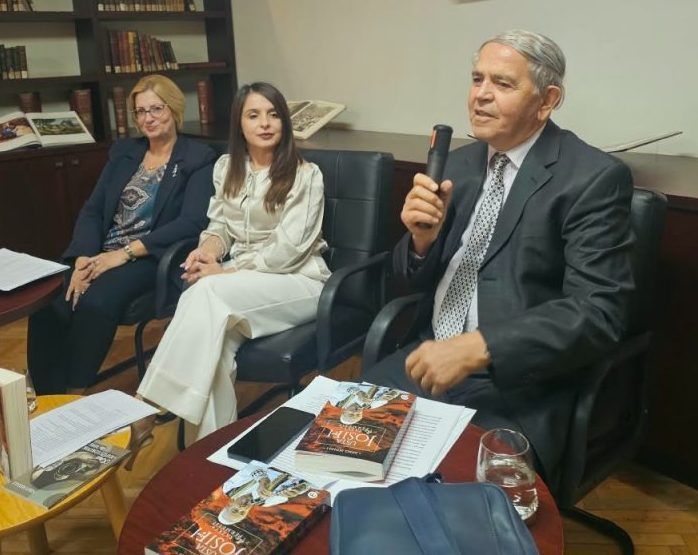
The book “Usta Josifi and the saze ensembles of Përmet” by Niko Mihali was promoted today at the National Library, the “Sotir Kolea” centre, in Tirana.
The monographic study is devoted to the rich tradition of urban saze music of the Përmet area, focusing on the figure of master Josif Shukollari and the other instrumentalists who have left their mark on this cultural heritage.
Assoc. Prof. Dr. Holta Sina Kilica, head of the Department of Musicology at the University of Arts in Tirana, praised the book as a special contribution to documenting the saze tradition of Përmet. She stressed that Niko Mihali’s monographic study brings an in-depth musicological analysis of the figure of Usta Josifi, placing him at the centre of a heritage that has marked Albanian culture. According to her, this publication is also a new scholarly approach that sheds light on the role of the instrumentalists and saze ensembles in the country’s musical life. “The author has managed to interweave cultural memory with academic methodology, giving this tradition its deserved place in the history of Albanian music”, Assoc. Prof. Dr. Sina said.
Recalling the great master of the Përmet saze, Laver Bariu, she underlined that his art lives on in his pupils, collaborators and all those who take it upon themselves to pass it on. Assoc. Prof. Sina recalled the journey of the Përmet saze, in which master Josif has performed from collaborations with BBC World to tours in Ioannina, Turin, Nikšić, Prague, Zagreb, Prizren and other cities. She further noted the assessments of musicologist Eno Koço and academician Vasil Tole, the latter stressing that the greatness of master Laver Bariu lies not only in the art he created, but also in his care to make it inheritable.
The author has also included in the book the story of the CD with 18 songs of Hafize Leskoviku, sung by Adriana Thanasi and accompanied by clarinettist Josif Shukallari with the Saze of Përmet, in collaboration with Klodian Qafoku, in August 2022.
Another valuable document is the list of the kaba and dances of the Përmet saze from 1988 to 2025, which reflects a long period of activity and creates a map of musical memory.
Mr. Shefqet Saliu praised clarinettist Josif Shukollari as a master of the clarinet who, according to specialists in this field, is among the most prominent pupils of the Laver school in the Përmet region. Artists, musicologists and art critics consider him a worthy successor of Laver Bariu.
Composer Bilbil Hereni described Mihali’s monograph as an important act for documenting Përmet culture and for preserving the Albanian musical identity. He underlined that Përmet has always been a blessed region, where the gërneta (clarinet) and the sounds of the saze have preserved the spirit of the place and protected it from oblivion. “This book is a long poem for the gërneta, an archaeology of the soul that brings to light memories, emotions and the master’s journey”, he said.
The promotional event was also greeted by the Artistic Director of the National Ensemble of Folk Songs and Dances, Sokol Marsi. On this occasion he praised author Niko Mihali for the monograph dedicated to master Josif, also thanking academician Vasil Tole for the preceding study book “Kabatë me gërnetë dhe violinë” (Kabas with clarinet and violin), in which the national school of the kaba and the role of the saze in the urban folk music of southern Albania are analysed.
In closing, Sokol Marsi praised author Niko Mihali for documenting the musical heritage and invited those present to follow the piece “KABA”, which was performed by the orchestra of the National Ensemble of Folk Songs and Dances.
Academician Vasil Tole praised Niko Mihali’s book for giving Usta Josif Shukollari and his saze their deserved place, as they remain pillars of the Përmet musical identity. He particularly praised the clarinettist’s contribution to recently realised projects, dwelling on the CD with 18 songs of Hafize Leskoviku, sung by Adriana Thanasi and accompanied by the Saze of Përmet, which until today no one had dared to perform.
Acad. Tole underlined that through this study the role of the saze is illuminated as bearers of a difficult art and as shapers of what is today known as the kaba of Përmet, which is now part of the world heritage protected by UNESCO.
The book was further praised for the way it was compiled and for its documentation of the heritage, ensuring that the styles, repertoire and stories of the instrumentalists are not lost over time.
Niko Mihali’s monograph helps in the analysis of the structure of the saze, their composition with clarinet, violin, llautë (lute) and dajre (frame drum), the interaction between the instruments and the way in which Përmet urban music has influenced the other areas of southern Albania.



Komentet
Bëhu i pari që komenton!
Lini një Koment të Ri
Për t'u përgjigjur një komenti specifik, kliko butonin 💬 Përgjigju poshtë atij komenti.