
School where Alexander the Great studied uncovered as archaeologists unearth complex where Aristotle taught
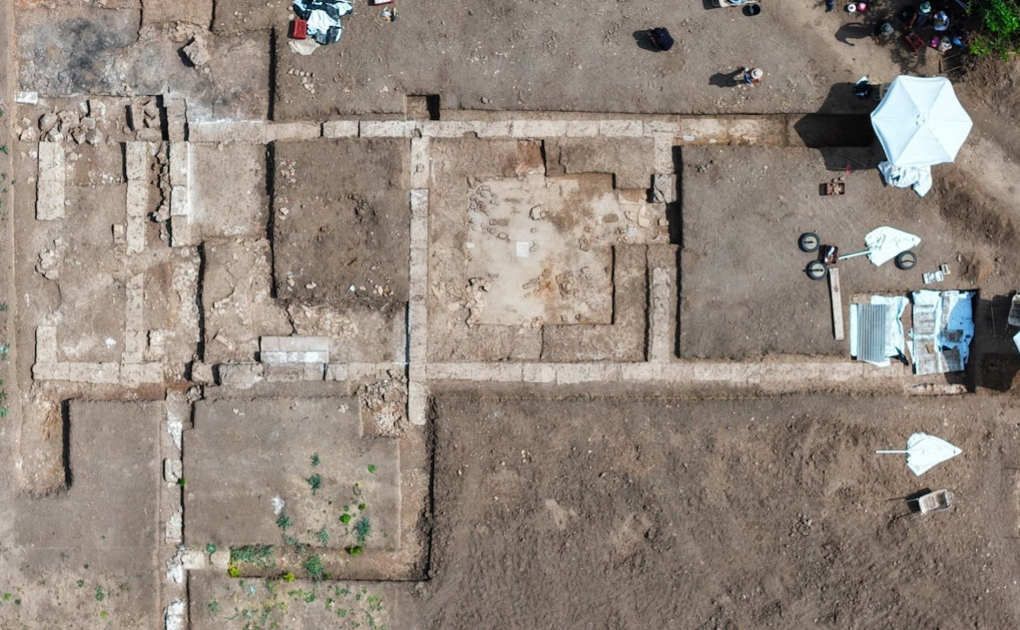
A major archaeological discovery in northern Greece is shedding light on one of the most famous chapters of ancient Macedonian history. Near the ancient city of Mieza, close to present-day Naoussa, archaeologists have unearthed a large school complex dating to the 4th century BC.
Researchers believe it is a complex built by order of King Philip II of Macedon around 343 BC for the education of his son Alexander and the young men of the most prominent Macedonian families.
It is precisely here that the great philosopher Aristotle is believed to have taught the young man who would later become known as Alexander the Great.
The excavations, begun in 2024 and led by archaeologist Angeliki Kottaridi, cover an area of about 30 hectares.
The complex has impressive dimensions and architecture, while some of its elements resemble the style of the Macedonian royal palace of Aigai, near present-day Vergina, where Philip II and Alexander lived.
The building was conceived as an ancient gymnasium, an institution where the education of the mind and the care of the body were inseparable.
Classrooms have been discovered in the complex, including a large hall with stone benches, as well as a stadium, a sports arena and a long covered portico known as a stoa.
But the life of the young men was not limited to lessons and physical activities.
Archaeologists have also discovered spaces intended for social life and the banquets of the Macedonian aristocracy.
The complex contained two large and luxurious banquet halls decorated with mosaic floors. They had raised platforms that could hold up to 12 banquet couches, known as kline.
These discoveries offer a rare glimpse into the lifestyle of the Macedonian elite and the education received by the young men of aristocratic families.
Among the objects discovered are four styli, tools used to write or engrave texts on wax tablets.
Coins and ceramic fragments have also been found. So far, however, no inscription has been discovered that directly mentions the names of Aristotle or Alexander the Great.
Researchers nevertheless link the discoveries to Alexander’s school because of the dating of the objects, the size of the complex, its proximity to the Macedonian royal court and its correspondence with the location described by ancient authors, including Plutarch.
In 342 BC, Philip II summoned Aristotle to educate his son Alexander. The philosopher was then 39 years old and already known for his work in philosophy, rhetoric and the study of nature.
Why Philip chose Aristotle in particular is not entirely clear.
Some historians think the philosopher was recommended to the king by his friends. Others have raised hypotheses about political motives, while another theory is linked to the friendship between the fathers of Philip and Aristotle.
Alexander was only about 14 when he began his lessons with the philosopher. According to Plutarch, he had a strong and independent character, but could be guided by reason when addressed in the right way.
One of the ways Aristotle tried to shape his pupil’s character was through Greek literature.
The teacher chose Homer’s “Iliad” as one of the main texts for Alexander’s education and gave him a copy.
According to the tradition handed down by ancient sources, Alexander kept this work with him even during his military campaigns.
Through the stories of ancient Greek heroes, Aristotle aimed to teach the prince an important moral principle: to avoid both cowardice and reckless courage, pursuing a courage guided by reason.
According to Plutarch, Aristotle conducted his lessons during walks on the shaded paths near the sanctuary of the nymphs in Mieza.
Other young men from the most important Macedonian families also took part in these lessons.
Aristotle taught them about value, courage and friendship, while to Alexander he also passed on a thirst for knowledge, curiosity about distant lands, an interest in books and medicine.
Above all, according to Plutarch, he instilled in him “a burning passion for philosophy.” The relationship between Aristotle and Alexander did not always remain so close.
When Alexander learned that Aristotle had made public some of his special teachings, he wrote to the philosopher expressing his displeasure.
At first, Alexander had said he admired Aristotle almost as much as his father, expressing the relationship with the words that he owed his father for life, and his teacher for a life worth living.
Over time, however, the relationship between them grew colder, particularly on political matters.
Aristotle’s teaching lasted about three years. The philosopher then left and returned to Athens.
Although Aristotle had a significant influence on Alexander’s intellectual formation, it remains debatable how much influence the philosopher had on his pupil’s political and military decisions.
Aristotle wrote a dialogue on colonies for Alexander and is believed to have dedicated to him a work entitled “On Kingship.”
Historical sources, however, do not provide clear evidence that his teachings determined Alexander’s political decisions during the years of conquest.
The discoveries at Mieza, meanwhile, offer a rare opportunity to better understand the environment in which one of the most famous figures of the ancient world, Alexander the Great, was intellectually formed.


Komentet
Bëhu i pari që komenton!
Lini një Koment të Ri
Për t'u përgjigjur një komenti specifik, kliko butonin 💬 Përgjigju poshtë atij komenti.