
Starship reaches orbit for the first time, but flight cut short after engine problem
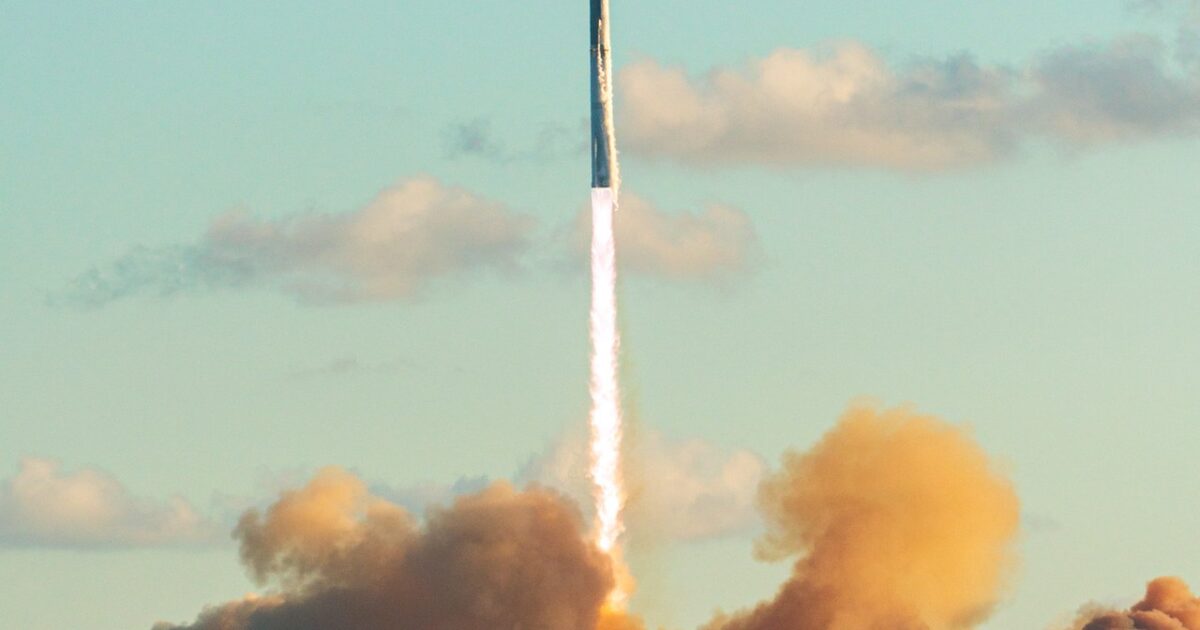
Following Monday’s launch, SpaceX announced that its giant Starship rocket had reached orbit for the first time, as the Associated Press reports — on the 14th test flight from the Starbase base in Texas, with the new Super Heavy v3 booster. One of the engines shut down early during ascent, causing several minutes of tension in flight control, but controllers decided to continue and took the vehicle into orbit. “Starship is orbital,” mission control announced amid cheers.
Starship, 124 meters tall — the largest and most powerful rocket ever built, according to the AP — carried the 26 latest Starlink V3 satellites, which were released one by one into orbit. These are the most advanced satellites to date, joining the network’s existing 11,000 satellites.
The plan was a 10-hour flight with 6 orbits around Earth at an altitude of 275 km and a speed of 28,000 km/h, to prove readiness for NASA’s Artemis program. But SpaceX shortened the flight “out of an abundance of caution” because of the engine problem. The vehicle re-entered the atmosphere over the Pacific and splashed down north of Hawaii three hours after launch; it tipped over and burst into flames after landing. The first-stage booster had not been planned to return to base and landed in the Gulf of Mexico within minutes of launch.
Previous test flights went no further than the Indian Ocean, often crashing in flames. But SpaceX managed to recover the previous Starship from the Indian Ocean in July and modified its heat shield based on its inspections, according to the AP.
NASA Administrator Jared Isaacman congratulated SpaceX on reaching orbit “managing every step in a safe, responsible and particularly inspiring way.” The achievement is a vital step toward certifying Starship for orbital flights. The Artemis III mission comes as early as next summer: a three-ship orbital exercise in which the Orion capsule with astronauts will dock with Jeff Bezos’s Blue Moon landers and then with Musk’s Starship. Artemis IV, no earlier than 2028, will land astronauts on the Moon — with Blue Moon or Starship, whichever is ready first.
Depending on the findings from Monday’s orbital debut, the next Starship could return to the launch base, where giant mechanical arms would catch it mid-air. Musk gives even or slightly better odds to the catch succeeding; if it works, SpaceX would reuse the vehicle later this year or early next year. Musk stressed that SpaceX is “extraordinarily careful,” because if the vehicle were to explode over land and rain debris on people, “our popularity would drop very fast.” Musk originally developed Starship for Mars, but is now focused on the Moon and on satellite transport; he plans to gradually retire the Falcon 9 rocket within a few years, while a second launch base is being completed at the Kennedy Space Center in Florida and a third is planned in Louisiana.



Komentet
Bëhu i pari që komenton!
Lini një Koment të Ri
Për t'u përgjigjur një komenti specifik, kliko butonin 💬 Përgjigju poshtë atij komenti.