
The new U.S. ambassador, Berisha’s non grata status, and the great misunderstanding
By Jakin Marena
The arrival in Tirana this weekend of the new American ambassador, retired General Eric Wendt, and the formal start of his diplomatic mission have sent anxiety soaring across Albania’s political scene.
Each political camp has its own expectations, and in one way or another sees the new U.S. ambassador as backing for its short- and long-term goals — backing not in the sense of being used, but because in Albania there is now a conviction that without Washington’s support, and that of EU member states, you can forget about power. Such is our stature: a small country, a dot on the great geopolitical map where the interests of the big players collide.
The very fact that Donald Trump’s U.S. government appointed a retired general as ambassador to Tirana shows the high regard for Albania as a friend and important partner in the turbulent Balkan region — the one country with unbroken stability in its strong partnership with the United States. Albania remains a regional leader, a safe and reliable ally for America.
Put more simply, the new ambassador is not coming to Albania to deal with trifles and Balkan squabbles, given his stature as a multi-star general — even though the opposition led by Berisha has made public the great expectations it holds for retired General Eric Wendt.
In fairness, the Albanian opposition labors under a great misunderstanding — first with itself, then with our great ally the United States, which has supported, supports and will support Albania, and above all the Albanian people.
The opposition’s misunderstanding began the moment the new ambassador’s name passed its first tests in the U.S. legislative bodies, continuing with his final appointment to Albania and his arrival this past weekend to present his credentials to President Begaj.
Since then, Berisha, through his closest people, began issuing “recipes” for how the new American ambassador should behave upon arriving in Tirana — aiming the “blade”, per these unsolicited “instructions”, at “striking Edi Rama’s narco-state”, toppling him from government and clearing the path for the DP and its allies to take power.
It is a film seen many times before: the fantasies of PD people and of Berisha himself ran wild long ago, to the point of planting media stories that Rama would be arrested at his home in Surrel, that American commandos would come in Apache helicopters to take him away in handcuffs, and other such dreams — through which the PD leadership has “fed” its supporters day after day, month after month, with the idea that the U.S. would topple Rama and bring the opposition to power. All without this opposition lifting a finger, as it consumes itself for 13 years running without winning a single electoral race against its political rival, the SP.
And while fantasy followed not the “course” of changing “blood” in spring and autumn but Berisha’s need to keep close to himself, as hostages, those few hopeless Democrats, the amplitude of speculation about American help to topple Rama from power soared — especially during Berisha’s visit to the U.S. on a “golden” visa, paid for by persons unknown, costing millions of dollars just so he could set foot on American soil, soil denied to him because the DP leader has been a functionally family-wide non grata in the U.S. since 2021.
Berisha presented that visit — taken under the same U.S. legal clause previously used by Cuban leader Fidel Castro and other U.S. non grata nominees, whether for health reasons or political meetings — as a window opened by Washington for the opposition toward power. As he did what he routinely does in the U.S. — handshakes in corridors with congressmen, senators and Republican convention delegates, and meetings in restaurants and eateries with Albanian emigrants, mostly from his native Tropoja — Berisha declared upon returning to Tirana that he had secured strong American backing for toppling “Rama’s narco-state”.
Berisha even went so far as to say there had been no U.S. non grata designation against him at all, only a temporary visa block — even though on the State Department’s official website the DP leader is officially listed as a person designated “non grata”, with the full expanded reasoning for the decision: high-level corruption, undermining democracy and blackmailing justice.
It is Berisha himself who, when asked whether he had been invited to the ceremony the U.S. Embassy will host on October 2 to introduce the new ambassador, admitted he knew nothing of the event, saying: “I wish the ambassador welcome; I have no knowledge of the ceremony.” So no invitation — not even as leader of the opposition — to that official ceremony.
That was a “test” the DP leader failed in his relationship with the United States, whose ambassador is expected to treat him as his predecessors did: as a family-wide non grata. And there will be no handshake, no ceremonial meetings, nothing at all. He remains “non grata”, despite the shocking misunderstanding he created among his supporters, whose heads he filled with claims that he was never non grata in the U.S. and that he had won American support to topple Rama.
But Rama, too, contributes mightily to this great misunderstanding of Berisha and the opposition, inflating their unrealistic expectations of toppling the SP government and clearing Berisha and the DP’s path to power. So it went in recent days, as Rama visited the U.S., took part in UN proceedings, and then announced he would hold an urgent press conference at Rinas airport — creating the false idea that he might resign, as if he did not want to enter the capital as prime minister. In Tirana, debate had also erupted over the arrest of former SHISH chief Vlora Hyseni and her immediate dismissal by Prime Minister Edi Rama.
Berisha was delirious, while inside the PD the tallies — and the spending on suits and ties — had broken out, each man already “handed” the ministerial post he would “take” immediately after Rama’s “toppling”. They bolstered this misunderstanding with the fact that the new American ambassador had arrived in Tirana that same day, having brought, in his diplomatic “briefcase” as they saw it, the “firman” for Rama’s toppling — and Berisha’s “baptism” as prime minister. But they were sorely disappointed, as Rama ended hopes of a possible resignation by declaring at the end: “Today I have returned to Albania, but Albania is not going back. No one and nothing will stop it, will stop us, will stop me.”
These dreams — unfortunately autumn dreams in broad daylight — have been dreamt by Berisha and his supporters for 13 years running: dreams of the chairs of power and other posts gained as a windfall, without toil or sweat and without votes in electoral contests, while waking always finds a PS government and Rama as prime minister. And it seems that is how it will continue — for a long, long time.
That is what is expected at next year’s local elections too, where the opposition still believes what Berisha spins for personal needs — he who, faced with the continuation of his U.S. non grata status and justice for the many charges on his back, keeps assuring them that power is near, in the home stretch, even though he has been stuck in that “home stretch” for years. It is expected again at the general parliamentary elections in the summer of 2029, marking another defeat to the SP and Rama.
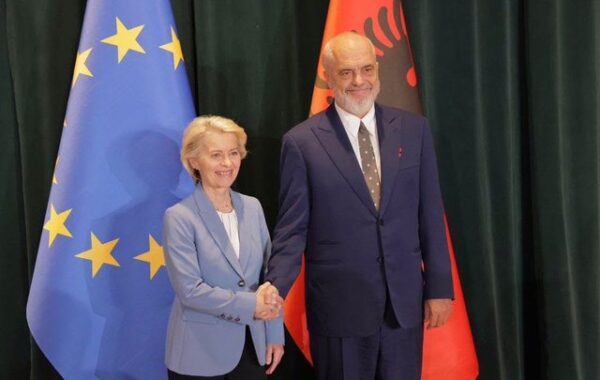
In fairness, reality is quite different — indeed, a reality far from generous to the PD and the opposition. For Berisha least of all: with him as chairman, the PD will not only never come to power but will speed toward oblivion together with its 82-year-old leader. Meanwhile Rama awaits in Tirana the president of the European Commission, Ursula von der Leyen, as Albania has been ranked by the Commission at the top of the priority list of countries for EU membership.
We say this because the new American ambassador, retired General Eric Wendt, represents the American state and above all the U.S. government led by Trump. The new ambassador’s diplomatic agenda prioritizes American interests in the region, contributing to blocking the spread of Russian influence in Albania and the region, supporting American business in Albania through what he calls economic diplomacy in his priorities — including the major American investment involving Trump’s son-in-law and daughter in Sazan and Zvernec — and above all strengthening NATO’s eastern flank against Russian aggression.
In this context, the new ambassador, in cooperation with Albanian institutions, has as the priority of priorities the preparations for the NATO summit to be held in Albania next year — confirmed at the Ankara summit — where U.S. President Donald Trump himself is expected to attend. That demands enormous commitment, in cooperation with Albanian security structures and the Rama government, leaving no hope for Berisha and the opposition in their dream of coming to power “for free”, without votes, through an “allied landing”. Still, no one stops Berisha from dreaming — even though, unlike all other living beings whose dreams are free, Berisha’s dreams cost millions of dollars.
Komentet
Bëhu i pari që komenton!
Lini një Koment të Ri
Për t'u përgjigjur një komenti specifik, kliko butonin 💬 Përgjigju poshtë atij komenti.