Vučić’s UN speech, Fetoshi: “He is using Kosovo to pressure the West”
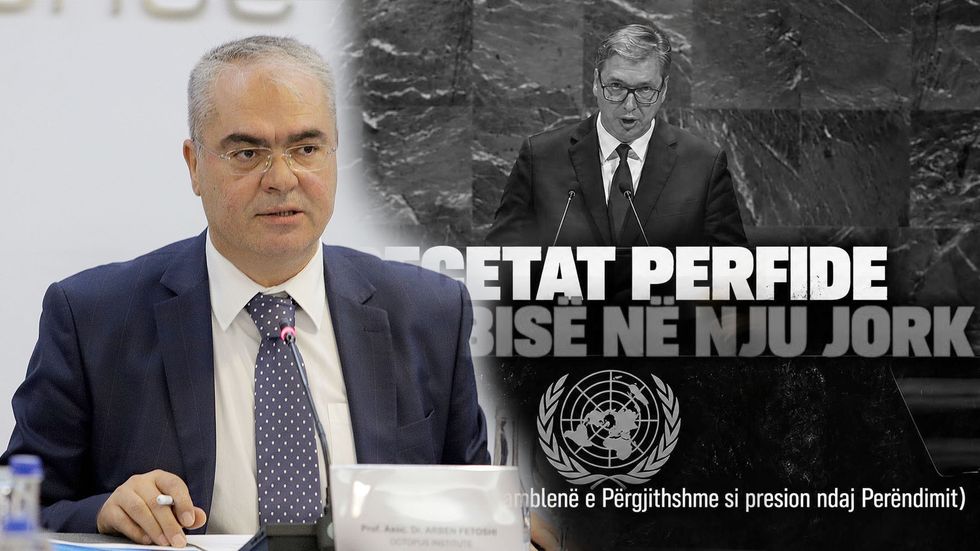
Octopus Institute director Arben Fetoshi assesses that the narratives about Kosovo, the accusations against Croatia and, as he calls it, the flattery toward President Trump in Vučić’s speech are the elements that outline the goals of the “Serbian World” and legitimize Putin’s aggression in Ukraine. Serbia’s president, Aleksandar Vučić, used the podium of the UN General Assembly to pressure the West, presenting Serbia as a victim of Western “injustice” and the 1999 NATO intervention as the point that, according to him, “destroyed” the international order. This is how the director of the Institute for Hybrid Warfare Studies “Octopus”, Arben Fetoshi, assesses it in his analysis “Serbia’s perfidious recipes in New York: Vučić’s moralizing at the General Assembly as pressure on the West.”
Fetoshi deconstructs Vučić’s address not only in relation to Kosovo but in a broader regional and geopolitical context. According to him, the Serbian president tried to place at the center the claim of Western “injustice” toward Serbia, avoiding the truth about the wars of the ’90s. “Once upon a time there was a sleek minister, who had packaged the packaging for his boss’s terror and 30 years later, in the capital of world diplomacy, tried to ‘nail’ those who stopped terror, ethnic cleansing and genocide in Croatia, Bosnia-Herzegovina and Kosovo,” Fetoshi writes in the introduction of the analysis.
Fetoshi assesses that Vučić tried to place Kosovo of 1999–2008 and today’s Ukraine within the same argumentative framework, presenting NATO’s intervention and the recognition of Kosovo’s independence as a precedent that, according to the Serbian president, opened “Pandora’s Box.” But, according to him, this narration deliberately avoids the repression, massacres, rapes and ethnic cleansing documented by the International Criminal Tribunal for the former Yugoslavia, as the cause of the Western reaction.
In this context, he brings to attention the indictment and trial against Milošević, as well as the final verdicts against senior Serbian political, military and police officials. Meanwhile, regarding Vučić’s accusations against Croatia for “the rise of Nazism” and “pride in the Nazi past,” which prompted the immediate reaction of Prime Minister Andrej Plenković, Fetoshi says these are claims for Serbian victimization through selective displacements from World War II. A special part of the analysis Fetoshi devotes to Vučić’s relationship with the United States of America.
According to him, the Serbian president tried to split America in two, labeling President Clinton a “destroyer” of the international order, while flattering President Trump, presenting him as a “hope” for correction. On the other hand, Fetoshi exposes Vučić’s claim of Serbia’s “neutrality” with the strategic alignment toward Russia and China, even as it seeks to benefit on the path of European integration.
In this context, he describes Vučić as Putin’s “European spokesman” for Western double standards. Further, he argues that to understand Vučić’s speech one must also analyze his relationship with the political legacy of Slobodan Milošević. He recalls Vučić’s 2018 statements about Milošević, as well as the recent debates in Serbia around the political rehabilitation of the former Yugoslav president’s figure. According to Fetoshi, avoiding responsibility for the Milošević era is not only a matter of interpreting the past, but relates to how the Serbian national project has adapted to the circumstances of the 21st century. At this point he places the concept of the “Serbian World,” which he sees as a transformed form of earlier nationalist objectives, less articulated through direct language and more through historical narratives, victimization, political influence and strategic ties.
In the final part, Fetoshi shifts the analysis from politics to communication. Referring to George Herbert Mead’s symbolic interactionism, he argues that facts do not gain political meaning by themselves, but through their interpretation and framing. Precisely here, according to him, lies the importance of Vučić’s strategy. In the digital environment characterized by “post-truth,” court documents and historical reports may remain outside the public’s attention, while political interpretations of the past are reframed for new audiences.
For this reason, Fetoshi mentions Human Rights Watch and Amnesty International reports on Kosovo, ICTY decisions and the cases of mass graves in Batajnica, Petrovo Selo and Rudnica, as documentary counterweight to the narrative that treats NATO’s intervention as a Western “Sin.” “The continuous communication of facts, with meaning proven by justice and documented by the media, is the best formula for deconstructing Vučić’s ‘narrative trap,'” he wrote.

Komentet
Bëhu i pari që komenton!
Lini një Koment të Ri
Për t'u përgjigjur një komenti specifik, kliko butonin 💬 Përgjigju poshtë atij komenti.