
A “mirror” for prices — Rama to suppliers: Make your profits, but let others breathe!
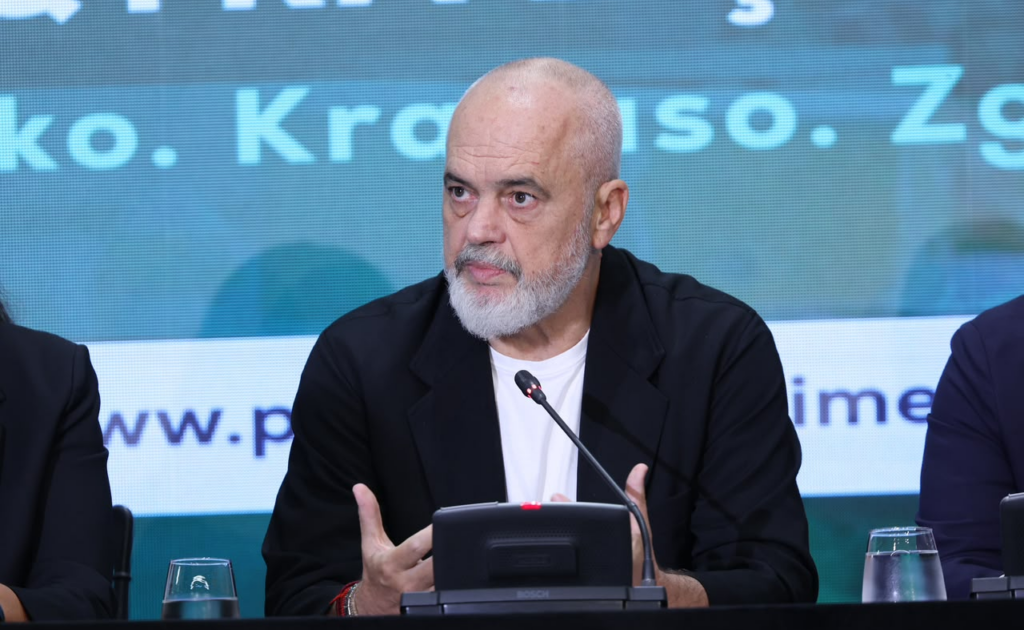
Prime Minister Edi Rama, Economy and Innovation Minister Delina Ibrahimaj and Finance Minister Petrit Malaj met on Friday with representatives of supermarket chains and the country’s main suppliers, where they unveiled the “Price Mirror” (Pasqyra e Çmimeve), a new digital platform designed to increase transparency and allow citizens to compare product prices.
The platform is expected to launch soon in a pilot phase. It will collect data on real product prices at points of sale, including VAT, unit of measurement, barcodes, store addresses and — under standards yet to be set — whether a product is in stock.
During the meeting, Prime Minister Rama asked supermarkets and suppliers to cooperate in putting the platform into operation, stressing that the goal is not to set prices or cap profits, but to create a more transparent market for consumers.
“Analyzed experiences show that supermarkets have found a common language with certain governments,” Rama said.
He added that only one of those present had responded so far, and called on the others to join the process.
“Only one actor present here responded; the others vanished. I believe you are aware that you are earning more than good custom in a community like ours allows — this is neither China nor America, where this aggressive capitalism has started to become concerning.”
Rama asked supermarkets to commit concretely to the project’s first phase by submitting data on products and points of sale.
“Let us commit together — not in principle, but concretely! You form the network of your points of sale, take part in a first pilot phase, and begin transmitting data. Submit the list of products matching this phase’s categories, with barcodes and units of measurement, so products are comparable. Publish the full list of all stores and addresses. Let the platform capture the real final price for the consumer, with VAT, and clearly distinguish the regular price.”
He also stressed the importance of keeping data updated so citizens have the most accurate information on prices and product availability.
“A standard should be set for how quickly prices change, and whether the platform should also show when a product is out of stock. For the citizen, the time has come for it to be very simple: to look, compare and choose — not to be in the dark, facing whatever the road throws at them, with no mirror of competition. I would ask us to agree on these things; no one is saying we will set prices or that you will not make profits — but the moment has come to look each other in the eye,” Rama said.
In closing, the prime minister addressed suppliers directly, asking that profits not weigh further on consumers.
“Make your profits, but let others breathe!” he told suppliers, warning that if they “burden citizens, they will create trouble for themselves.”
Rama stressed that the focus of the initiative is products vital to consumers — not products like deodorants.
Finance Minister Petrit Malaj explained that through data analysis the government aims to better understand how prices are formed, from producer or importer to consumer.
“We want to understand the margins created along the price-formation chain, from the moment of production to the final consumer, or from import to the final consumer. First and foremost we want to understand the margins where we can intervene with our fiscal policies to ease the burden on consumers somewhat.”
Malaj added that the analysis will also help identify the sectors forming the price chain and assess whether margins are reasonable or abusive.
“On the other hand, we want to understand which sectors form the chain and whether margins are abusive. By analyzing margins, we ourselves gain deeper, clearer information.”

Komentet
Bëhu i pari që komenton!
Lini një Koment të Ri
Për t'u përgjigjur një komenti specifik, kliko butonin 💬 Përgjigju poshtë atij komenti.