
French Media: Albania Between Modern Transformation and a Rich Cultural Heritage
Albania is becoming one of the most attractive destinations in the Mediterranean, thanks to the interplay of historic heritage, distinctive cities, nature and modern developments, according to an article in the French media outlet TourMaG.com.
From Tirana and Kruja to Shkodra and Durrës, the country offers a journey between history and modernity, while new investments are giving Albanian tourism another dimension.
Albania’s north: Culture and modernity
A rich heritage and a destination changing fast.
Positioned at the heart of Europe and the Balkans’ Mediterranean region, Albania, a country that was isolated for many years, has opened up to tourism over the past few years.
Tourism infrastructure and services are gradually adapting to the demands of Western visitors.
From the capital, Tirana, to the north and the coastal areas, the country blends traces of history with new investments and developments.
Tirana, a capital between history and modernity
With around 900,000 residents, nearly a third of the country’s population, Tirana is a capital of diverse sights and architectural styles.
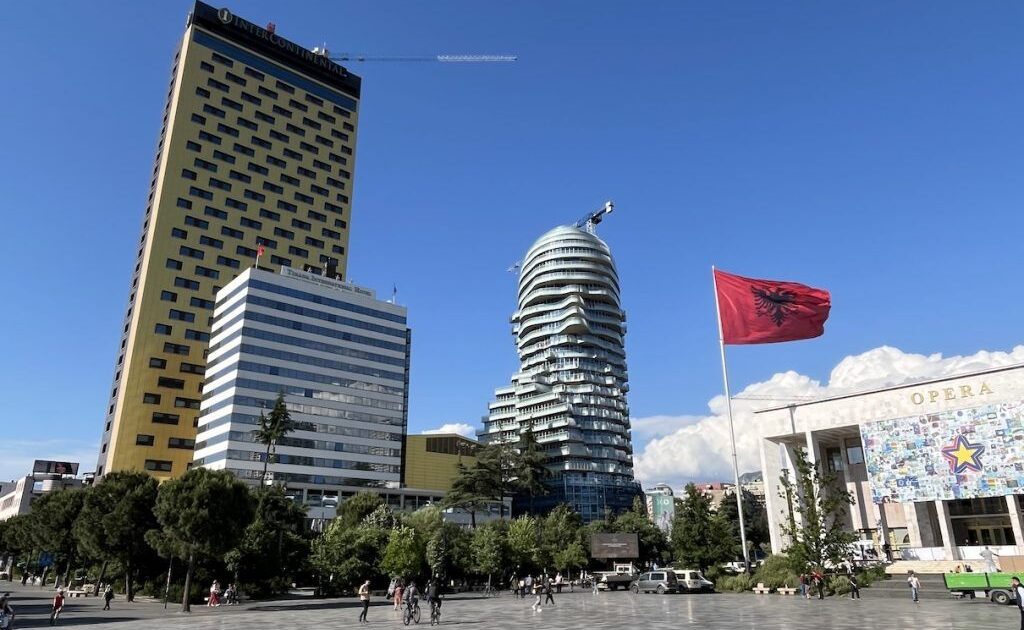
Alongside the modernist buildings of the 1930s and those of the communist period built after World War II, modern and futuristic buildings have risen, aiming to place the capital within the architectural developments of the 21st century.
The result is a varied architectural landscape where different eras and styles intertwine.
In the city center lies Skanderbeg Square, Tirana’s main pedestrian square, dedicated to the Albanian national hero.
Skanderbeg is also commemorated through his famous equestrian monument.
Near the square are the National History Museum, with its large facade mosaic created in the 1980s, the Palace of Culture, built in 1963, the Bank of Albania from 1938, and the Et’hem Bey Mosque, built at the end of the 18th century.
These historic buildings coexist with new structures, such as the “InterContinental” hotel and the modern “Tirana’s Rock” tower, whose silhouette was designed in the shape of Skanderbeg’s face.
Traces of the communist dictatorship
The dark period of Enver Hoxha’s communist dictatorship can be explored through the House of Leaves.
The building, once the headquarters of the State Security (Sigurimi), now serves as a museum documenting the system of repression, surveillance and propaganda used by the Albanian state during the communist period.
In the evening, visitors can enjoy Tirana’s lively atmosphere and Albanian cuisine at the many bars and restaurants of Pazari i Ri and Blloku, two areas known for nightlife and social life.
Kruja and Skanderbeg’s Castle
About 40 kilometers north of the capital lies Kruja, a city that attracts visitors for its position on the mountain slopes as well.
Kruja Castle is closely tied to the history of Gjergj Kastriot Skënderbeu, who in the 15th century led the Albanian resistance against the Ottoman Empire.
The castle, rebuilt in the 1980s, includes a large museum dedicated to Skanderbeg and offers beautiful views toward the Adriatic Sea.
Kruja is also known for the Old Bazaar, where several artisans continue to produce, using traditional methods, shoes and woolen goods, including traditional headwear.
Shkodra and the “Marubi” National Museum of Photography
About 80 kilometers further north lies Shkodra, a city of around 150,000 residents, located about 30 kilometers from the Adriatic Sea.
The city sits near Lake Shkodra, which stretches across the border between Albania and Montenegro.
Shkodra offers two main points of interest.
The first is Rozafa Castle, built in the 14th century and tied to the Venetian period.
Its ruins spread over a considerable area atop a hill and offer sweeping views of the city and the lake.
The second is the city center, particularly Kolë Idromeno and G’juhadol streets, known for their many promenades, cafés and terraces.
Another important stop is the “Marubi” National Museum of Photography, which preserves a significant collection of photographs documenting Albanian society through several generations of the Marubi family.
Durrës, the ancient city by the sea
At the same latitude as Tirana lies Durrës, Albania’s second-largest city and one of the country’s most important historic centers.
Owing to its long history, Durrës has at different times been under the influence of various civilizations and powers, including the Greeks, Romans, Byzantines, Angevins, Venetians and Ottomans.
The city was also an important point on the trade routes linking East and West.
Durrës’s history can be discovered particularly through its archaeological heritage.
Among its most important monuments is the Roman Amphitheater, which could once hold around 15,000 spectators and now sits surrounded by the modern city’s buildings.
Visitors can also see traces of the ancient defensive walls and the Archaeological Museum, which presents evidence and objects from the city’s various historical periods.
Durrës, a rapidly growing tourist city
Durrës is undergoing significant tourism development.
The city is connected to Italy and the port of Bari through numerous ferry lines.
According to the article, Durrës is also expected to get a new marina, while new hotels continue to be built along the coast.
What to know before traveling to Albania?
Albania can be reached from Paris to Tirana by direct flight, with a travel time of about 2 hours and 40 minutes.
To enter Albania, visitors can use a passport or ID card, if the document is valid.
The country’s official currency is the Albanian lek.
To enjoy milder temperatures and avoid the large influx of tourists during the summer months, the article recommends traveling in spring, particularly in May and June, or in early autumn, in September and October.


Komentet
Bëhu i pari që komenton!
Lini një Koment të Ri
Për t'u përgjigjur një komenti specifik, kliko butonin 💬 Përgjigju poshtë atij komenti.