
‘They will fall apart quickly’ — scientists reveal what will happen to the Solar System after the end of the Sun’s life cycle
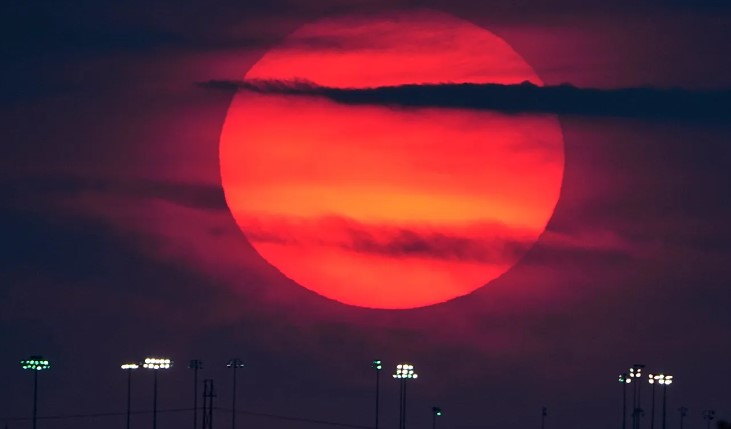
A new study suggests that the outer giant planets of the Solar System could be swept into orbital chaos much earlier than previously thought, after the Sun ends its life.
Researchers at the California Institute of Technology (Caltech) have analyzed how the Sun’s loss of mass during its transformation into a white dwarf would affect Jupiter, Saturn, Uranus and Neptune. According to the new modeling, the orbits of these planets could become unstable around one billion years after the Sun turns into a white dwarf.
This is much earlier than previous estimates, which suggested that the system of giant planets could remain stable for about a quintillion years.
According to the scenario known until now, the Sun will first expand into a red giant, most likely engulfing Mercury, Venus and Earth. It will then lose most of its mass and turn into a white dwarf.
Previous models assumed that the Sun’s mass loss would be mostly gradual, causing the outer planets’ orbits to expand and the system to remain relatively stable for an extremely long period.
The new study takes into account a more disorderly mass-loss process. The researchers argue that episodic and random changes in the Sun’s mass can cause small changes in the planets’ orbits, which over time accumulate and can push the system toward instability.
To test this scenario, the researchers used supercomputers and ran hundreds of numerical simulations of the solar system, modeling the movement of the Sun, Jupiter, Saturn, Uranus and Neptune over extremely long periods.
The Solar System is about 4.57 billion years old, while the Sun has roughly five billion years left before it enters the red giant phase.
The findings were published in the scientific journal The Astrophysical Journal Letters, in the study titled “Terminal Instability of the Solar System Induced by Stochastic Solar Mass Loss.”
According to the authors, the results significantly change how the long-term fate of the outer planets can be understood, showing that the system is not necessarily as stable in the distant future as previous models suggested.



Komentet
Bëhu i pari që komenton!
Lini një Koment të Ri
Për t'u përgjigjur një komenti specifik, kliko butonin 💬 Përgjigju poshtë atij komenti.