
Greece and Bulgaria exchange historic religious objects in a landmark cultural agreement
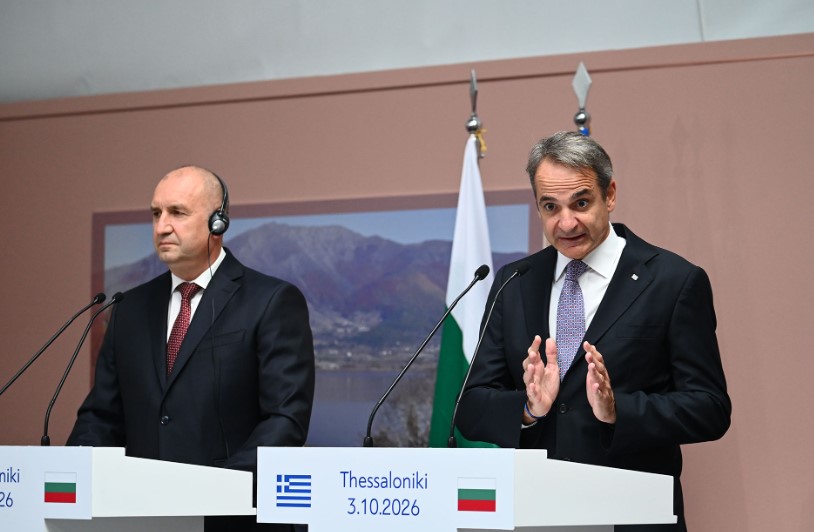
Greece and Bulgaria on Saturday exchanged historic religious objects and anthropological remains under an agreement returning to Greece 48 sacred objects more than a century after they were removed during the First World War.
The handover ceremony was held at the Museum of Byzantine Culture in Thessaloniki and was attended by Greek Prime Minister Kyriakos Mitsotakis and Bulgarian Prime Minister Rumen Radev. The agreement was signed by the two countries’ culture ministers, Lina Mendoni of Greece and Evtim Miloshev of Bulgaria.
The artifacts being returned to Greece were removed in 1917, during the First World War, and were later kept or displayed at Bulgaria’s National Museum of History in Sofia. They come from the Monastery of Panagia Eikosifoinissa, the Monastery of Timios Prodromos in Serres, and the Metropolitan Diocese of Serres and Nigrita in northern Greece.
“Monuments cannot be treated as spoils of war,” Mitsotakis said during the ceremony.
He described the agreement as more than a cultural exchange, saying it laid the foundations for deeper cooperation between the two countries and expressing hope that it would lead to the return of other cultural objects.
Mitsotakis said Greece was also fulfilling its part of the agreement by returning to Bulgaria the remains identified as those of Tsar Samuel, who ruled the First Bulgarian Empire from 997 to 1014, together with anthropological material from four sarcophagi excavated at the Basilica of St. Achillios on the island of Agios Achillios in Greece’s Prespa region.
The remains were excavated in 1965 by archaeologist Nikolaos Moutsopoulos and in recent years were kept at the Museum of Byzantine Culture.
“These were preserved and safeguarded for decades by the Greek state and are now being returned to the Bulgarian people, so that they may be honored in your country in the way you consider most fitting,” Mitsotakis told Radev.
He said the agreement concluded negotiations that had begun almost five decades earlier, with the first discussions held in the 1970s between then Greek prime minister Konstantinos Karamanlis and Bulgaria’s communist leader Todor Zhivkov.
“It took time, and above all political will and determination to overcome the obstacles of the past,” Mitsotakis said.
He also referred to Greece’s long campaign for the return of the Parthenon Sculptures from the British Museum, saying that “the time for justice has come.”
Radev said the agreement showed that Greece and Bulgaria had overcome past disagreements and built a relationship based on mutual respect and friendship.
“I have full hope that what we achieved today will further consolidate our strategic cooperation,” Radev said, describing the two countries as having developed a strong strategic partnership that contributes to stability, security and prosperity in the region.
The agreement completes a memorandum of understanding recently signed by the two countries’ culture ministers after years of negotiations led by Greece’s Ministry of Culture.
The returned Greek artifacts are on display at the Museum of Byzantine Culture in Thessaloniki until November 5. They will then be formally handed over to the monasteries and the diocese from which they were removed more than a century ago.
Komentet
Bëhu i pari që komenton!
Lini një Koment të Ri
Për t'u përgjigjur një komenti specifik, kliko butonin 💬 Përgjigju poshtë atij komenti.