
Ibrahimaj at the Economic Ministerial: Our focus is on regional economic integration and moving closer to the European market
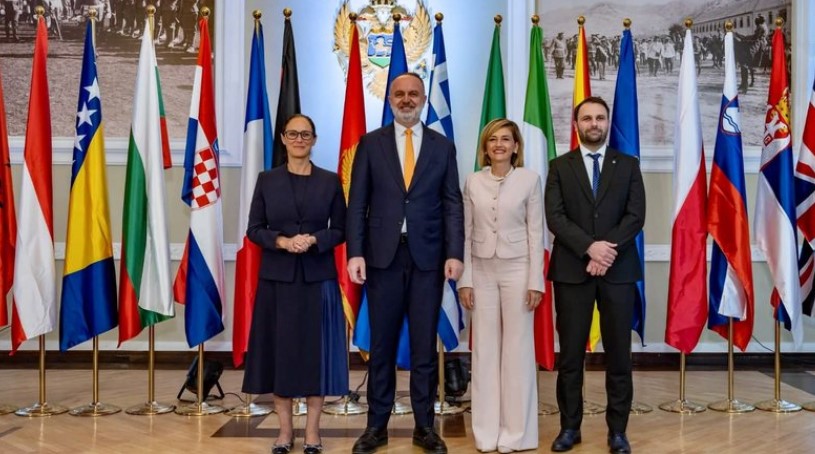
The Minister of Economy and Innovation, Delina Ibrahimaj, took part in the Economic Ministerial of the Berlin Process, held in Cetinje, Montenegro, with the participation of the economy ministers of the six Western Balkan countries, representatives of the European Commission, regional organisations and international financial institutions.
At the centre of the discussions was the implementation of the action plan for the Common Regional Market, the strengthening of economic cooperation and the advancement of the Western Balkan countries’ convergence with the European Union, through the reduction of trade barriers and increased competitiveness.
In her speech, Minister Ibrahimaj stressed that the next phase of regional cooperation must focus on implementation and concrete results for businesses and citizens. “Our priority must be clear: to move from commitments to implementation and from agreements to measurable results for businesses and citizens,” Ibrahimaj said.
In this regard, the minister presented the priorities of the Albanian CEFTA Chairmanship, in the 20th year of the agreement, with a focus on facilitating trade and lowering costs for businesses. The measures include the expansion of the Green Lanes, the harmonisation of the working hours of authorities at border points, the simplification of controls for fruit and vegetables, the recognition of conformity assessment results for industrial products and the use of electronic trust services.
“Regional integration should not be measured by the number of agreements we adopt, but by the time and money businesses save and by the opportunities we create for them to grow,” the minister declared.
Alongside trade facilitation, Ibrahimaj stressed the need for a more integrated regional space for investment, production and innovation. In this framework, one of the priorities of the Albanian CEFTA Chairmanship is “Higher Quality Investment & Higher Productivity”, aimed at attracting investments that bring technology and skills, raise productivity and develop skills and jobs.
The minister also underlined the importance of creating regional value chains in sectors with complementary potential, such as agri-food, manufacturing, tourism and services, as well as strengthening the links of the region’s companies with European value chains. Innovation, digitalisation and the development of human capital were highlighted as important elements for the region’s future competitiveness.
Part of the discussion was devoted to linking regional integration with the process of European integration. Ibrahimaj stressed that the Common Regional Market is not an alternative to EU integration, but a practical instrument for accelerating it. “For Albania, the Common Regional Market is not an alternative to European integration. It is a practical instrument for accelerating it,” Ibrahimaj said.
In this regard, the minister pointed to the role of the Growth Plan for the Western Balkans, which links regional economic integration with gradual access to the European Single Market, in areas such as goods, services, the movement of workers, SEPA, road transport, energy and digital integration. “Albania is the country with the best performance in the region in terms of implementing the Growth Plan,” the minister declared.
Speaking about the next phase of integration, Ibrahimaj stressed that regional cooperation must maintain common standards, while countries that are ready should be able to advance faster in certain areas. “Flexibility should accelerate integration, not create fragmentation,” the minister stressed.
Minister Ibrahimaj invited the ministers and international partners to Tirana, on the occasion of the 20th anniversary of CEFTA, to continue the discussion on the next phase of the region’s economic integration.
Komentet
Bëhu i pari që komenton!
Lini një Koment të Ri
Për t'u përgjigjur një komenti specifik, kliko butonin 💬 Përgjigju poshtë atij komenti.