
In full / Veliaj’s letter to Parliament on the new territorial map, asks for the suspension of the final review of the draft law
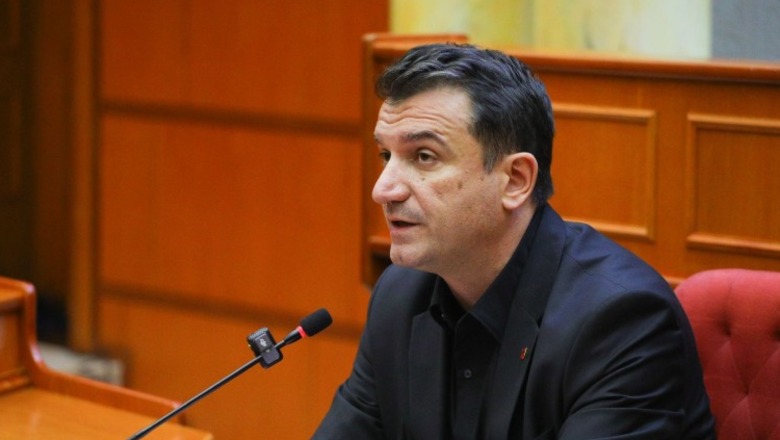
The Mayor of Tirana, Erion Veliaj, has sent a letter to Parliament regarding the new territorial map.
In the letter addressed to Parliament on the draft law on the new administrative-territorial division, the Mayor of Tirana, Erion Veliaj, presents nine requests which, according to him, must be fulfilled before the process continues and the new map is finally approved.
Veliaj first asks for the suspension of the continuation of the final review of the draft law until a real, prior and effective consultation with the population of the affected areas is held and documented. According to him, the consultation must be held at a stage when its results can also bring about a revision of the territorial solution. He also asks that the consultation methodology, the information made available to citizens, the participation and the positions expressed be made public, as well as the way in which those positions have been reflected or the reasons for their non-reflection.
For the Municipality of Tirana, Veliaj asks for the creation of the conditions for the institutional process to be carried out in full, including the opinion of the Mayor, the informed review by the Municipal Council and the real consultation of citizens, TCH informs.
A special request is related to the proposal for the inclusion of the Rinas administrative unit in the territory of the Municipality of Tirana. Veliaj asks that for this change a full territorial, demographic, administrative and financial assessment be presented, including the assets, liabilities, personnel, revenues, expenditures and the continuity of public services.
The letter also requests the harmonisation of the territorial draft law with the necessary changes to Law No. 139/2015 on local self-government. Veliaj asks that the legal status of the “city”, its functions, organisation, financing and service guarantees be defined in binding provisions.
Another issue is the manner of proportional representation of cities. Veliaj asks for the definition of the legal and electoral mechanism for this representation, guaranteeing the equality of the vote and the representation of the inhabitants of villages and administrative units.
The Mayor also asks for the harmonisation of Article 3 of the draft law with Article 92 of the law on local self-government and the clear regulation of the transitional period. This part includes the definition of the competent bodies, the administration of assets and liabilities, budgets, personnel and the provision of services.
For every concrete territorial change, Veliaj asks that the fulfilment of the criteria of Article 108, point 2, of the Constitution and of Article 86 of Law No. 139/2015 be documented.
Finally, he asks that it be expressly defined that the competence of municipal councils for the reorganisation of administrative units is limited within the territory of the municipality and does not include changing external borders or transferring territory from one municipality to another.
Veliaj’s full letter:
“There are moments in the exercise of a public mandate when the duty towards the institution, towards the law and towards the citizens who have entrusted you with their vote naturally coincide. But there are also moments when respecting this duty requires you to say clearly what you think, even when your opinion is not necessarily the easiest to hear for the people with whom you have shared and continue to share the same political responsibility.
I consider this letter to be such a moment.
I am responding to the request forwarded to me through the administration of Parliament, within the framework of the procedure initiated by the group of proposing MPs, as the representative of a community that has given me the mandate directly to represent it and to serve it until its conclusion.
I am part of a political majority that has undertaken the modernisation of the Albanian state, the reform of institutions and the bringing of the country closer to European standards. Precisely for this reason I believe we have a greater responsibility: our reforms should not be measured only by our ability to approve them, but by our ability to make them sustainable, institutionally functional and legitimate.
I have no objection in principle to the revision of the administrative-territorial map. Demographic, economic and social changes may make such a revision necessary. But administrative-territorial reform is not the drawing of a new map. It affects local autonomy, democratic representation, the exercise of the mandate of elected bodies, municipal competences and functions, local finances, citizens’ access to services and the constitutional relationship between the citizen and the power they elect closest to themselves.
The Constitution has placed local government on two foundations: the decentralisation of power and local autonomy. When it comes to changing territory, Article 108 point 2 does not give the legislator unlimited discretion. The division must be based on common economic needs and interests and historical tradition, while borders cannot be changed without first obtaining the opinion of the population that lives in them.
These are the premises that precede my opinion.
These constitutional guarantees must also be read in harmony with the European Charter of Local Self-Government, which constitutes a fundamental standard for the protection of local self-government. The Charter requires that local authorities be consulted, at the appropriate time and in the appropriate manner, on issues that affect them directly and, in particular, that changes to territorial borders not be made without prior consultation of the affected communities. This means that consultation cannot serve to legitimise ex post a predetermined territorial solution; it must take place at a stage when the opinion of the community and of local institutions can really influence the content of the reform.
Changing borders is not a reform of self-government
The draft law proposes the transition from 61 to 46 municipalities. It provides that the municipality, as the basic unit of local government, is composed of “cities”, that cities have a special legal status and that the organisation and representation of the municipality will be based on the proportional representation of the constituent cities according to population. So we do not have only a new map, but a new institutional architecture: municipality, city and administrative unit or villages.
What we have here is not only a new model that remains to be completed in the future, but a direct inconsistency with the law in force on local self-government. Article 6 of Law No. 139/2015 defines that the municipality is composed of administrative units and that the latter are composed of cities and/or villages. Article 1 point 2 of the draft law reverses this hierarchy: the municipality is composed of cities, while cities are composed of administrative units and/or villages. So, whereas the law in force builds the structure Municipality–Administrative Unit–City/Village, the draft law builds the structure Municipality–City–Administrative Unit/Village.
This inconsistency cannot be left to be resolved after the approval of the map. All the more so when the draft law itself declares that the special legal status of the city will be regulated by the law on the organisation and functioning of local government, while the law that today regulates precisely this field places the city in an opposite legal position. For this reason, the amendment of Law No. 139/2015 does not appear as a possible adaptation after the reform, but as a condition of the normative coherence of the very model being proposed.
We cannot decide the borders today and decide tomorrow how the territory we created today will be governed. It is the public function, local democracy and the interest of the community that must determine the optimal territory, and not the predetermined territory that then imposes on the legislator the functions, institutions and representation.
This is not only a choice of good administrative policy, but the logic on which Law No. 139/2015 itself is built. Its Article 86 links administrative-territorial reorganisation with economic and social interests, tradition, culture, traditional ties and other local values, but above all with the aim of performing functions at a higher level for the benefit of the local community. So, the law in force also conceives of territory as an instrument for the better exercise of functions, and not of functions as a consequence that must later adapt to a predetermined territory.
The report and the explanatory memorandum mention deputy mayors for cities, integrated desks, mobile services, public transport, participatory budgeting, performance reporting, as well as measures for the transfer of assets, liabilities, budgets and employees. However, these guarantees have not been included in the provisions of the draft law. The explanatory memorandum cannot replace the legal norm. The elements that condition the functioning of the new map must be translated into clear, binding and enforceable provisions.
The law on local self-government and the new map must be treated together
Law No. 139/2015 is not a technical law on municipal administration. It defines autonomy, subsidiarity, bodies, functions, competences, financing and the centre–local relationship. The law itself defines subsidiarity as the exercise of functions and competences at the level of government closest to the community, taking into account the nature of the task, efficiency and economy. It also defines that the mission of self-government includes governing as close as possible to citizens, recognising the different identities of communities, delivering services according to their needs and the comprehensive participation of the community.
Therefore the question that requires an answer from you is: Can we first determine the territory and only afterwards decide the model of self-government that will function upon it?
My assessment is that these two processes must be at least simultaneous. Before the final approval of the map, its consequences on competences, functions, financing, representation, administrative organisation and the provision of services must be clear. Otherwise, the map will not be a product of the model of self-government, but the model of self-government will be forced to become a product of the map.
This issue becomes even more concrete in the light of Article 92 of Law No. 139/2015, which requires that the units created or affected by the reorganisation function normally “according to this law”, guaranteeing the continuity of basic functions and services. If the new draft law changes the territorial structure, creates a new legal status for the “city” and foresees a new logic of representation, then it must be clear, before the new map enters into force, how these changes will function within or through the amendment of the basic law on local self-government. Otherwise a gap is created between the new map and the legal regime that must make it functional.
Special clarification is also required for the relationship between Article 3 of the draft law and Article 92, point 1, of Law No. 139/2015. The draft law foresees the continuation of the functioning of the bodies elected in 2023 until the constitution of the new bodies in 2027, while the law in force foresees partial elections when reorganisation with a change of borders creates new units or brings incompatibility with the continuation of the mandate of the majority of councillors. The regime that will apply must be expressly defined, as well as the manner in which, during the transitional period, competences will be exercised, revenues administered and services financed in the affected territories.
Every territorial change must pass the test of Article 108 of the Constitution
Article 108 point 2 sets as material criteria the common economic needs and interests and historical tradition. For this reason, for each merger or border change it must be demonstrable: the concrete need that justifies it; the common economic interest; the historical, geographical and social connection; the impact on access to services; the financial and administrative impact; the impact on representation; the preservation of the community’s identity; and the proportionality between administrative efficiency and the proximity of government to the citizen.
The proposers themselves have identified as objectives of the reform the preservation of local identity and the balance between efficiency and proximity to the citizen. These cannot remain only political objectives of the report. They must become demonstrable criteria for every concrete territorial change and the same standard of assessment for every territory proposed.
For the Municipality of Tirana, the draft law has direct consequences, because it foresees the inclusion of the “Rinas” administrative unit in its territory. Before the Municipality of Tirana gives a full and reasoned opinion, it must be provided with a special assessment of the population and the affected territory, the competences and services that will be transferred, the assets and liabilities, the impact on local revenues and expenditures, the personnel, territorial planning and the continuity of public services.
From the documentation forwarded it results that the legislative initiative belongs to the group of proposing MPs and that the administration of Parliament has forwarded it to obtain opinions. This institutional distinction must be maintained, but the main issue is the order in which the special procedure of territorial reorganisation is developing.
Article 89 of Law No. 139/2015 provides that the proposal for reorganisation, for each particular case, is presented to Parliament together with the economic, social, cultural, demographic and administrative reasons, the opinion of the population of the units being reorganised, the relevant maps and the manner of settling financial matters and liabilities. In the concrete case, the draft law has been drawn up and deposited with the new division, the tables, the maps and the relevant solutions, while the opinion of the population is requested after this solution has been formulated.
The report accompanying the draft law also presents the obtaining of the population’s opinion as a process that will be completed before the final review in a plenary session. This shows that the opinion of the population was not part of the material on which the territorial solution was initially built, but is intended to be attached to it at a later stage.
Such a sequence creates the risk that the consultation will be reduced to a formal procedure to complete the documentation of an already finished project, instead of serving as a real process for shaping or changing the territorial solution. To avoid this consequence, it must be proven that the consultation is held on alternatives that are still open, that citizens are given full information on the consequences of the change and that the results of the consultation can bring about a revision of the map, the tables and the content of the draft law.
Article 90, point 3, of Law No. 139/2015 grants local bodies a period of 60 days from the receipt of the proposer’s request to express their opinion. The documentation forwarded to the Municipality also foresees the 60-day deadline. Respecting this deadline is necessary, but the deadline, on its own, does not solve the problem of sequence: the consultation must have a real possibility to influence a solution that has not been treated as irreversible.
The opinion of the population is a prior constitutional condition
The Constitution does not require only informing citizens. Article 108, point 2, requires that borders not be changed without first obtaining the opinion of the population. The word “first” defines a prior condition and not a formality that can be fulfilled after the territorial solution is completed. The same sequence is reflected in Article 89 of Law No. 139/2015, which includes the opinion of the population among the elements that accompany the proposal when it is presented to Parliament.
Consequently, the consultation must be informed, comprehensive, documented and held at a stage when the territorial alternative is still really open. The affected territory and population, the reasons for the change, the consequences on representation, services, finances and property, the manner of consultation, the participation, the positions expressed and the manner in which they have been taken into consideration must be made known. Without these elements, obtaining the opinion risks remaining only a formal confirmation of a decision-making already carried out.
The forwarded documentation requests the reasoned opinion of the Mayor, the review and institutional position of the Municipal Council, including alternative positions, as well as the organisation of the population consultation by the Municipality. The Mayor and the Council are different bodies, with distinct legitimacy and competences. The Council must have the opportunity to become acquainted with the Mayor’s institutional opinion and to take it into consideration, without being obliged by it, before finally forming its own position.
In the case of the Municipality of Tirana there is an institutional circumstance that Parliament cannot overlook. In the procedure initiated by the proposers and forwarded through Parliament, the Municipality of Tirana has been asked, as part of the same process, to present the reasoned opinion of the Mayor and the position of the Municipal Council, as well as to organise the consultation of the population. These are not three disconnected formalities, but complementary elements of forming the institutional position and obtaining the community’s opinion.
The Mayor should have had the opportunity to present his opinion before the Council, while the Council, without being in any way obliged by it, should have had the opportunity to take it into consideration while forming its own position. This has been made objectively impossible. The Mayor is under a measure that prevents the normal exercise of his mandate and the request to enable his participation in this process has been refused by SPAK.
Thus an institutional contradiction is created. Parliament requests the exercise of a function by the elected local body, while the effect of a measure taken within the competences of another state body makes the effective exercise of this function impossible. The consequence does not affect only the Mayor; it harms the completeness of the Council’s position and of the process through which the Municipality must organise and convey the opinion of the citizens, which Article 108, point 2, of the Constitution requires before the change of borders.
Proportional representation of the “cities” requires constitutional clarification before approval
The draft law also foresees that the organisation and representation of the municipality will be based on the principle of proportional representation of the constituent cities according to population. If the “city” becomes the reference unit for the composition of the municipality’s representative body, then there is a direct intervention in the way in which citizens’ votes are translated into political representation.
The Constitution defines that the councils of the basic units are elected through general, direct elections and secret ballot and that the right to elect local bodies is linked to permanent residence in the territory of the respective unit. Therefore, before the new principle is approved, it must be clarified:
What is the “city” for electoral purposes? Are territorial representation zones created within the municipality? How is the equality of the vote preserved between citizens living in different cities? How are the inhabitants of villages and administrative units represented? And above all, can the principle of representation be defined today, while the legal and electoral mechanism for its realisation is left to a future legislative intervention?
These issues cannot be left only to future electoral legislation, because the territorial draft law itself is already defining today the principle on which representation will be built. When the law that defines the territory simultaneously also defines the territorial reference unit for political representation, it must be predictable in its consequences on the equality of the vote and the representation of the constituent communities.
The competence for internal reorganisation must be clearly limited
The draft law foresees that the Municipal Council may change the name, territorial extent and borders of the constituent administrative units and their subdivisions, with final approval by the Council of Ministers. The formulation must expressly define that this competence is exercised only for internal reorganisations that do not change the external border of the municipality and do not transfer territory from one municipality to another.
Law No. 139/2015 recognises competences for updating administrative-territorial maps on the basis of the law in force on territorial division. The technical or cartographic updating of a border defined by law is not the same as the legal change of territorial extent. The draft law must clearly separate these two cases and must not allow a competence for internal organisation to be interpreted as a competence for changing borders between municipalities.
If the transfer of territory from one municipality to another is intended, such a change must be carried out by a special law and in full respect of Article 108 of the Constitution and of the procedure foreseen in Law No. 139/2015. The decision of the Municipal Council and the approval of the Council of Ministers cannot replace this procedure.
All these issues are linked, in the end, to a fundamental requirement of the rule of law: predictability and legal certainty. A reform that simultaneously changes the territory, the internal structure of municipalities and the principle of representation of their communities must be complete and enforceable from the moment of its approval. The definition of the elements without which the legal, institutional, financial and democratic consequences of the proposed map cannot be fully assessed today must not be left to future legislation. The more fundamental the reform, the higher the standard of clarity and of its normative coherence must be.
Conclusions and requests
For all these reasons, I assess that the draft law, in the form and at the procedural stage at which it has been forwarded to me, does not yet offer all the guarantees and normative elements necessary for the approval of a reform of this constitutional importance. In particular, the drafting and depositing of the territorial solution before obtaining the opinion of the population creates the risk that the consultation will be held as a subsequent formality and not as a process that really influences the content of the reform. This position does not constitute opposition to the need to review territorial organisation, but a request that the reform be complete, coherent, really consulted and constitutionally sustainable.
Before the continuation of the process and the final approval of the new map, I consider it necessary that:
The continuation of the final review of the draft law be suspended until the real, prior and effective consultation of the affected populations is held and documented, at a stage when its results can bring about the revision of the territorial solution;
The consultation methodology, the information made available to citizens, the participation, the positions expressed and the manner in which they have been reflected or the reasons for their non-reflection be made public;
In the case of the Municipality of Tirana, the conditions be created for the institutional process to be carried out in full, including the opinion of the Mayor, the informed review by the Municipal Council and the real consultation of citizens;
For the inclusion of the “Rinas” administrative unit in the Municipality of Tirana, the full territorial, demographic, administrative and financial assessment be presented, including assets, liabilities, personnel, revenues, expenditures and the continuity of public services;
The territorial draft law be harmonised with the necessary changes to Law No. 139/2015 and the legal status of the “city”, its functions, organisation, financing and service guarantees be included in binding provisions;
The legal and electoral mechanism of the proportional representation of cities be defined, guaranteeing the equality of the vote and the representation of the inhabitants of villages and administrative units;
Article 3 of the draft law be harmonised with Article 92 of Law No. 139/2015 and the administration of the transitional period be clearly regulated, including the competent bodies, assets, liabilities, budgets, personnel and the provision of services;
The fulfilment of the material criteria of Article 108, point 2, of the Constitution and of Article 86 of Law No. 139/2015 be documented for every concrete territorial change;
It be expressly defined that the competence of municipal councils for the reorganisation of administrative units is limited within the territory of the municipality and does not include changing external borders or transferring territory between municipalities.
Dear ladies and gentlemen MPs,
I cannot say today, on behalf of the citizens of Tirana, whether they are for or against the proposed map. Precisely this must be determined by the constitutional procedure, through a consultation that is not held to formally confirm a ready-made solution, but to give the affected population the real opportunity to influence it. The Mayor can give his opinion, the Municipal Council can give its own, the proposers can argue for the reform and Parliament exercises its legislative competence; but none of these institutions can replace the opinion that the Constitution reserves to the affected population itself.
I was elected to serve the citizens of Tirana until the end of my mandate. This responsibility does not become smaller when its exercise becomes more difficult. On the contrary, precisely in these moments it is proven whether the public mandate is understood as a position that belongs temporarily to its holder, or as a responsibility that derives from the citizens and must be exercised in their service.
Therefore, the institution “Municipality of Tirana” must exercise the competence that the Constitution has given it and no other state competence must be exercised in such a way as to make this competence practically invalid.
The separation and independence of powers do not mean their isolation from the common constitutional order. Every body is independent in exercising the competences that the Constitution and the law have given it, but no competence must be exercised in a manner that strips another constitutional competence of its real content. Respect for the sphere of competences, the function and the democratic legitimacy of other institutions is part of the very principle of the rule of law.
I believe that the political majority to which I belong must not fear this standard. On the contrary, a majority that has undertaken deep institutional reforms must have the ambition that its reforms be sustainable not only for as long as it has the votes to approve them, but also when they are subjected to the test of time, constitutional review and implementation by other political majorities.
When the Constitution requires that citizens be heard, our duty is to create the conditions for them to speak themselves and then to listen to them.
With respect,
Erion VELIAJ
MAYOR OF TIRANA”
Komentet
Bëhu i pari që komenton!
Lini një Koment të Ri
Për t'u përgjigjur një komenti specifik, kliko butonin 💬 Përgjigju poshtë atij komenti.