“Le Monde” After the Hague Verdict: Controversial Court, Used Evidence From Belgrade
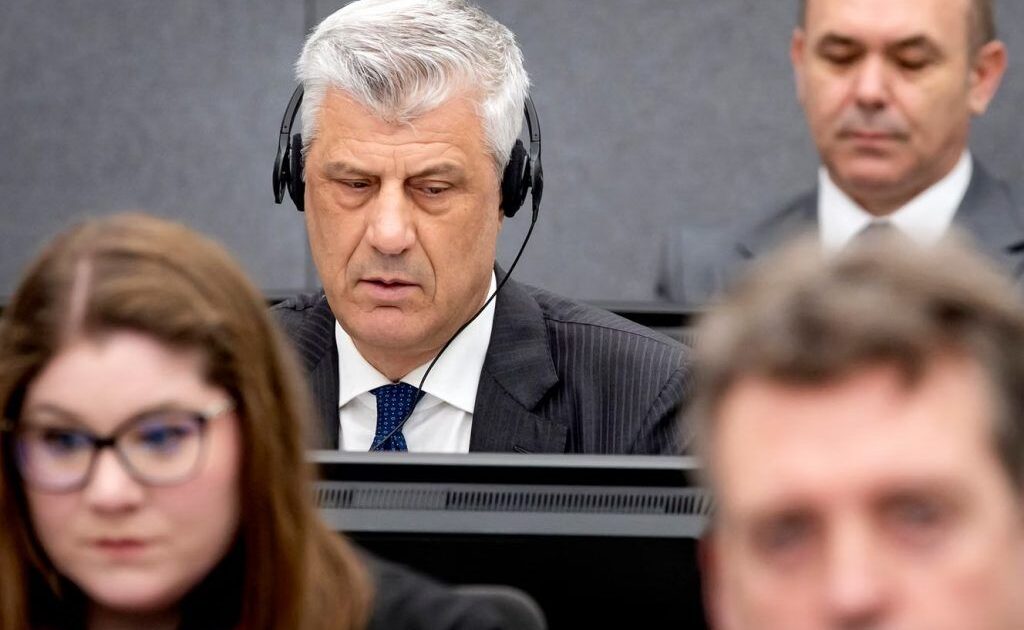
– The international trial panel of the Kosovo Specialist Chambers today found former president Hashim Thaçi guilty of war crimes, according to the French media “Le Monde.”
The special court for Kosovo, based in The Hague, Netherlands, today, on September 16, sentenced former Kosovo president Hashim Thaçi to 25 years in prison for war crimes committed by Kosovo Albanian guerrillas in the late 1990s.
The international trial panel of the Kosovo Specialist Chambers found Hashim Thaçi guilty, among other things, of “unlawful arrest, torture, murder and cruel treatment.”
“The trial panel sentences you to a single sentence of 25 years in prison, deducting from this period the time you have already spent in detention,” presiding judge Charles Smith said while reading the verdict.
Hashim Thaçi, dressed in a dark suit, white shirt and tie, listened to the verdict in silence.
“A terrible verdict for Kosovo, for our liberation war. It is a sad, unjust and undeserved decision,” Kosovo’s foreign minister, Glauk Konjufca, told media outside the court.
Murder, torture, persecution and unlawful detention
Hashim Thaçi is considered a hero by many residents of Kosovo.
A large number of people gathered in the capital to watch the announcement of the sentence on big screens.
In Prishtina’s central square, a countdown had been placed until the moment of the verdict announcement, accompanied by the message “Kosova waits.”
The same screens and panels had been placed in other cities too.
At the moment the verdict was announced, the crowd fell silent.
Many people seemed shocked by the decision, as Thaçi’s supporters had expected him to be freed.
Preparations for his return to Kosovo had already begun.
But once it became clear that the former president would remain in detention, Prishtina’s central square emptied almost entirely within minutes.
More sentences
More than three years after the start of this first-instance trial, the Kosovo Specialist Chambers found Hashim Thaçi, the former political leader of the Kosovo Liberation Army (KLA), guilty of crimes committed by this guerrilla force during the war against Serbian forces and immediately after the end of the conflict, in 1998 and 1999.
At the time he was indicted, in November 2020, Hashim Thaçi was president of Kosovo.
After the indictment was raised, he resigned and surrendered in The Hague, where he was placed in detention.
During the trial, the Prosecution spoke of murders, torture, persecution and unlawful detentions of persons in detention camps in Kosovo and in northern Albania.
According to the indictment, these crimes were committed by KLA members against hundreds of civilians, including Serbs, Roma and Kosovo Albanians considered political opponents.
Around 13,000 people were killed during the conflict in Kosovo, of whom about 11,000 were Kosovo Albanians, most of them civilians.
The war ended after NATO’s bombing campaign, which forced Serbian forces to withdraw from Kosovo’s territory.
Other sentences
For most Albanian residents of Kosovo, Hashim Thaçi and the KLA are symbols of the war for Kosovo’s independence.
Besides former president Thaçi, this trial also tried Kadri Veseli, former head of KLA intelligence and one of Thaçi’s closest associates; Jakup Krasniqi, the KLA’s spokesperson; and Rexhep Selimi, head of its operations.
Jakup Krasniqi was sentenced to 25 years in prison, Rexhep Selimi to 13 years, while Kadri Veseli to 18 years in prison.
According to the court, all four were found criminally responsible for the arbitrary detention and torture of hundreds of people, as well as for 96 murders.
However, they were acquitted of the charges of crimes against humanity.
Prosecutor Kimberly West sought 45 years in prison for each of the four defendants, who were accused of crimes against humanity and war crimes.
All four former KLA leaders denied guilt and declared themselves “not guilty” during the proceedings.
Controversial court
The Kosovo Specialist Chambers (KSC), although based in the Netherlands and composed of international judges, were created on the basis of Kosovo law, specifically to try suspected crimes committed by KLA members during the war.
Before this court was created, earlier cases tried in Kosovo were largely unsuccessful, due to suspicions of witness intimidation and political interference.
Since its founding, the court has been deeply unpopular in Kosovo. The court’s use of evidence secured from Belgrade, which still refuses to recognize the independence of its former province, has further fueled accusations of political bias.
Throughout the trial, prosecutors tried to make a distinction between Kosovo’s war for independence and the four people being tried.
They say the four defendants are responsible for crimes committed against detainees held in KLA detention centers in Kosovo and in neighboring Albania, as well as for murders of Serbian, Albanian and Roma civilians committed for political motives.
The crimes were committed during and immediately after the Kosovo war, which caused around 13,000 victims.
In response to these accusations, the lawyers of the four defendants have argued that the KLA did not have a strict command structure and that its high figures had no way to control fighters who committed crimes and, for this reason, could not be held responsible for their actions.
Source: Le Monde


Komentet
Bëhu i pari që komenton!
Lini një Koment të Ri
Për t'u përgjigjur një komenti specifik, kliko butonin 💬 Përgjigju poshtë atij komenti.