‘PISA 2025’: The distorted mirror of the government’s success with education
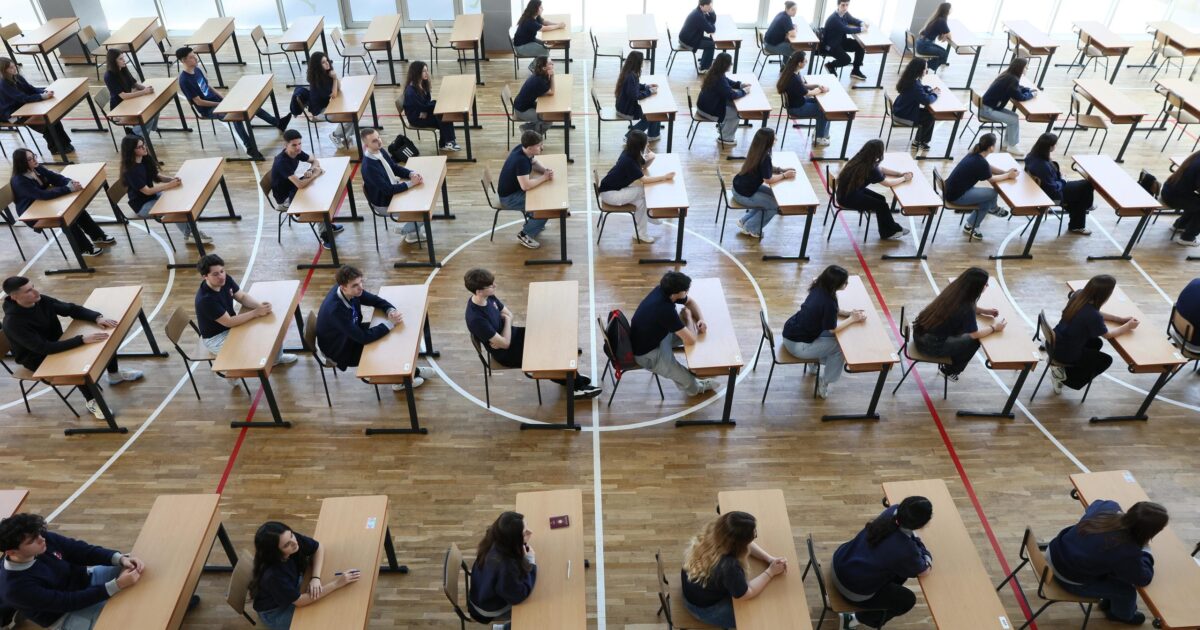

Prime Minister Edi Rama started Wednesday with a live communication with followers on Facebook, announcing a jump of dozens of points in the ‘PISA 2025’ ranking of Albanian students, a ranking he called an ‘extraordinary report card’ for the work done by the Ministry of Education.
At first glance, the 2025 test data show a galloping improvement compared to the level of the last test conducted in 2022, ranking Albania first in the region.
But Albania’s result has a problem; it is classified in the OECD’s ‘limited reporting’ category because the data collection sample was not done in conformity with this organization’s standards.
Unlike other years, Albania submitted result data for only 76% of schools, far below the 85 percent standard required by the OECD, while small schools with fewer than 21 pupils from the 15-year-old population were excluded from testing.
As a result, the data for Albania are accompanied in the report by a note, where the lack of sample coverage is considered ‘a structural gap’ that cannot be corrected with statistical data.
“The selected schools that did not take part in the assessment are likely to be disproportionately concentrated in rural and socio-economically disadvantaged areas, serving populations with historically lower academic performance,” the note reads.
The Ministry of Education and the Educational Services Center that organizes the testing did not give an answer, by the time of publication of this article, as to why the exclusion of these schools had been decided and whether this exclusion had influenced the increase in the final results.
Oliver Clavet, a statistics spokesperson at the OECD, told BIRN that these methodological changes are the responsibility of the participating country and were not made with OECD approval. According to him, the note in the report served as information that these data should be “treated with the necessary caution.”
Civil society organizations and education experts in Albania opposed the data reported by the government as unrepresentative and the selection of the school sample as an attempt to ‘manipulate’ their conclusions.
‘Qëndresa Qytetare’ (Civic Resistance) in a public reaction asked the ministry for full transparency on the sampling process and the publication of all documentation explaining why a part of Albanian schools was left out of the testing.
How did the sample affect the results?!
PISA is the largest international comparative survey in the field of education in the world, assessing the degree of mastery of knowledge in mathematics, reading and science of 15-year-old students. In 2022, Albania recorded its lowest historic result, while three years later the country averaged 435 points in science, 408 points in reading and 433 points in mathematics.
The averages are about 50–65 points higher in the three assessment areas, but this difference is not enough, according to statistics experts, to prove progress in the learning of Albanian children.
Enkelejda Havari, lecturer of Economics at the ‘IESEG School of Management’ in Paris, and Erand Llanaj, researcher at the University of Bielefeld in Germany, both representatives of the ‘Academic Diaspora’ grouping, made an independent analysis of the data to answer the question of how much of the difference from 2022 reflects improvement in learning and how much relates to the change in sampling.
According to them, the sample taken in 2025 has visibly more schools in urban areas.
“The share of rural schools fell from 51% to 18%, while that of schools in cities or larger areas rose from 18.5% to 46.6%,” the lecturers assessed, emphasizing that small schools tend to be more disadvantaged and have fewer resources.
The change in the sample limits comparison between the two cycles.
Still, to examine the sensitivity of the results to the sample composition, Havari and Llanaj reweighted the 2025 results according to the rural and urban composition of the 2022 sample. In this exercise, the averages turned out about 13–14 points lower in mathematics, reading and science.
The authors emphasize that this does not constitute a calculation of Albania’s ‘real’ result nor a measurement of the impact of the excluded schools, but it is an illustration of how the change in sample composition can influence the average.
The analysis also evidences an increase in self-reported effort by students during the test: from 8.35 in 2022 to 8.90 in 2025, on a scale from 0 to 10. According to the authors, this indicator merits further examination, but it does not prove that the change in effort caused the increase in scores.
Calling their exercise ‘limited’ but ‘clear,’ Havari and Llanaj emphasize that “the results do not prove the absence of progress,” but these results do not allow, however, “that its magnitude be measured reliably through direct comparison with 2022.”
An inaccurate picture of reality
“The principle of PISA testing is all-inclusive,” Ndriçim Mehmeti tells BIRN, arguing that a test aiming to give a panorama of the education system.
According to him, the exclusion of these schools risks leaving out of the picture a part of the students facing more unfavorable educational and social conditions.
In this way, says Mehmeti, the result may reflect more the performance of the part of the system that remained within the sample than the state of education as a whole.
For expert Fatmir Sejdiu, this selection was made by the ministry deliberately, leading to results that do not show the whole picture of Albanian education.
“There is a very important methodological issue here, which Kumbaro deliberately hides, while the distributors act blindly: the OECD says that in PISA 2025 schools with fewer than 21 PISA-eligible students were not contacted, creating a gap in the coverage of the Albanian sample,” Sejdiu emphasizes.
For Sejdiu, this is precisely where the main problem lies. If certain parts of the system remain out — he emphasizes — then a better result cannot automatically be interpreted as evidence that the entire education system has made the same progress.
Experts note a paradox between the institutions’ attempt to present a good but not all-inclusive result and the real measurement of these results in function of future education policies.
Fiqiri Çifligu, a connoisseur of the education system, says that although it cannot be proven that the ‘intention’ behind leaving small schools out was to achieve higher results, what should concern the public is what we ‘gain’ from producing such a result.
“If hypothetically such a selection were made to improve the result, the benefits would be mainly short-term and tied to public communication,” Çifligu said.
According to Çifligu, although the results may be presented as a ‘success story’ in public debate, in the long term they have a cost.
“An education system benefits more from an accurate picture of its state than from a somewhat higher but less representative result,” Çifligu concluded.



Komentet
Bëhu i pari që komenton!
Lini një Koment të Ri
Për t'u përgjigjur një komenti specifik, kliko butonin 💬 Përgjigju poshtë atij komenti.