
The Five NBA Teams in the Toughest Salary-Cap Situations
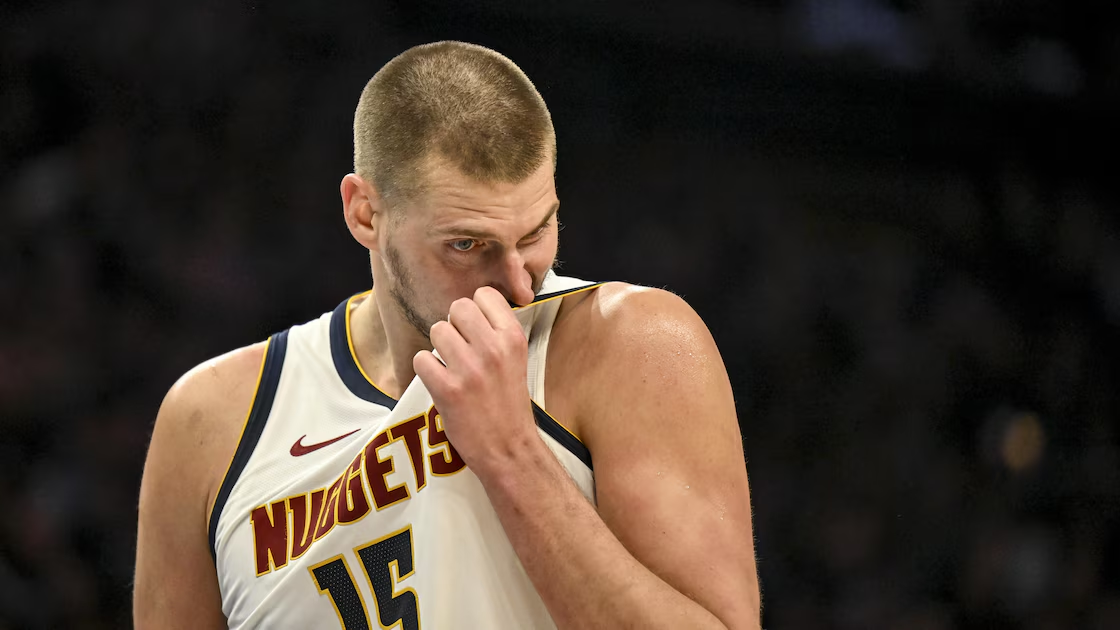
Some NBA teams are tightly bound to their cores and have little financial room to maneuver, putting their long-term stability at risk. From the Cleveland Cavaliers to the Denver Nuggets, the teams on this ranking have paid to build strong contenders but have lost flexibility and much of their future capital in various forms.
According to Bleacher Report, the Cleveland Cavaliers rank fifth due to major long-term commitments: Donovan Mitchell and Evan Mobley are expected to earn together around $133 million in the 2029-30 season. The club is constrained by the signings of core players like James Harden, Jarrett Allen and Peyton Watson, while bench depth is limited and the team is approaching the hard financial cap. Cleveland has spent heavy draft capital to build this group; first-round picks are limited by redistributions and trades, with swap options in 2028, 2030 and 2032, and only one second-round pick available in 2033. If the team fails, the path to improvement may only go through trading its core stars.
The Los Angeles Lakers come fourth after going all-in this summer to build around Luka Dončić together with Austin Reaves and Walker Kessler. Reaves got a nearly max long-term contract, while Kessler was brought in via trade. Dončić still has two guaranteed seasons with a player option before 2028-29, and if he stays committed the team has high offensive potential, but if results weaken he could seek new paths. The Lakers have limited draft capital — only one first-round swap and a few second-round picks available — forcing them to seek improvements mainly through small market moves or taking on other contracts in trades.
The LA Clippers rank third, after a series of consequences that shrank their future assets. After the NBA’s investigation into irregular sponsorship deals involving Kawhi Leonard, the team lost five first-round picks; some were recovered through trades, but under the Stepien rule some picks cannot be sold directly, only offered as swaps. Still, within the next few years the Clippers have several first-round picks and 4-5 second-round picks available, and a relatively cleaner salary structure with some expiring contracts, which could give them room to build or trade veterans for desired assets. An open question remains whether the received penalty will deter stars from joining the team.
The Orlando Magic rank second due to deep commitment to a promising but still unproven core at the highest levels: Paolo Banchero, Franz Wagner, Desmond Bane (brought in via trade), Jalen Suggs and Wendell Carter Jr. Anthony Black will be available for an extension, otherwise he becomes a restricted player in the summer of 2027. For a club that rarely pays the luxury tax, a bill of around $33 million is expected for 2026-27; keeping Black without saving trades could push the team under the hard cap. The Magic still have some draft assets — they could trade the 2032 or 2033 first-rounder or offer swaps in 2027, 2031 and one of 2032/33 — as well as 6-7 second-round picks, but the lack of immediate sporting growth puts them in a delicate position.
At the top of the list stand the Denver Nuggets, the reigning champions with Nikola Jokić, who face challenges similar to those experienced by great teams after major success: difficulty maintaining dominance without sacrificing financial flexibility. The key question is whether Jokić will use his contract option and leave as a free agent or renew, since every decision of his will determine the club’s ability to rebuild or add depth. Denver has major obligations to players like Aaron Gordon, Christian Braun and Jamal Murray and owes three first-round picks to others (two to Oklahoma City and one to Brooklyn), with only a few swaps and 4-5 second-round picks available for maneuvering.
Komentet
Bëhu i pari që komenton!
Lini një Koment të Ri
Për t'u përgjigjur një komenti specifik, kliko butonin 💬 Përgjigju poshtë atij komenti.