
“The new law gives municipalities the right to organize themselves” — Territorial Reform, Mazniku to the opposition: You speak about things you do not know
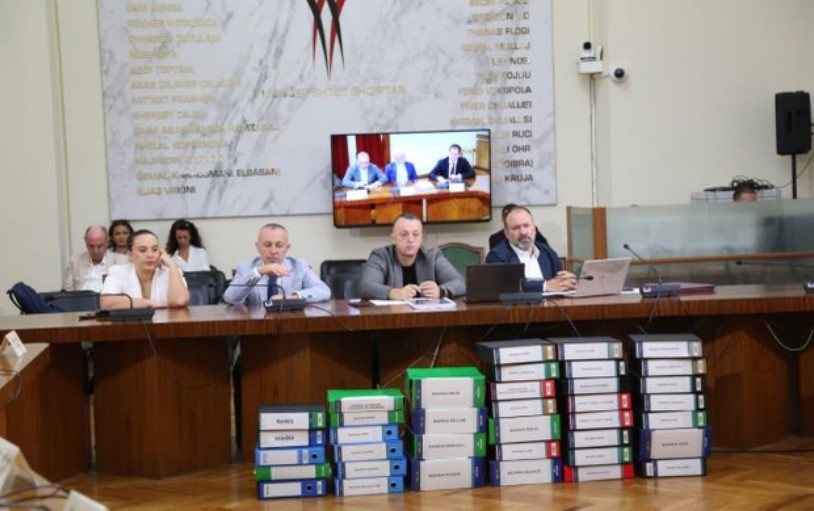
In the Committee on Legal Affairs, Public Administration and Human Rights, Arbjan Mazniku, co-chair of the Special Committee on Administrative-Territorial Reform, responded to opposition MPs’ claims about the procedure for consulting municipalities on the territorial reorganization.
Mazniku said the procedure is in line with the provisions of the law on local governance and that all municipalities have been included in the process because of the changes the new law also envisages in their internal organization.
Mazniku explained that the new law is not only about changing the boundaries between municipalities, but also envisages a new right for them to organize their own territory internally.
“The procedure you explained — that once a proper proposal with a proper map has been made, at that moment the possibility also arises for municipalities and their councils to give an opinion in relation to the specific organization. And that moment began when an initiative was proposed in Parliament. That initiative was sent to all municipalities, which had a 60-day deadline to respond. Article 89 charges the proposers with presenting to Parliament the opinion of the population living in those units that will be reorganized. We have given all municipalities the opportunity, in accordance with the Constitution, to express themselves and, secondly, in accordance with Article 89, point B, we present to this committee the opinion of the population living in these units that will be reorganized. Mr. Bylykbashi said: why was it also sent to municipalities that are not affected by the reorganization?
We sent it to all municipalities because the law itself, in two of its points — first, in the concept of municipality-city-administrative unit, from the point of view of internal organization it affects all municipalities, and secondly, from the new right this law proposes, that municipalities have the right to organize their own territory themselves — is an element that affects the internal organization of all municipalities, because the law envisages reorganization with a change of boundaries and envisages reorganization without a change of boundaries,” Mazniku stressed before the committee.
He then turned to the co-chair of this reform, Democratic Party MP Luçiano Boçi, rejecting his argument about how the procedure was implemented.
“Mr. Boçi, you speak about things you do not know and do not understand. Article 88 of the law, if you had read it, says reorganization without a change of boundaries. From reorganization without a change of boundaries, because of the right it gives municipalities, all 61 municipalities are affected. The new law gives them a right they did not have until today, and for this reason we sent it for opinion to all municipalities.”
Continuing his explanation, Mazniku also referred to Articles 89 and 90 of the law on local governance, arguing that municipalities and their councils have the right to express their official position when a concrete reorganization proposal is made.
According to him, this phase of the process began after a concrete initiative, together with the reorganization proposal, was presented in Parliament, and all municipalities were given a 60-day deadline to express their opinion.
Mazniku also stressed that the proposers have a legal obligation to present to Parliament the opinion of the population living in the units that will be reorganized.
“Article 89 charges the proposers with presenting to Parliament the opinion of the population living in those units that will be reorganized. We have given all municipalities the opportunity, in accordance with the Constitution, to express themselves and, secondly, in accordance with Article 89, point b, we present to this committee the opinion of the population living in these units that will be reorganized.”
Mazniku argued that consultation with the municipalities is not a formal procedure, but is also linked to the new competences the law envisages for the organization of local territory.
Komentet
Bëhu i pari që komenton!
Lini një Koment të Ri
Për t'u përgjigjur një komenti specifik, kliko butonin 💬 Përgjigju poshtë atij komenti.