
Which is the airport that operates without air conditioning, even though it is located in a tropical zone?
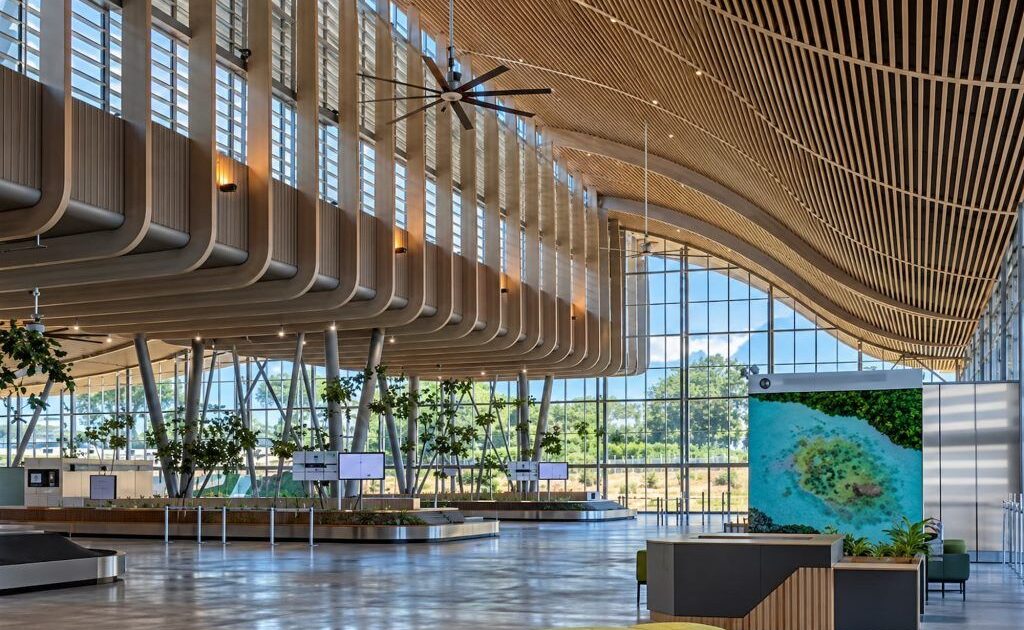
An airport on the French island of Réunion, in the Indian Ocean, is drawing attention for a special architectural solution: the arrivals terminal of Roland Garros Airport, built from scratch and inaugurated in 2024, which operates without a traditional air-conditioning system, writes Focus.
In the hottest and most humid months, from November to April, outside temperatures can reach around 30 degrees Celsius, while inside the terminal they are usually kept at 25–26 degrees.
This is achieved through a combination of natural ventilation, the roof’s special structure and giant fans placed on the ceiling.
The idea was developed by Marc Delanoë, who in 2016 led the airport’s environment and energy team and is today responsible for sustainable development.
According to him, the decision not to use air conditioning was a challenge, but further studies showed that the project could work.
Does the roof create the ventilation effect?
One of the terminal’s key elements is the roof with a wavy profile, divided into two parts by a central opening.
This structure creates a zone of lower pressure, helping to draw in air and circulate it throughout the building.
The terminal has more than 800 windows with automatic louvres, which open or close depending on weather conditions.
During hot periods, they stay open and make use of the steady trade winds, which blow from the east.
According to the project’s data, this way of ventilating can lower the indoor temperature by around 4–5 degrees Celsius, creating a cooler environment without the use of air conditioners.
In the cooler months, the system reduces the entry of outside air. And in the event of a cyclone, the building can be closed completely.
The giant ceiling fans also help in the cooling process, some of them with a diameter of about 7.5 metres.
Saves energy and cuts emissions
The terminal cost around 60 million euros to build.
According to the project’s data, avoiding the use of air-conditioning systems has brought savings of around 150,000 euros a year in electricity bills.
This represents a reduction of around 60 percent compared with buildings equipped with traditional air-conditioning systems.
The benefits are not only economic. According to the designers, carbon dioxide emissions are around eight times lower than those of a similar building that would use air conditioning.
Can it also be applied in Europe?
The Réunion experiment shows the potential of architecture that adapts to the climate, but experts stress that the model cannot automatically be copied everywhere.
Réunion has a tropical climate, but temperatures during the hot period usually range around 23–30 degrees Celsius, while the trade winds offer a continuous source of natural ventilation.
The situation is much more complicated in large European cities, where during heatwaves temperatures can exceed 40 degrees Celsius. Moreover, air pollution is another obstacle to the use of natural ventilation in urban areas.
According to Delanoë, in cities with high pollution, the use of direct ventilation could cause pollutants to accumulate inside buildings.
Nevertheless, the Roland Garros Airport terminal is being seen as an example of how architecture, the local climate and technology can be combined to reduce dependence on air conditioning, while lowering both energy costs and the impact on the environment.



Komentet
Bëhu i pari që komenton!
Lini një Koment të Ri
Për t'u përgjigjur një komenti specifik, kliko butonin 💬 Përgjigju poshtë atij komenti.