
Who is financing construction? Bank debt accounts for only 5% of assets, suppliers and clients 20–30%
“Monitor” analyzed a sample of 163 construction companies included in the detailed database built from the 1,000 largest companies in the country by revenue, to look at key financing indicators such as expected receivables from clients, bank debt, and suppliers. The history of these indicators was reviewed for the period 2017–2024. Construction companies turn out to be highly dependent on suppliers and on money expected to be collected from clients. Receivables (money expected to be collected from clients) and supplier obligations (liabilities owed to third parties) accounted for around 29% and 20% of total assets respectively, compared with 5% for bank debt. The data indirectly show that the economy’s exposure to construction is so high that, although 52% of the loan stock is tied to real estate, bank financing accounts for very little in builders’ balance sheets — indicating that the sector’s expansion has been fed by sources far larger than formal credit and real demand, in an economy that today offers among the lowest wages in Europe.
Ornela Liperi
SPAK’s recent strikes showed that formal capital in construction has often been combined with informal capital. The second-largest residential company in 2025, with annual turnover of nearly 52 million euros, was found by SPAK’s investigation to be part of one of the largest criminal organizations in Albania.
This structured network secured profits of millions of euros from selling narcotics in Europe and then invested them in the Albanian economy, with a particular focus on the construction sector. SPAK’s investigations show how easily informal money entered construction, even through the most elementary schemes, such as physically transporting cash by truck.
The Financial Intelligence Agency has also often cited construction in its reports as a high-risk sector where money can be laundered.
With the sector circulating around 400 billion lek (about 4.2 billion euros a year, excluding the volume that comes from public works through capital and operating spending), it is difficult to estimate what percentage of it is financed by informal money.
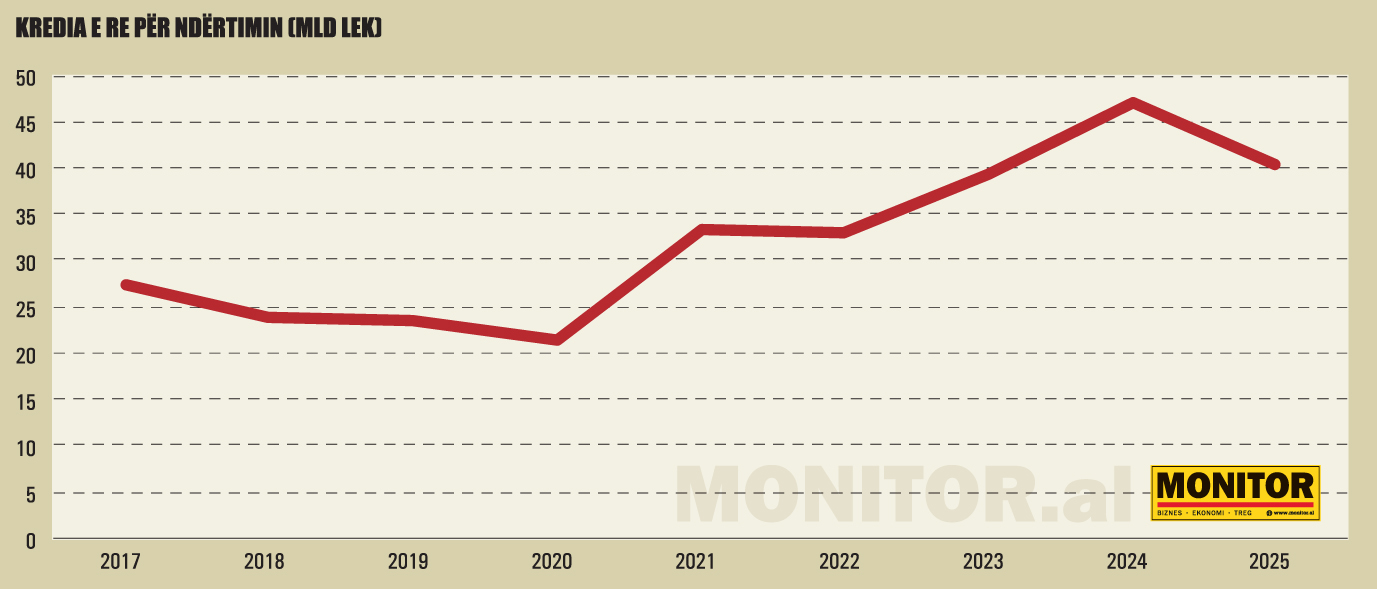
New credit for construction was 40.4 billion lek in 2025, according to Bank of Albania statistics, accounting for 14% of total new lending to businesses and the second-largest after retail and wholesale trade (37%).
After strong growth in 2020–2024, new lending to construction marked its first contraction trend, down 14% in 2025, signaling a pullback by the banking sector toward this sector.
On the other hand, it should be noted that rising prices in areas of interest for short-term rental indicate real demand for residential space, although this remains limited to Tirana, a few coastal cities, and areas with tourism development potential.
Source: Bank of Albania
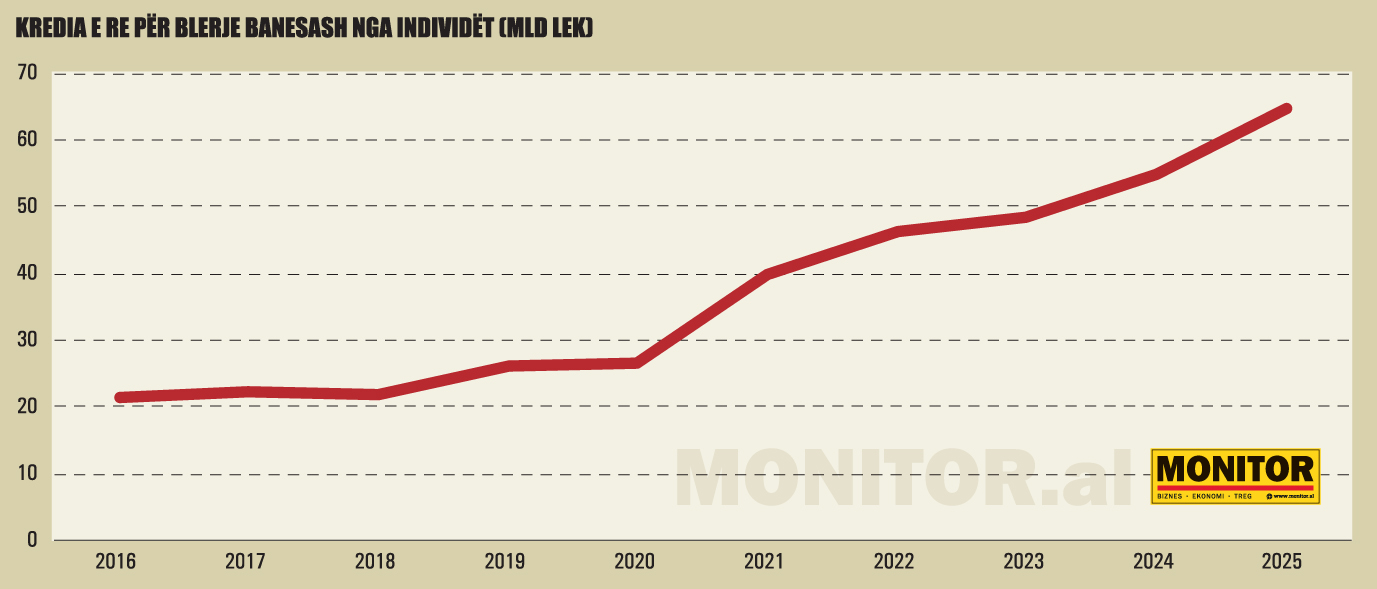
In total, new lending for real estate and home purchases was 135 billion lek in 2025, accounting for 31% of total lending to the economy in 2025, according to Bank of Albania statistics. 64 billion lek was granted for home purchases by individuals and 71 billion lek for real estate for businesses.
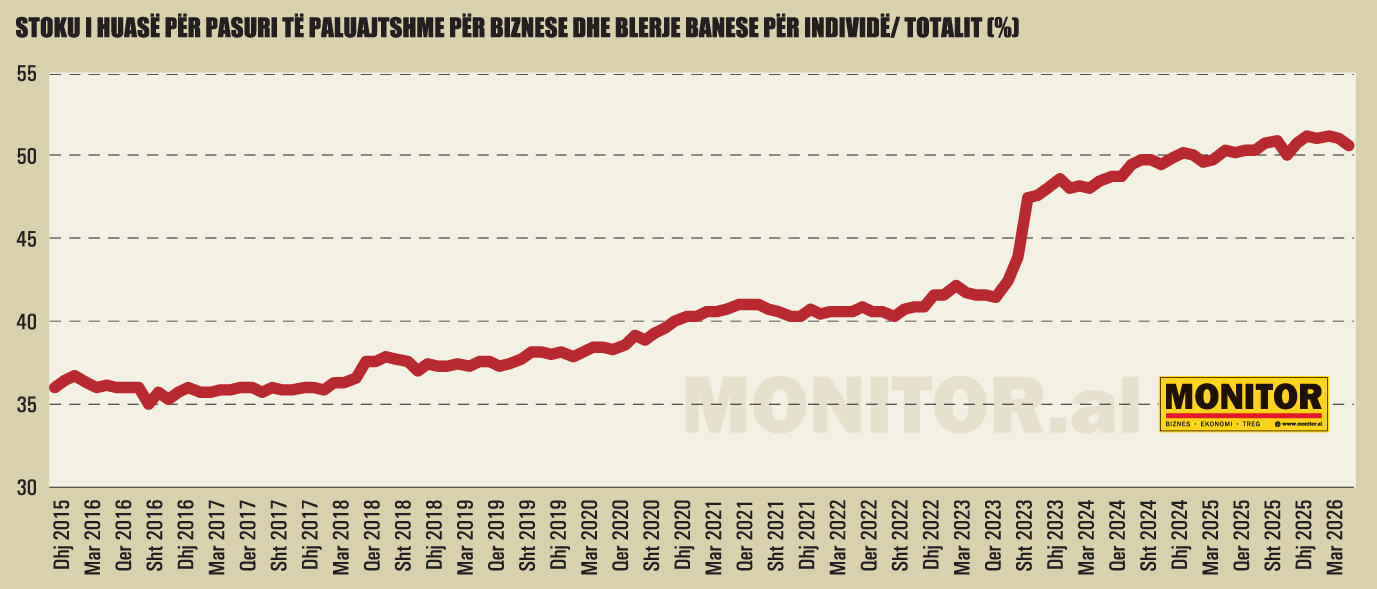
The banking system’s exposure to the real estate market has risen significantly in recent years. According to Bank of Albania data, in the 2025 Annual Banking System Supervision Report, the stock of “loans for home purchases” by individuals holds the largest share of the total loan portfolio at 26.8%, followed by “real estate loans” by businesses at 24.3%. Together they account for around 52% of the loan stock granted by the banking system.
Source: Bank of Albania
In value, the stock of loans for properties and real estate is 243.6 billion lek for individuals and 216 billion lek for businesses, for a total of 470 billion lek, or nearly 4.7 billion euros, to be repaid by individuals and businesses.
The Bank of Albania has stated that it has treated the growth of credit for real estate as a potential source of risk to financial stability and has strengthened the collection and analysis of data on loans for housing, commercial property, builders, and real estate projects.
“When property prices rise fast, banks and borrowers can become less careful; when the cycle turns, losses appear quickly. For this reason, the Bank has strengthened the collection and analysis of data on loans for housing, commercial property, builders, and real estate projects.”
In May 2025, the Bank of Albania approved upper limits for two key indicators: the size of the loan relative to the property’s value and the weight of the monthly installment relative to the borrower’s income. This means banks cannot grant loans that are very high compared to the property’s value, nor allow the monthly loan installment to weigh too heavily on the household’s income. The limits are more cautious for foreign-currency loans and for homes bought for investment or rental.
These measures did not manage to restrain individual credit for home purchases in 2025, with new lending growing by 17.4% to reach a record 64 billion lek.
Source: Bank of Albania
Read also: Is construction approaching the downturn cycle again
Construction is financed little directly by banks, but real estate credit remains an important indirect financing channel
A common form of financing in the real estate market remains client advances and financing through suppliers, including clearing arrangements — the exchange of goods or services instead of cash payment. This makes a considerable part of the sector’s financing difficult to measure directly.
“Monitor” analyzed a sample of 163 construction companies included in the detailed database built from the 1,000 largest companies in the country by revenue, to look at key financing indicators such as expected receivables from clients, bank debt, and suppliers.
The history of these indicators was reviewed for the period 2017–2024. (The results should be read as indicators of the financial model of the sector’s large companies and not necessarily as a representative average for the entire construction market. In some indicators, extreme values were excluded to avoid distorting averages.)
The data show that construction companies’ financial model relies more on working capital than on bank credit. Working capital, in this case, means the relationship between the money the company expects to receive from clients and the obligations it owes to suppliers and partners.
Construction companies turn out to be highly dependent on suppliers and on money expected to be collected from clients. Receivables (money expected to be collected from clients) and supplier obligations (liabilities owed to third parties) accounted for around 29% and 20% of total assets respectively, compared with 5% for bank debt.
Construction companies dependent on expected collections from clients and on clearing
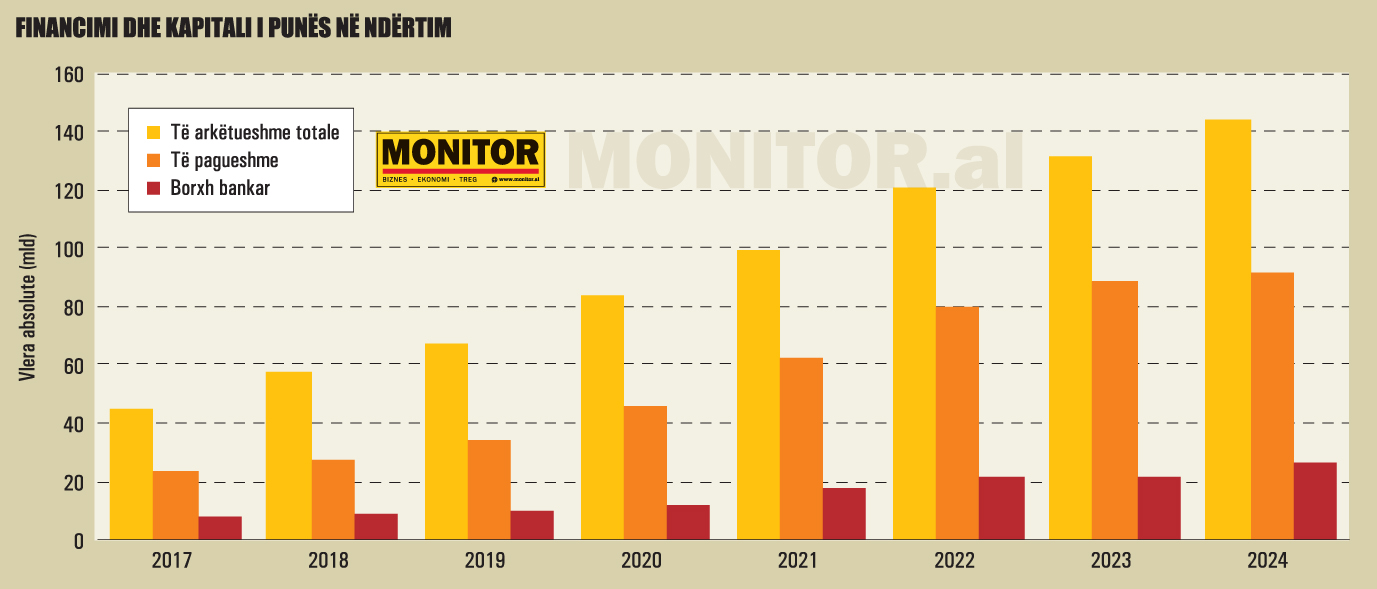
Total receivables (amounts companies are owed by clients or other parties) accounted for 29.2% of assets in 2024, down from 37.4% in 2017. Although the weight has been declining, it remains considerable. Relative to sales, the level is even higher. Receivables accounted for 83.4% of sales in 2017, peaked at 90% in 2019, and were still 76.4% in 2024.
In simple terms, this means a large part of the revenues declared by companies has not yet been turned into collected cash, signaling considerable capital committed in the project cycle. For the construction sector, this is linked to the nature of projects, installment payments, and long contract completion deadlines.
Obligations to suppliers and other parties, or payables, carry a high weight in construction companies’ balance sheets. Payables account for around 17.7–21.7% of construction companies’ assets. Relative to sales, their weight is even higher: from 43.3% in 2017, it passed 50% in 2022 and 2023, while in 2024 it was 48.6%.
In practice, this means suppliers finance part of companies’ activity by providing materials or services and accepting payment at a later point. In the construction sector, this mechanism can also take the form of clearing, where the supplier is compensated not with cash at the time of supply but with apartments, commercial units, or other properties in the project.
For this reason, part of the sector’s financing never passes through the banking system at all and is much harder to measure through traditional financial statistics.
Sales without cash
In 2024, around 76% of sales by the 136 largest companies in the construction sector were still to be collected. In simple terms, this means a large part of the revenues declared by companies has not yet been turned into collected cash, signaling considerable capital committed in the project cycle.
Source: Bank of Albania
Bank debt accounts for only 5% of assets
Contrary to the perception that may be created by the strong growth of bank credit to the real estate sector, company balance sheets show that bank debt is not the main source of financing for builders.
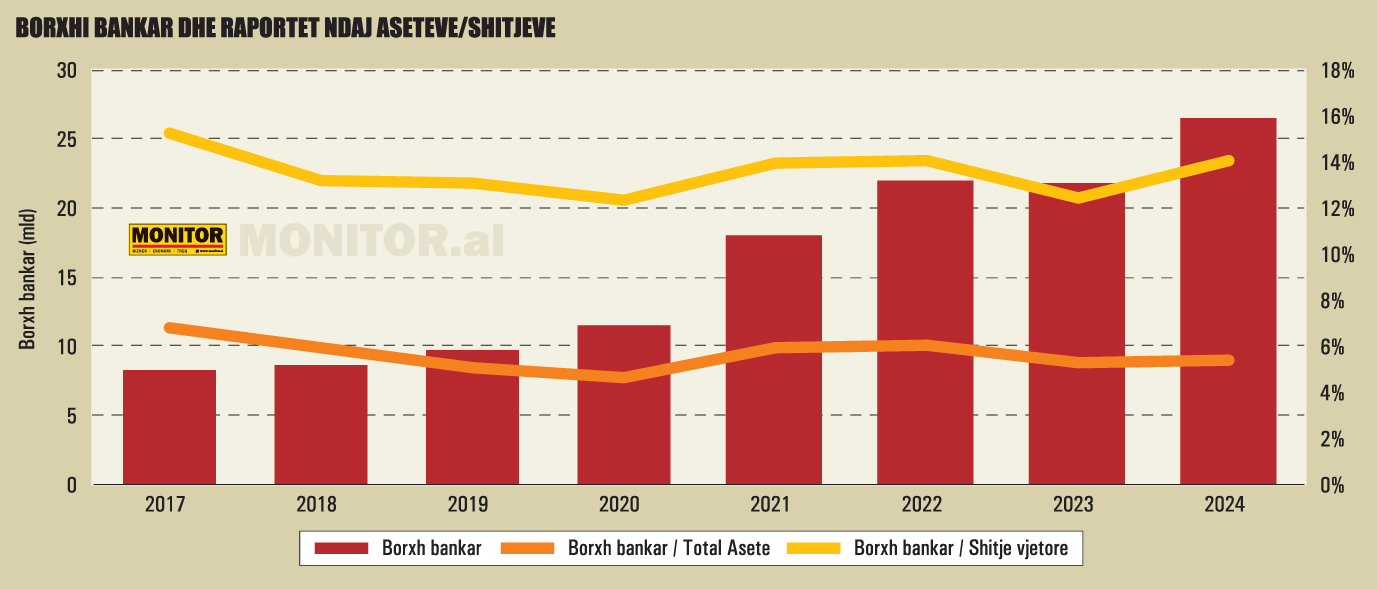
After excluding from the analysis companies with extremely high values that could distort the average, bank debt accounts for only 4.6–6.8% of the analyzed companies’ assets.
In 2017, the ratio was 6.8%, while in 2024 it had fallen to 5.3%.
Even relative to sales, bank debt has moved within a relatively stable range of around 12.3–15.2%, without showing a strong structural upward trend.
Source: Bank of Albania
Lorenc Sulanjaku, Director of the Business Risk Department at “Union Bank”, who analyzed the data from “Monitor”‘s database, says the indirect data suggest the operating model creates high needs for working capital, which are financed partly by client advances, suppliers, and clearing arrangements, rather than by traditional bank credit.
But he clarifies that the analysis above refers mainly to the direct financing of construction companies by banks. This does not imply that the banking sector has low exposure to the real estate market as a whole, since a considerable part of credit to individuals and businesses for property purchases may serve, indirectly, as a source of financing for construction projects, especially when sales are made during the construction phase and before the building is finalized.
“In this context, although bank credit tied to real estate holds a significant weight in banks’ portfolios, this exposure should not be confused with the direct financing of construction companies,” he adds.
So, although direct exposure to banks remains relatively low, the sector is dependent on the continuity of sales, the pace of collections, and the functioning of the payment chain between builders, clients, and suppliers. This dependency, Mr. Sulanjaku warns, makes the sector sensitive to any disruption in the money cycle: a delay in collections can quickly translate into deferred payments to suppliers, a rise in unpaid obligations, and increased financial pressure along the entire construction chain.
“This risk becomes more pronounced in an environment where formal bank financing is not the main source of capital, since companies have less room to absorb temporary liquidity shocks through credit lines or bank refinancing. As a result, the sector’s financial sustainability depends not only on the level of contracted sales but also on the real speed of their conversion into cash.”
This model also creates another significant risk: liquidity. If collections from clients are delayed, if sales slow down, or if suppliers demand faster payments, companies may face immediate pressure on cash inflows and on their ability to settle operating obligations on time.
In conclusion, company balance sheets suggest that large builders do not rely predominantly on direct bank financing. However, this does not make the sector any less important for the financial system, says Mr. Sulanjaku.
On the contrary, banks’ exposure to the real estate market remains considerable through credit to individuals and businesses that buy property — credit that often serves as an indirect source of financing for construction projects during the development phase.
For this reason, the assessment of the sector’s risk is measured not only by the level of bank loans in builders’ balance sheets, but by the entire financing chain of the real estate market and the link between the pace of sales, mortgage credit, collections from clients, and obligations to suppliers,” says Mr. Sulanjaku.
Risk
Although direct exposure to banks remains relatively low, the sector is dependent on the continuity of sales, the pace of collections, and the functioning of the payment chain between builders, clients, and suppliers. This dependency, Mr. Sulanjaku warns, makes the sector sensitive to any disruption in the money cycle: a delay in collections can quickly translate into deferred payments to suppliers, a rise in unpaid obligations, and increased financial pressure along the entire construction chain. “This risk becomes more pronounced in an environment where formal bank financing is not the main source of capital, since companies have less room to absorb temporary liquidity shocks through credit lines or bank refinancing. As a result, the sector’s financial sustainability depends not only on the level of contracted sales but also on the real speed of their conversion into cash.”
Will the new expected wave of construction materialize?!
Since 2025, INSTAT no longer publishes the full area of construction permits granted, as it provides only information on construction permits based on data secured from municipalities.
INSTAT has clarified that the reported data do not include permits over 7 floors granted by the National Territorial and Water Council (KKTU). As a result, in 2025 the declared area of permits was only 1.3 million square meters (nearly halved) — granted by municipalities alone.
Although KKTU has continuously granted construction permits for towers and resorts, there has been no transparency about how much area was granted for construction in 2025 and in the first 5 months of 2026.
An indirect estimate based on the strong growth of infrastructure tax revenues suggests a new wave of construction.
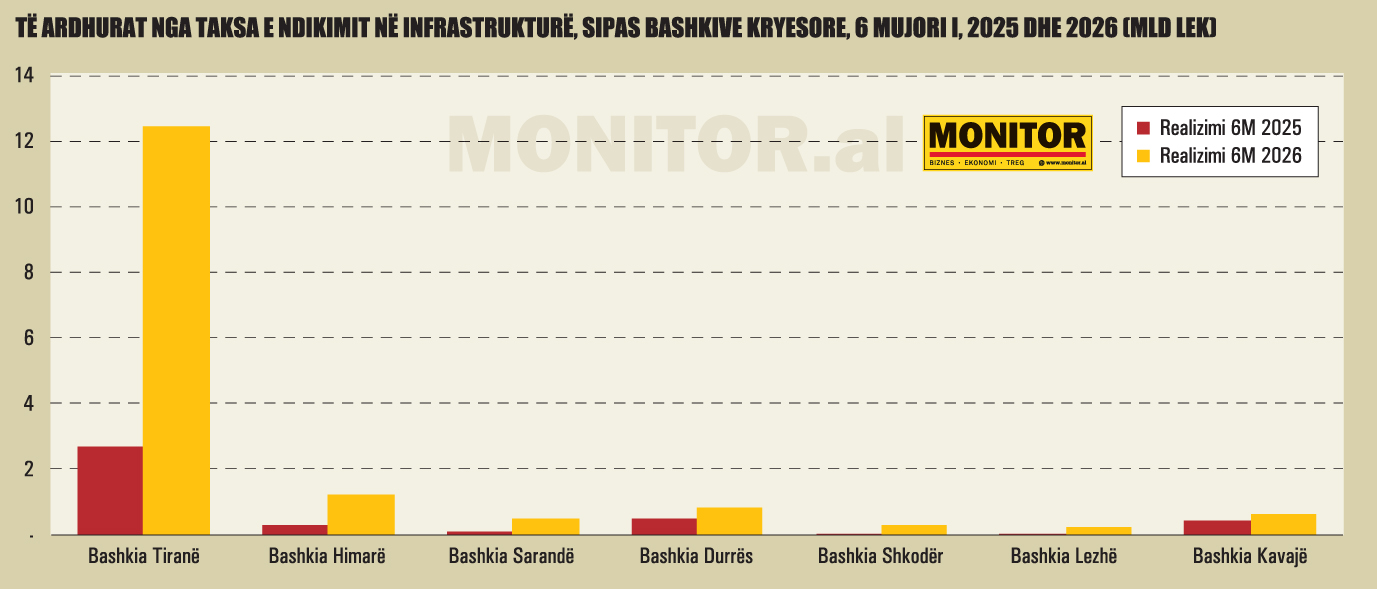
According to data from the Ministry of Finance, revenues from the infrastructure impact tax alone reached 18.3 billion lek for the first 6 months of 2026, tripling compared with the same period of 2025.
For comparison, 18.6 billion lek was collected from the infrastructure tax for all of 2024 and around 16 billion lek in 2025. About 68% of this amount was collected by Tirana alone.
Unlike the last cycle, which was concentrated mainly in Tirana, the new wave seems to have included not only the capital but also the coast. In Himara, collections rose 300%, in Saranda 576%, in Durrës 58%, in Kavaja 37%.
Source: Ministry of Finance, Local Finances
Permits for tall buildings have been granted in the Golem beach area, and numerous permits for resorts have been granted in the South — for some of which public resistance has begun, such as in Zvërnec.
Time will tell whether the projected developments will be realized or will remain only on paper due to lack of financing or weakening demand.
However, in Albania, every forecast remains difficult, since an unpredictable factor always enters the equation: informal flows.
Expectations
Time will tell whether the projected developments will be realized or will remain only on paper due to lack of financing or weakening demand. However, in Albania every forecast remains difficult, since an unpredictable factor always enters the equation: informal flows.
READ ALSO: 200 VIPs of 2025; the economy that is creating neither value nor employment | Industry enters a long downturn cycle | The clothing and footwear industry is going through the deepest crisis in the history of the transition | Sokol Kraja: Construction is momentary; capital should focus on industry and value-added sectors | The milk-processing industry is trying to build economies of scale



Komentet
Bëhu i pari që komenton!
Lini një Koment të Ri
Për t'u përgjigjur një komenti specifik, kliko butonin 💬 Përgjigju poshtë atij komenti.