Bosnia and Herzegovina – Nationalist parties dominate the elections, turnout at its lowest level
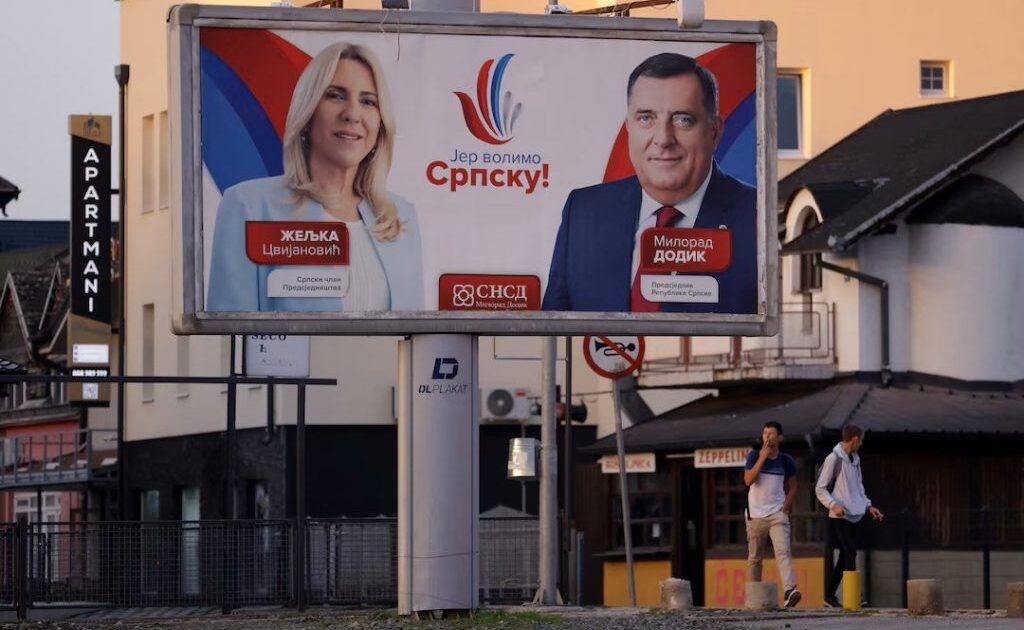
BELGRADE, Oct 5 /ATSH-DPA/ – Nationalist parties continue to be the main political force in Bosnia and Herzegovina, after general elections that, according to preliminary results of the Central Election Commission (CIK), are expected to bring changes to the country’s politics. The vote count was carried out yesterday in more than 90% of polling stations.
Turnout in the elections fell to its lowest level ever recorded, dropping to just 41.5%, from 51.5% in 2022.
Denis Bećirović, from the Bosniak community, and Želka Cvijanović, from the Serb community, were re-elected to Bosnia and Herzegovina’s tripartite Presidency.
The only new member is the representative of the Croat community, Darijana Filipović.
The Social Democrat Bećirović won the race for the seat belonging to the Bosniak representative, with 38.1% of the vote, defeating Bakir Izetbegović, leader of the SDA party, a Bosniak nationalist party based in the Muslim community, who received 34%.
Cvijanović, a Serb and a member of the ruling nationalist SNSD party in the Serb-run part of the country, won by a wide margin.
She received 55.6% of the vote, while her opponent, Marinko Božović of the moderate nationalist SDS party, received 26.8%.
With the election of Darijana Filipović, a Croat and a member of the HDZ BiH party, a Croat nationalist politician becomes part of the country’s highest state institution.
Her predecessor, Željko Komšić, a Social Democrat and non-nationalist, did not run for another term.
Filipović won the seat belonging to the Croat representative, with 48.2% of the vote, against the Social Democrat Slaven Kovačević, who received 28.8%.
Divisions among the nationalist groups
The small Balkan country is largely divided among the parties representing the main communities: Bosniaks, mostly Muslim, who make up about half of the population; Serbs, mostly Orthodox, about a third; and Croats, mostly Catholic, about 15%.
From 1992 to 1995, Bosnia and Herzegovina was engulfed in a civil war, fuelled by Serbia, in which around 100,000 people lost their lives and more than 2 million people were forced to flee their homes.
Since the end of the war, Bosnia and Herzegovina has been divided into two largely autonomous entities with broad self-governing powers: the Federation of Bosnia and Herzegovina (FBiH), where mainly Bosniaks and Croats live, and Republika Srpska (RS), where mainly Serbs live.
Bosnia and Herzegovina has been a candidate country for European Union membership since the end of 2022.
A peculiarity of Bosnia’s electoral system is that the Serb member of the Presidency is elected only in the Serb-run part of the country, while the Bosniak and Croat members are elected by voters across the whole Federation of Bosnia and Herzegovina.
This means that Bosniak voters can also vote for the Croat candidate and can elect a Croat candidate who is not a nationalist. This has happened several times in previous elections too.
Besides the three members of the state Presidency, voters yesterday also elected the federal parliament, the parliaments of the two largely autonomous entities – Republika Srpska and the Federation of Bosnia and Herzegovina – the president of Republika Srpska and the 10 cantonal parliaments in the Federation of Bosnia and Herzegovina.
Because of the very complicated constitutional system and the negotiations to form governing coalitions, which usually last for months, yesterday’s election results offer little possibility of predicting what the country’s governance as a whole will look like.
The separatist strengthens his power among the Serbs
In the Serb-run part of the country, Milorad Dodik’s SNSD further strengthened its power.
Savo Minić, the SNSD candidate, won the elections for president of Republika Srpska.
Meanwhile, the SNSD remains the main force in the parliament of Republika Srpska, taking 39% of the vote, up from 34.6% in 2022.
Dodik, who for years was president of Republika Srpska, was removed from office last year by a court in Sarajevo because of separatist activities aimed at detaching Republika Srpska from the state of Bosnia and Herzegovina.

Komentet
Bëhu i pari që komenton!
Lini një Koment të Ri
Për t'u përgjigjur një komenti specifik, kliko butonin 💬 Përgjigju poshtë atij komenti.