Damati: On Appeal the Verdict Can Change — the Four Former KLA Leaders Could Even Be Fully Acquitted

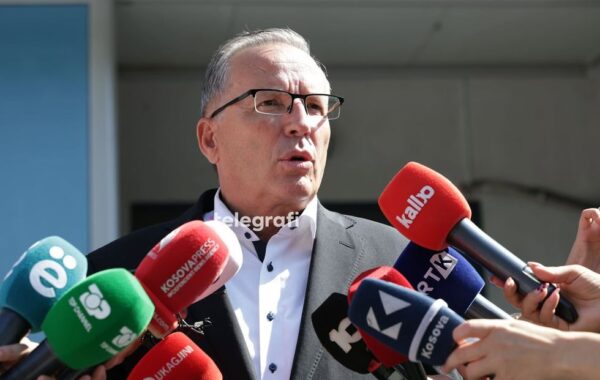
Following the Hague Specialist Chambers’ verdict against the four former Kosovo Liberation Army leaders, lawyer Musa Damati explained the legal procedures that follow and the possibility of appealing the verdict before higher levels of justice.
Damati stressed that, above all, it is important to distinguish between individual criminal responsibility and the Kosovar people’s war for freedom and independence.
“First, it is important to clarify, and crucially so, that the Hague verdict did not criminalize the movement and the efforts of the Kosovar people in the war for independence and freedom against the Serbian occupier,” Damati stated.
According to him, another important element is the verdict’s content regarding the charges of crimes against humanity.
“Second, it is also important to stress that in no part of it did the Hague verdict prove the prosecution’s charge concerning alleged crimes against humanity. So there is no proven charge of crimes against humanity,” he said.
Damati also drew a comparison with the verdicts of the International Criminal Tribunal for the former Yugoslavia, noting that in that process crimes committed against the civilian population in Kosovo were examined and established.
The lawyer further stressed that the first-instance verdict is not final and that the parties have the right to appeal it.
“The decision is not final; it can be appealed, and I naturally believe it will be appealed. The second instance has the competence and jurisdiction to change this verdict,” Damati stated.
According to him, the Court of Appeals may intervene in the first-instance verdict in various ways, including changing it, softening the criminal sanctions or even fully acquitting from criminal responsibility, if the legal grounds for such a decision are established.
“So the verdict can be changed, the criminal sanction can be softened, but they can also be fully acquitted of criminal responsibility,” he said.
Damati clarified that the legal battle does not necessarily end with the second-instance verdict.
According to him, after the appeal, under certain circumstances, there are also extraordinary legal remedies at the third instance.
“The right of appeal, in addition to the second instance, also includes continuation to the third instance through extraordinary legal remedies,” Damati stated.
He assessed that the process requires major legal commitment and that the final verdict may differ from the first-instance one.
“The legal battle continues and requires serious legal work, and the eventual final verdict could be completely different from the preliminary first-instance verdict. This happens not infrequently in legal practice,” Damati concluded.
It is worth noting that on Wednesday the Specialist Chambers sentenced the four former Kosovo Liberation Army leaders to a combined 81 years in prison.
Hashim Thaçi was sentenced to 25 years in prison, Jakup Krasniqi to 25 years, Kadri Veseli to 18 years and Rexhep Selimi to 13 years.
The trial panel stressed that each of the four accused bears individual criminal responsibility for the war crimes of unlawful or arbitrary arrest and detention, cruel treatment, torture and unlawful killing. /Telegrafi/

Komentet
Bëhu i pari që komenton!
Lini një Koment të Ri
Për t'u përgjigjur një komenti specifik, kliko butonin 💬 Përgjigju poshtë atij komenti.