
FULL SPEECH / From Artificial Intelligence to the “Flamingo Revolution”: Rama’s 25 minutes at the UN podium
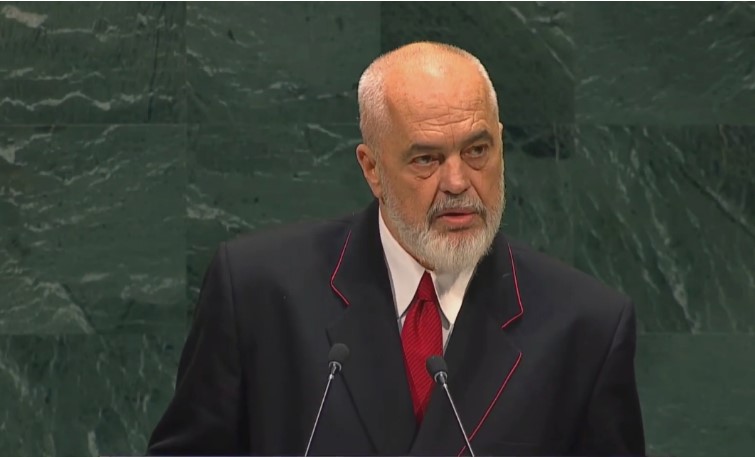
Prime Minister Edi Rama delivered a 25-minute speech today from the central hall of the UN Assembly, touching on several hot geopolitical topics and domestic current affairs, basing his narrative on Artificial Intelligence, which was also the organization’s keyword.
He recalled that Albania’s government was the first to deploy Artificial Intelligence in the executive, with minister Diella, and also denounced fabrications through the “flamingo revolution” and the manipulation of the masses via social networks and even AI.
Edi Rama’s full speech:
“It seems it is my turn to preach in this desert where we gather every year, and this turn has come, and I take it as a privilege of the few.
Mr. President,
Dear representatives of the peoples of the United Nations,
I was very positively surprised that so many friends wanted to know about what is happening in our country with artificial intelligence, and I thought it was a good idea to share my thoughts on this with you.
Gunpowder changed the battlefield. Nuclear fission changed the meaning of human survival. Artificial intelligence is changing something even more intimate. Who can enter a citizen’s mind, imitate a trusted voice, produce a reality calibrated on a person’s fears, and do it millions of times at the same time?
Albania is not a developer of cutting-edge language models, but we are a nation that has already lived the future that others are still debating. I think the message we owe you is an extremely simple one. The immediate and greatest risk is not that artificial intelligence will stop obeying humanity. The greatest risk is that it will obey the wrong individual perfectly. The challenge comes on three levels, in three layers. What does it do in our country? What does it do to us, and who gains the power to reach us. First, what does it do in our country?
In fact, public debate imagines machines that wake up, have ambitions and turn against their creators, but the systems we face today do not wake up with hatred in their hearts. They multiply ours. They have no ambitions of their own, but they serve the ambitions of others. They carry no flags, but they can be deployed by a state. They do not tell lies for their own interest, but they can tell billions of lies on others’ behalf.
The machine has no conscience, but it can borrow a government’s reach, a weapon’s precision and a friend’s intimacy. And at the same time, the economic incentives surrounding artificial intelligence increasingly reward replacing human effort instead of expanding and growing human capacity.
“Write the code so I don’t have to understand it.”
“Draft the report so I don’t think through it.”
“I’m making a judgment, make a decision so I don’t bear responsibility for it.”
When success is measured only by how much work the machine takes away from the human being, we may create more efficient institutions, but we will have less capable humans.
A civilization that outsources ongoing effort may outsource knowledge. A civilization that leaves knowledge in others’ hands may in turn leave judgment in the hands of a civilization that leaves judgment outside — may discover that it has in fact left responsibility in outsiders’ hands, and in fact it is not inevitable, it is a choice.
We can build an artificial intelligence that learns instead of merely responding, that guides instead of merely commanding, and that empowers the human being instead of the human being becoming dependent on it.
The question is not how fast the machine did the work. We must ask the question: what did the human being learn? Who understood the decision? Who can challenge this decision, and who answers for the decision when it is wrong?
Albania became the first country to bring an artificial intelligence instrument into the architecture of government through Diella, our world-renowned minister of artificial intelligence, and we did not do this to transfer sovereignty from humans to the machine. We did it to make public services more accessible, procedures more transparent and the state more accountable.
No machine carries democratic legitimacy and no algorithm inherits constitutional responsibility. Behind every decision with public impact there must remain a legal mandate, a human institution and a name that can be called to answer.
The second layer is what artificial intelligence can do to us. Artificial intelligence inside a country and an accountable state can reduce the distance between citizens and public services. Meanwhile, artificial intelligence outside accountability can eliminate the distance between lies and the human mind. Albania has experienced such a thing firsthand, and I am sure you have followed or simply learned about the so-called flamingo revolution.
The fabricated narrative of an Israeli invasion of the Albanian coast. An invasion that never happened. It was fabricated, personalized and conveyed through voices, pages and channels that citizens already trusted.
One citizen received a story of national betrayal, another heard a story of religious provocation, while another absorbed the conspiracy of a foreign invasion. Different fabrications enter different emotional worlds, all in service of the same strategic lie. The consequences were real. Citizens had their own reasons to protest, don’t misunderstand me, but suddenly they began protesting against a phantom enemy too.
Antisemitic expression entered our public discourse for the first time ever. Don’t forget, Albania is the only country in Europe that ended World War II with more Jews than at its start.
Fear turned into anger. Anger turned into mobilization and fabrication turned into political reality, and it was not a laboratory experiment. I am not talking to you about science-fiction films. It was simply a Tuesday in Tirana, our capital. The algorithm did not invent the target. It was a human actor who did this. The algorithm did not develop, did not ignite hatred, but discovered how to activate our hatred. This is systematic deception as a service. Election interference no longer requires just a television station or a piece of propaganda repeated to the whole population. It can now operate with each voter’s determination. Two neighbors can live on the same street, vote at the same polling stations and live inside completely different realities, each of which has been produced specifically for each of them.
When this happens, democracy does not merely lose a debate or just a round of elections; it loses the common ground on which debate becomes possible and loses the chance to have it.
Sovereignty is no longer eroded at borders; it is eroded through “feeds.” In the 20th century sovereignty meant control over land, territorial waters and national airspace. Today in Europe we are running like mad to add more and more, to throw more and more money we don’t have to protect our lands, to protect our skies from a possible future war, but somehow we forget that in the century we live in, this must also mean a free society’s ability to protect the conditions under which its citizens form their own opinion. Without this ability, sovereignty over land, over skies becomes simply an illusion, and then comes the third layer: distribution.
For entire centuries the greatest threat to freedom of speech was censorship.
Today, freedom of speech is likewise threatened by the weaponization of freedom of distribution. Speech is the right to express an idea; distribution is the power to put that idea before millions of people. Speech belongs to the human being. Distribution can be bought, automated, manipulated and secretly assigned, secretly decided by platforms, corporations, criminal networks and foreign states. The right to speak is universal, but there is no universal right to unlimited and artificially amplified anonymous distribution. When a lie is multiplied billions of times, the truth no longer needs to be censored, because it is simply buried.
The citizen remains formally free to speak, but speaks in a storm that no human voice can withstand.
Freedom of speech, consequently, can suffer defeat without banning a single book, without imprisoning a single journalist and without deleting even a single post.
The answer to bad speech and bad speaking remains more freedom of speech, but the answer to secret and industrial amplification must be exposure, and it must come sooner rather than later.
Who created the message, who paid for it? Was it distributed by humans or by machines?
Why was the citizen targeted? Was the visible public reaction original, coordinated or directed from outside?
To defend democracy and to defend a way of life and each nation’s freedom to live in its own way does not mean controlling what people are allowed to think. It means exposing the hidden powers that seek to control what people are forced to see. If we defend freedom of expression while leaving control of distribution entirely in the dark, then it is the same as defending the door while surrendering the entire room.
Some respond by demanding that artificial intelligence be stopped or slowed down. We are too small, but with more respect we will not agree. A pause by democracies will not bring a pause by dictatorships. A moratorium respected by responsible states will not constrain hostile powers, international criminal networks or manipulation industries. We cannot regulate ourselves into powerlessness.
For this fundamental strategic question, the US president is right: we must not stop, we must accelerate, but acceleration must have a direction. We need an artificial intelligence that is verifiable, transparent and accountable, built by free societies, shared among allies and placed in the service of citizens.
The counter-response to the weaponized use of automation is not technological surrender; it is democratic capacity, it is sovereign capability, it is good artificial intelligence in the hands of those who remain accountable to legislation.
Sovereign artificial intelligence does not mean isolation; it means that no country should be powerless before systems it cannot understand, control or accept without challenging them.
Every country must be able to protect its own language, authentic communications, authenticate public communications, detect coordinated manipulations, preserve data and inform its own citizens without depending entirely on the commercial priorities of a distant corporation.
That is why Albania, on its microscopic scale compared to this gigantic challenge, is building a digital mirror supported by artificial intelligence.
The mirror will identify manipulation in real time, will test claims against authorized information, will detect coordinated structures — not only what is seen, but also how and why it reached them.
It will not tell citizens what to think. Truth cannot be decreed by any government. It must be data-backed. Drawn from the right sources, tested, challenged and openly defended. Our mirror does not aim to become an arbiter of opinion. It aims to become a transparency infrastructure. It does not seek to create a ministry of truth, far from it, but seeks to protect society against an industry of lies. Consequently, Albania calls for an international agreement on sovereign and democratic artificial intelligence.
First, citizens must know when impactful political content has been artificially generated or manipulated in its content.
Second, the distribution architecture must become transparent. Citizens and states must be able to know who created, financed, targeted or artificially amplified impactful political content.
Third, every impactful use of artificial intelligence by a public institution must preserve a clear chain of human legal accountability.
Fourth, democracies must create a joint early-warning system so that data on AI-driven manipulation can travel among all like-minded countries as fast as the manipulation itself. As smaller countries with small languages, they must not be left out of this protective “architecture.” Digital sovereignty cannot once again be a privilege reserved for the richest states.
Lies “travel” without visas. Lies don’t care about walls, about border controls. Algorithms cross borders without needing any passport and without fear of any kind of government. Those who attack our countries already cooperate across jurisdictions. Our countries, our democracies first and foremost, must learn to do the same. This is not ultimately a race between humanity and machines; it is a race between different human purposes, each amplified by machines; between those who use Artificial Intelligence to illuminate and those who use it to sow darkness; between those who use it to empower people, their citizens, and those who use it to manipulate them; between those who accept responsibility and those who hide behind automation. You should not fear that machines will become more human. We should fear that human beings become invisible behind machines.
Dear friends, every generation is called to defend freedom on a territory where freedom is under threat. For one generation the territory was the battlefield, for another it was the ballot box. For ours it is very clear: it is the human mind. Let us ensure that no citizen is left alone against an ever more terrifying algorithmic army; let us ensure that no small nation is forced to borrow the meaning of reality from outside its own borders.
Let us ensure that no democracy wakes up without any elections to discover that its citizens exercised their freedom of choice inside a world secretly designed for them by someone they cannot even see and don’t know is the power behind their choice.
Artificial intelligence will not decide whether this century belongs to freedom or manipulation. We will decide. The machine will obey. The question is whom will it obey? Under which law and in service of which human purpose.
Albania has made its modest choice. We have chosen acceleration, not surrender. We have chosen innovation, not abdication. We have chosen the growth, not the atrophy, of human capability. We have chosen freedom of expression. We know what it means to live without it. And precisely because we have chosen it, we refuse to confuse it with the uncontrolled freedom of machines, money and foreign powers to reach everyone everywhere without any accountability. We choose truth not because truth is always easy or comfortable, but because without a shared commitment to reality we cannot have a shared public life. And without this commitment by all of us to the reality of the world we live in, we will be engaged. We will be implicated in the most terrible betrayal that the parents of this world in human history will have committed against their children. And without a shared world there can be no United Nations.
Here ends my preaching in the desert, and the hope I have that it is in fact the last place I lean on.
Thank you!”
Komentet
Bëhu i pari që komenton!
Lini një Koment të Ri
Për t'u përgjigjur një komenti specifik, kliko butonin 💬 Përgjigju poshtë atij komenti.