
Giant chair sculptures spark an originality clash at The Armory Show
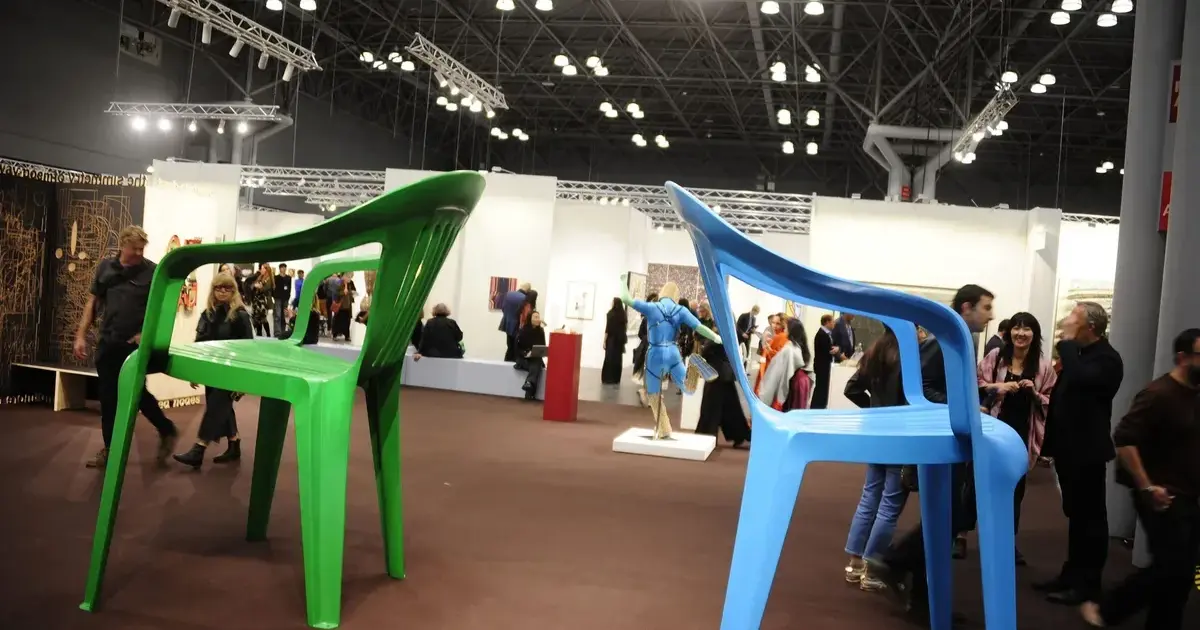
Two colossal chair sculptures exhibited at The Armory Show in New York have ignited an originality dispute between two artists, as USA Art News reports, based on Artnet News reporting. The fair, whose 2026 edition closed on Sunday at the Javits Center, presented the works in its “Platform” section devoted to large-scale sculpture. The works in question are “Nuestra Silla (Our Chair)”, 2026, by Lucia Hierro — stainless-steel sculptures, about 2.3 metres tall, giant blue and green chairs that reproduce, on an enlarged scale, the folding plastic chairs common on the porches and sidewalk domino games of New York’s Dominican neighbourhoods. Hierro, a New Yorker of Dominican origin, produced the work with the Marc Straus gallery; the fair’s website describes the chairs as coming from the life of Dominican porches.
The debate erupted shortly after the fair opened for VIPs, when friends of the artist Kuril Chto (real name Andrey Zaytsev, born in St. Petersburg, Russia, who left in 2017 and lives in Lisbon, Portugal) began tagging him on social media in photos of the giant chairs, thinking they were his. Chto is the author of the sculpture “Blue Chair XXL”, about 2.4 metres tall, which he calls “Monobloc” for its single-mould construction; the work has been exhibited since 2023 (Galeria Foco, Lisbon 2023; the CAN: Contemporary Art Now fair, Madrid; and during the 2024 Venice Biennale in “Under Jove’s Protection”, presented by New York’s Bahnhof Gallery). His partner and manager, Tania Pinchuk, said he was left “truly stunned and in disbelief”; together they discovered that the chairs were Hierro’s. For the Venice edition (themed “Foreigners Everywhere”), Chto had explored the Monobloc as an object of the emigrant and the traveller, comparing it to his own migration experience; the project continues and he has submitted the sculpture to public calls for public art, including in the U.S. — which makes the situation particularly painful for him.
Hierro responded to Artnet saying she had sent Chto a direct message explaining that she had never seen nor known his work, expressing interest in the different histories of this chair and offering discussion; she described the case as a genuine instance of “parallel thinking”. The Marc Straus gallery said: “This idea that maybe she took it from something she saw is nonsense. These chairs were part of her everyday life. She transformed them into this iconic work.” According to him, Hierro had conceived the idea years earlier but lacked funding until his involvement; the stainless-steel chairs, about 500 pounds each, were produced and “powder-coated like a really good car” in China, then shipped China–Los Angeles–by truck to Newark, New Jersey–Javits Center (a logistical “nightmare”, in his words). The Marc Straus gallery announced the sale of all five of Hierro’s chairs at $85,000 each, three of them bought by unidentified museums; three other chairs (yellow, orange and white, not exhibited at the fair) are kept in a warehouse in New Jersey.
It should be noted that neither of the two artists invented the idea of monumentalising ordinary furniture — both follow the tradition of Robert Therrien, who since the early 1990s began turning household furniture into imposing sculptures; “Under the Table” (1994), a kitchen table with chairs nearly 10 metres tall, is part of museum collections, including The Broad in Los Angeles.
Komentet
Bëhu i pari që komenton!
Lini një Koment të Ri
Për t'u përgjigjur një komenti specifik, kliko butonin 💬 Përgjigju poshtë atij komenti.