
The “200 meters” that freed Gotovina — and the lesson for the KLA four
Markač was sentenced to 18 years in prison. The third defendant, Ivan Čermak, was acquitted.
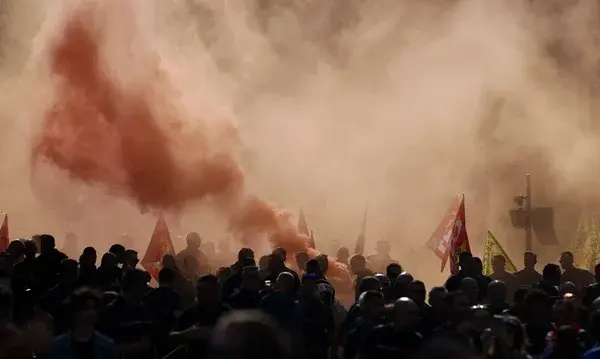
The verdict sparked anger and disbelief in Croatia, where the two generals were widely seen as heroes of the war of independence.
“A decision without evidence, purely political,” said Danica Krivić, a pensioner from Zagreb, at the time.
But the battle that would change the outcome would not be fought on the streets of the Croatian capital. It would be fought inside the verdict itself.
The “200-meter standard”
When the defense appeared before the Appeals Chamber in May 2012, it focused on a very concrete element: the so-called “200-meter standard”.
At first instance, the judges had used this distance to assess the artillery attacks in Krajina.
Strikes landing more than 200 meters from an identified military target had been used as evidence of unlawful attacks.
Payam Akhavan, then part of Gotovina’s defense team, says that precisely there lay one of the decisive weaknesses of the verdict.
According to him, the 200-meter threshold was not supported by evidence, but had become a key link in the reasoning that tied the attacks to the joint criminal enterprise.
“It was exactly that wrong premise that became the basis of the whole theory of the joint criminal enterprise. But the whole case was like a house of cards, and as soon as the ‘200-meter’ card was pulled, the entire structure collapsed. Fortunately, everything ended well. The Appeals Chamber accepted that a trial chamber cannot simply invent evidence,” Akhavan tells Radio Free Europe‘s Expose program.
The Appeals Chamber was unanimous that the 200-meter standard had been wrongly applied.
But on the consequences of this error, the judges were divided.
By three votes to two, the majority concluded that, without that standard, the finding of unlawful artillery attacks did not stand. Thus the finding of a joint criminal enterprise fell too.
On 16 November 2012, the sentences were overturned and Gotovina and Markač were acquitted.
“This is our joint victory. In the war we had ‘Storm’, and this was our legal ‘storm’. We won and everything is over,” Gotovina said after the decision.
The verdict, link by link
After what Gotovina called a “victory”, there were whole months of preparations to dissect the verdict and find the point where it could be challenged.
Akhavan says this required that the evidence and the law be seen from a new perspective.
“I think it is very important that the evidence and the law be seen with fresh eyes. That the chain of evidence and the legal reasoning on which the finding of a joint criminal enterprise was based be examined link by link,” he says.
In practice, seeing the case with “fresh eyes” also meant expanding the team.
Tomislav Kuzmanović, then part of Markač’s defense, says that for the appeal two new lawyers were also hired — Kai Ambos and John Jones — to analyze the verdict from another angle.
The teams of Gotovina and Markač, meanwhile, coordinated strategy where their interests met.
“I still remember the conversation I had with [Gotovina’s lawyer] Luka Mišetić after the first-instance decision, about the so-called 200-meter standard, which had appeared out of nowhere. We immediately understood that precisely there we had to start the appeal. We had common issues in defense, but each team had its own approach. Each challenged the court’s findings in its own way, but our approaches complemented each other,” Kuzmanović recalls for Expose.
The argument did not remain only in the lawyers’ hands.
The defense also sought to test the 200-meter standard from the military point of view. One of the experts engaged was Geoffrey Corn.
“From the military point of view, this standard was arbitrary. There is no military rule according to which every strike falling outside a certain distance from the target is automatically considered unlawful,” says Corn, now at the University of Texas School of Law, for Expose.
What did the Croatian state do?
Building such an appeal also required something else: resources.
After the conviction, the Croatian state’s support became clear publicly as well.
The then prime minister, Jadranka Kosor, called the finding of a joint criminal enterprise unacceptable and said the Government would use the legal possibilities for it to be overturned on appeal.
The Government also engaged the Croatian Academy of Legal Sciences for a study on this concept.
Radio Free Europe tried to contact Kosor and Gotovina himself, but received no response.
The Minister of Justice in the key period of the appeal, Orsat Miljenić, replied that he does not wish to comment on this topic.
Marko Milanović, professor of Public International Law at the University of Reading, says the Croatian state’s support went beyond financing.
It included investigators and experts, but also access to state documents, including materials from the Brioni meeting, where, just days before Operation “Storm”, the Croatian leadership discussed and finalized the plans for it.
The transcript of that meeting became one of the key pieces of evidence in the trial against Gotovina.
Milanović says the Croatian state also had a broader interest.
“They were defending a narrative, an official version of the truth. In Croatia’s case, it was the version of the truth of the Croatian political elites. So, it wasn’t only the fate of those individuals that mattered, but the cause as a whole,” he tells Expose.
But the state’s support and the defense’s strategy were not the same thing.
The lawyers who worked on the case say Croatia provided financing and resources, but that the legal decisions remained with the defendant and his team.
“In a criminal process, the defendant is the one who decides. He must give instructions to the lawyer. And now, since 14 years have passed, I can say that in this respect there was no problem in the relationship between the defense team and General Gotovina,” says Akhavan.
From Gotovina to Thaçi and the others
Now, the turn for appeal belongs to the former KLA leaders: Hashim Thaçi, Kadri Veseli, Jakup Krasniqi and Rexhep Selimi.
All four were convicted on 16 September for war crimes, with sentences ranging from 13 to 25 years in prison.
The court found that they had contributed to a joint criminal enterprise, while the defense warned it would challenge the verdict.
In the debate over what may happen on appeal, the Gotovina case has returned as a point of reference.
But how far can this comparison go?
For Corn, the difference is essential.
“In the Gotovina case, the issue was not whether he bore responsibility for the actions of his subordinates. As the commander of the operation, that was taken for granted. The issue was whether their actions constituted violations of the law. With Thaçi it is different. It is not contested that KLA members committed violations of international humanitarian law. The question is whether Thaçi bears responsibility for those violations,” says Corn.
This means the Gotovina experience cannot be copied.
But one lesson from it remains: the appeal must find the point where the evidence and the legal reasoning do not hold.
With Gotovina, that point was the “200-meter rule”. With Thaçi and the others, the defense must look for whether, within the reasoning that links them to the crimes through the joint criminal enterprise, there is a link not supported by evidence or by law.
“It may happen that a single, but decisive, premise is wrong, and its overturning leads to the collapse of the entire finding of a joint criminal enterprise. In some cases, it may be a factual finding not supported by the evidence; in others, it may be an error in law,” says Akhavan.
A team built for appeal
This is why Kuzmanović sees the appeal phase as a job of its own.
According to him, it requires a team built specifically to dissect the verdict and identify errors that could affect the outcome.
“In my opinion, it is very important that they have strong teams for appeal and sufficient support. I believe Kosovo has allocated considerable resources for the defense teams. This support must continue, and even grow, so that they have a real chance on appeal. They can also do what we did: engage outside experts, for another perspective and additional support. For us, this was very useful,” says Kuzmanović.
Radio Free Europe sought to speak with Luka Mišetić, Thaçi’s lawyer, who had also defended Gotovina on appeal, to understand what from that experience might be relevant for the phase now awaiting the defense of the KLA four.
But Mišetić said he does not plan to give interviews in the near future.
Radio Free Europe also asked the Government of Kosovo what concrete steps it plans after the verdict, but received no response.
Prime Minister Albin Kurti, however, publicly promised support for the coming phase.
“The Government of the Republic of Kosovo is committed to providing support, in every way and with all the means at its disposal, with the aim of correcting the verdict of the Specialist Chambers against the former KLA leaders, which is legally and morally unjust and historically and factually inaccurate,” Kurti wrote on Facebook.
What this support means concretely, the Government did not clarify.
But if the Gotovina case offers a lesson, it is not that a heavy sentence is necessarily overturned on appeal.
It is that the appeal is won or lost inside the verdict itself: in the evidence, in the law, and in the links that connect them.
Akhavan says this requires that emotions be set aside and the verdict examined calmly and methodically, to build the strongest possible argument.
Because, as he says: “The game is not over yet.”

Komentet
Bëhu i pari që komenton!
Lini një Koment të Ri
Për t'u përgjigjur një komenti specifik, kliko butonin 💬 Përgjigju poshtë atij komenti.