
Wiretaps, phone checks and limits on publishing case files, Rama on the changes to the Criminal Code: The fight against corruption is not being softened
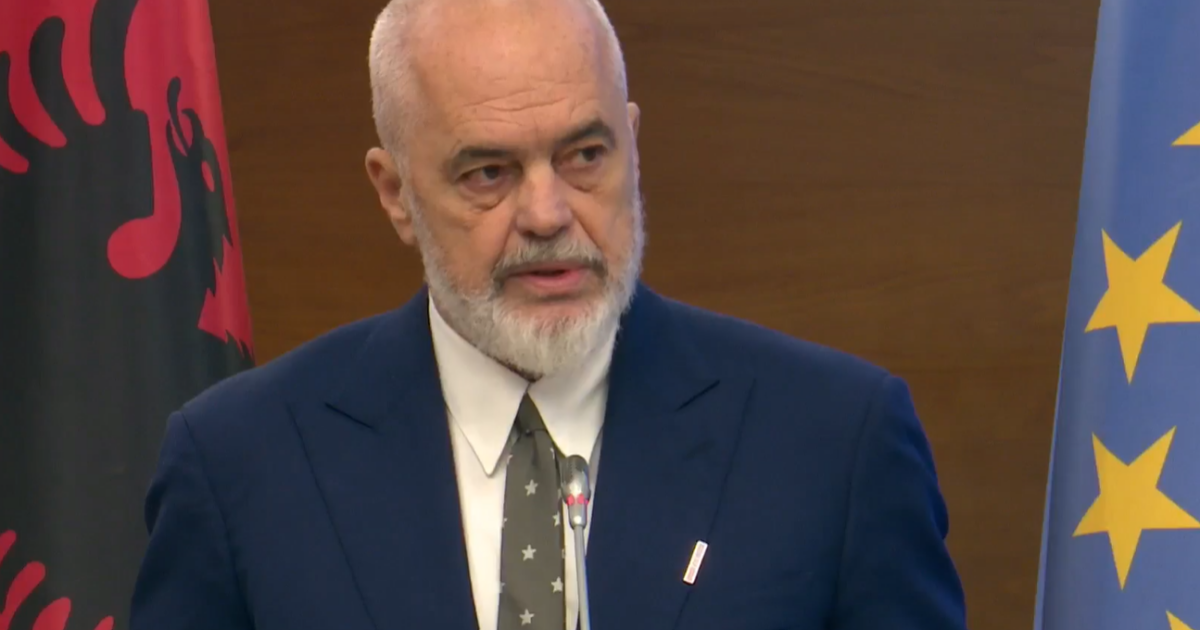
Prime Minister Edi Rama today presented the changes to the Code of Criminal Procedure, included in the New Package of Procedural Guarantees, which touches about a fifth of the Code and contains 105 articles.
According to Rama, 19 academics and magistrates from Italy, France and the Netherlands were engaged in drafting the package, together with experts of the Council of Europe, with the support of the justice ministries of Italy and France. The Albanian technical secretariat, according to the prime minister, coordinated the work.
According to the package presented by Prime Minister Edi Rama, for offences with a maximum sentence of under 5 years, imprisonment on remand will not be imposed, while the prosecutor will have the obligation to also investigate the circumstances that exonerate or favour the person.
The changes also affect phone checks and wiretaps. The police and the prosecution may seize a device, but opening, copying or processing its content will require prior authorisation from the court.
As for wiretaps, it is envisaged that only the communications related to the investigation will be transcribed.
The package also sets rules for the presumption of innocence and the publication of investigation materials, including restrictions on the publication of wiretaps and of certain data.
According to Prime Minister Rama, responsibility for disclosing the secret will not fall on the media, but on the person who has the legal obligation to keep it.
Rama stated that these changes to the Code of Criminal Procedure do not remove the prosecution’s powers to wiretap, check, seize, investigate assets or cooperate internationally, “but they change the way these powers are exercised and strengthen what we dramatically lack, the court’s control over them.”
The package of changes will not soften the fight against corruption and organised crime.
“For corruption, organised crime, terrorism, trafficking, crimes with weapons or serious violence and the cases of the Special Court, special regimes are preserved.”
Prime Minister Rama’s full speech:
“Honoured representatives of the Council of Europe and especially, honoured Gianluca,
Honoured professors who have come from Italy, France and the Netherlands,
Ladies and gentlemen magistrates, lawyers, excellencies, ambassadors,
Exactly ten years ago, in 2016, the Assembly of Albania turned into an act the boldest aspiration of our programme for an Albanian Renaissance. We changed the Constitution and legislated the liberation of justice from political power, after a chronic dependence that had lasted since the day of the founding of the Albanian state, in 1912.
The Justice Reform demolished the old edifice of the judicial power and raised an entirely new architecture. It created new institutions of self-governance of the judiciary, a special superstructure for the fight against organised crime and corruption, a salary system much higher than the top of the state pyramid and a unique Vetting process, as the foundation of the new path of Albanian justice.
Today, after ten years, we have seen, heard and learned a lot. We have seen the strength of the reform, but also the weaknesses that emerged from the confrontation with reality. We have seen results that once seemed not impossible, but could not even be imagined. But we have also seen failures and deformations that cannot be hidden behind the results. Nevertheless, beyond every difficulty and vicissitude, the burden of the great turn through the Justice Reform has been worth all the rent, as the saying goes. One sentence sums up all the good of this reform, as brutal as it is beneficial: Ten years demolished the century-old cult of impunity.
Honoured guests and dear friends,
Ten years ago, we handed the judicial power the sword of punishment, which for a hundred years had remained in the hand of political power. Today we want to take another step, more modest in size, but no less meaningful in purpose.
We want to give more balance to the scales of justice, so that the judicial power never makes the law above justice, but justice is always the force of everyone’s equality before the law. This is the essence of the new package that we present publicly today and which its own highly honoured co-authors have called the “Package of Procedural Guarantees”.
After the adoption of the Code of Criminal Procedure in 1995 and the changes that accompanied the Justice Reform, this is the first intervention that addresses in such a complete and organic way the presumption of innocence in the criminal process.
Put in my words, this means that if until now we have mainly strengthened the side of the scales where the power of the state over the individual weighs, in this package we give the deserved weight to the side where the power of the individual’s right vis-à-vis the state stands.
The start of discussions on this package was prompted by the alarm raised by the European Committee for the Prevention of Torture and other European and international mechanisms, which put before us a harrowing mirror: in Albania, the scales of justice tilt very noticeably toward the repressive weight of the state.
Even today, if you ask an Artificial Intelligence model which country bears the heaviest burden of pre-trial detention among the systems of the entire European continent, the answer comes back very bitter: Albania.
The Council of Europe’s latest report, on the situation as of 31 January 2025, shows that almost 62% of the people in Albanian prisons are pre-trial detainees. That is, they are kept in prison for what they are accused of, not for any sentence they have received. The European average of pre-trial detainees on the same date was 26%, or in other words, Albania was more than twice as bad compared to all of Europe.
In Greece 24.8%, in Serbia 21.5%, in North Macedonia 14.3%, in Romania 12.4% and in Bulgaria 7%.
So this is not some regional curse, nor some unavoidable Balkan record. It is a very serious Albanian problem, which the Assembly of Albania must address on paper without wasting time, and we must accept it as a common challenge to be won, by the judiciary and the executive — we, by ensuring the financial and logistical support for further improving the judiciary’s working conditions, and the magistrates by dedicating themselves to implementing this package of guarantees as a mission of national dignity.
How can we accept the fact that the comparison with Russia is even more shocking? There, in the homeland of repression, where pre-trial detention is routinely decided with a phone call, pre-trial detainees are 30% of the prison population. 30%. That is, not even half of Albania, which is negotiating membership in the European Union.
Honoured prosecutors and judges,
Please, we cannot continue with such figures, behind which there are people’s lives, family dramas, children’s traumas and sometimes irreparable consequences not only for those who suffer them, but also for society. We are a very small country and a people who come from a very traumatic history, for us to do to ourselves with our own hands the colossal damage of such a penal policy, which has a negative impact not only on its direct victims, but also on society, which never becomes better or more humane when the scales of justice tilt noticeably toward state repression.
In the general jurisdiction, the average stay in pre-trial detention reaches 253 days in Albania — more than eight months — against about 155 days in European Union countries, where there are also reasonable limits on pre-trial detention time that are completely missing in Albania. While in the Special Court this time climbs to the unimaginable figure for Europe of 616 days, or more than a year and eight months, compared with Europe’s five-month average. They are groaning figures that speak for themselves.
And it is not that this inhuman calamity was born yesterday, so beware all those who may rush to see this grim reality through the glasses of negativity toward the Justice Reform.
Back in 2006, ten years before the Justice Reform, a study by the OSCE Presence in Tirana found that 41% of pre-trial detainees had not met their defender before the hearing at which the removal of their liberty was decided, while 59% of their lawyers had not been present at their clients’ first questioning by the prosecution.
Let us be very clear: the fact that this evil is old makes the data even graver, because the continuity, the extremely negative inertia, shows us that we do not have before our eyes a consequence newly born of the independence of the judicial power, but we have in our midst an old culture of dependence of justice on the cult of force.
Pre-trial detention, which according to the Constitution and the European Convention on Human Rights should be the last measure, in Albania is the centre of gravity of the criminal process.
The European Committee for the Prevention of Torture, the United Nations, the Council of Europe and the European Court of Human Rights have constantly underlined that pre-trial detention in Albania is routinely requested with ready-made formulas and decided by repeating the prosecutor’s reasoning, without a real analysis of the person’s profile, of the concrete risks that may threaten the investigation or a trial at liberty, and of the possibility of softer measures.
The Strasbourg Court, in a series of cases against Albania, has also found the unjustifiable lack of a real review of the continuation of coercive measures. Therefore this package is a concrete response to a concrete, real and wounding problem that Albania has not with those who are in pre-trial detention today, but with human freedoms and rights, and which is directly linked to Chapter 23 of the negotiations with the European Union.
The package touches about a fifth of the Code of Criminal Procedure and comes as a single, coherent architecture, which rises on one defining principle: every exercise of power in the criminal process must have a clear basis in law, must be proportional to the aim, must be subject to the substantive and not merely formal control of the court, and must produce legal consequences when it exceeds its limits.
Dear Gianluca,
I want to dwell here especially on the invaluable role of your team and of you personally. Your direct engagement gave this work the direction, discipline and necessary European integrity that you have brought, and it is fundamental to the result we have before our eyes. Grazie!
The precious support of the governments of Italy and France opened the doors to first-class expertise, while the contribution of the Italian, French and Dutch professors and magistrates gave the package the comparative depth that such a reform requires.
I want to thank them all, one by one, not only for their indisputable professionalism, but also for their impressive readiness to come to our aid.
This package could not have been a product of our own, because it required high-precision legal technique, as it intervenes at the neuralgic point of the most delicate balance of a democracy: society’s need to protect itself from crime through the judicial power, and the individual’s right to protect himself from the error or abuse of the judicial power over his life.
Precisely for this reason we chose to entrust its drafting to 19 academics and magistrates from Italy, France and the Netherlands, together with Council of Europe experts, with the active support of two ministries, the Italian ministry of justice and the French ministry of justice, while the Albanian technical secretariat did only the coordination of all this very voluminous work.
The 100-odd articles of this package are the fruit of hundreds of hours of work and debate among experts who, not without purpose, come from different legal traditions, under the strict observation of the Council of Europe, which has certified every step, as well as the final document that lies before us to become a basis for public consultation.
There is in those 105 articles no Albanian-style patchwork and no patch exported from abroad. Every solution has been confronted with our Constitution, with the decisions of the Constitutional Court, with the unifying decisions of the High Court, with the jurisprudence of the Strasbourg Court and with European Union law.
The Council of Europe has passed the package through the filter of the Convention and of European standards, assessing it as a project that increases the transparency of the criminal process and genuinely expands defence rights. This is for us the best guarantee that we are undertaking another modernising reform for the justice system and a Europeanising one for the Albanian state, where the criminal process must start from the origin of liberty, not from prison as the origin.
I have told, if I am not mistaken on another occasion too, the episode with Professor Raphaële Parizot, who was placed at our disposal by the French Ministry of Justice as one of the personalities in the field of penal policy. After she saw the ordering of the measures in our Code, she said that we have a conceptual, ideological problem at the very starting point, because according to her, a Code that begins with imprisonment and then descends to the lighter measures teaches the system this ordering and encourages it to always think of prison first.
The new package stands against precisely this logic.
The court must start from liberty, examine the softer measures, assess house arrest, and reach prison only when every other alternative is insufficient.
Thus, for example, for offences with a maximum sentence of up to three years, as a rule, coercive measures will no longer be imposed. For offences with a maximum sentence of under five years, imprisonment will no longer be imposed. The grave nature of the offence, taken on its own, will no longer suffice. Neither the person’s silence nor the non-admission of the charge can any longer be used as evidence of dangerousness. The risk must be concrete, current and supported by facts that relate to the person himself.
The court must make its own independent assessment, and if it copies the prosecutor’s arguments and does not reason why the softer measures do not suffice, the decision is invalid and the judge’s disciplinary responsibility arises.
Whenever detention is imposed, the court must also assess the financial guarantee, calculated of course according to the person’s real financial situation, with the necessary exceptions for risk to the evidence, grave crimes involving violence, terrorism, offences against the constitutional order and the specific cases that fall within the competence of the Special Court.
Every month, the prosecutor must report to the court whether the reasons for the measure continue to exist, and argue them. Liberty cannot be restricted once and then forgotten as if it no longer existed.
The package also strengthens the protection of people in vulnerable situations. Mothers with children up to six years old, the father or guardian when the mother is no longer alive or is unable to provide care, persons over 70 years old, the seriously ill and persons in therapeutic programmes can no longer be treated as if their human circumstances did not exist.
The second major change establishes real equality between the defence and the prosecution.
The lawyer cannot be a decoration in the courtroom and a spectator during the investigation. He must have the right to carry out his own investigations, to take statements, to request documents, to carry out technical verifications and to engage experts.
The materials collected by the lawyer will be presented directly to the judge and will be assessed according to the same criteria of legality and relevance as the prosecution’s materials.
The person will have unconditional access to the evidence on the basis of which his liberty was taken away, and will receive the complete file free of charge before the case is sent to trial. Without this access, the right of defence remains a promise on paper.
The prosecutor will have the express obligation also to investigate the circumstances that exonerate or favour the person. Because the prosecutor of a democratic state does not have as his mission to find a culprit at all costs. He has as his mission to discover the truth at all costs.
The third important change closes a grey area of questioning. A person cannot be summoned as a person with knowledge of the facts and in fact be treated as a suspect, without a lawyer and without guarantees. Whoever is summoned to the Prosecution or the Police, even as a person with knowledge, will have written on the summons sheet the right to appear with a lawyer. When the suspicion against him existed at the moment of questioning, statements taken under a different status can no longer be used against him.
Questioning and the main investigative actions will be mandatorily recorded in audio and video. The justification “when possible” is removed from the Code. If the state questions a person, the state must be able to show at any time exactly how it took his statement and how much it respected his dignity as a citizen during the questioning. And for the first time, it is written without any equivocation that statements or information obtained under torture, through inhuman treatment or degrading behaviour toward the person are absolutely unusable. A state that seeks the truth cannot produce it through violence or verbal pressure on the person.
The fourth change comes as a necessity to protect private life in the smartphone era. The phone is no longer simply a means of communication. It is the archive of a person’s life — of his communications, photographs, movements, finances and relationships. Therefore, seizing the device can no longer in any way be an unlimited permission to read and see everything that its archive contains. The police and the prosecution may seize the device, that is not in discussion, but to open, copy or process the phone’s content, prior authorisation from the court is required. The court’s decision must specify the device, the categories of data, the applications, the period and the search criteria. In urgent cases, also narrowly defined by law, the action must be validated by the court within 48 hours. Any data obtained outside the authorisation is unusable, while any extracted material unconnected to the investigation must be destroyed.
The same logic applies to wiretaps. Only the communications related to the investigation must be transcribed, including those in the person’s favour. People’s private lives, unconnected to the criminal offence, cannot be turned into usable material, as an instrument of pressure or as a media consumption product.
The taking of biological samples and the storage of genetic profiles are also regulated for the first time in a complete manner, with informed consent or a court decision, with the presence of the defender and with mandatory destruction following a final acquittal.
The fifth change gives the investigation a verifiable beginning, a clear object and an end. The proceeding must be registered on the day the prosecutor learns of the offence, not when he deems it appropriate. The person has the right to know that a proceeding has been registered against him and to ask the court to verify the date. If during the investigation another offence emerges, it must be registered as such, as another offence. Investigations hidden away in time, kept in a drawer for years and used as a shadow over someone’s head, can in no way be a routine in a state governed by the rule of law.
Cases that have a real prospect will go to trial. Today’s criterion of “sufficient evidence” is replaced by the standard of a “reasonable expectation of conviction”. The prosecutor must weigh the evidence of the prosecution and of the defence and show why the case has a real chance of ending in a conviction. The criminal process cannot be used as a punishment in itself, taking away someone’s honour and years of life through the courts, when the evidence cannot support any verdict of guilt.
The sixth change is of particular importance, because it takes the presumption of innocence outside the courtroom and makes it a standard of behaviour for institutions. Handcuffing is not a declaration of guilt. The leaking of the investigative secret is not transparency. Trial in the marketplace before the trial in the courtroom is not justice. The publication of the content of wiretaps outside the part cited in the reasoning of a decision, of victims’ identifying data without their consent, of images of persons under physical coercive measures, and of decisions on security measures beyond the limits set by law, will be prohibited. The prosecutor, officer, lawyer or professional who has the obligation to keep the secret and breaches it will have to bear responsibility. This norm does not aim to create a thought police against the media. Responsibility never falls on the media; it falls on the one who has the legal obligation to keep the secret and takes it out of the file. Even the language of official acts must respect innocence. No one may be presented as guilty before a final decision. When this is breached, the person gains a swift remedy for correcting the act.
The package simultaneously strengthens the protection of the victim. For domestic violence and sexual crimes, new measures are created, such as removing the defendant from the home and prohibiting approach or contact, at a distance of not less than one thousand metres and with the possibility of electronic surveillance. When the removal leaves the family without means of subsistence, the court may set a periodic payment in its favour. The victim’s identity is protected and her means of taking part in the process are strengthened. The right to be heard is also strengthened. Decisions in chambers that affect liberty and rights can no longer be taken through an invisible procedure. The parties must be notified, present their arguments and be heard. At the request of the defendant or of the victim and with the court’s authorisation, the hearing may be broadcast live, protecting the rights of third parties and of victims.
Honoured attendees, the most important novelty of this package is not only the establishment of a more reasonable balance between the prosecution and rights. It is the fact that the violation of rights has consequences. A right without a consequence is only a beautiful sentence in the Code and a void for abuse in reality. Evidence obtained in violation of the law cannot be used. An act performed in breach of the guarantees loses its legal value. The court may itself ascertain the violation, without waiting for the party to request it, and alongside absolute and relative nullity, an intermediate regime is created for serious violations of the right to be heard, to intervene and to present evidence. And responsibility can no longer remain nameless. The judge who restricts liberty without his own reasoning, the prosecutor or officer who disseminates protected information, the employee who fails to record the questioning and the officer who abuses flagrancy or urgency must answer personally. A violation remains a violation even if in the end the person is convicted.
And finally, I want to be very clear about what this package does not do, because I can already hear the noise that will begin before many have read the text, and especially from those who will never read the text at all. This package does not touch any pillar of the Justice Reform. It does not remove from the prosecution any power to wiretap, check, seize, investigate assets or cooperate internationally. It changes the manner in which these powers are exercised and strengthens what we dramatically lack: the court’s control over them.
For corruption, organised crime, terrorism, trafficking, crimes involving weapons or serious violence and the cases of the Special Court, special regimes are preserved. This is a conscious choice, because the fight against corruption and organised crime must not be softened in any way.
This package does not reopen closed cases. Acts and evidence lawfully obtained before its entry into force remain valid. The review, within sixty days, of the security measures in force is not an amnesty. It is an individual review by the same court, case by case, with a right of appeal for the parties. Rights have no biography, they have no party, they have no profession and they have no popularity. Rights either hold for everyone, or they are not rights.
The independence of justice is not immunity from the law. Procedural control is not political interference. On the contrary, the more independent justice is, the higher the quality of its reasoning must be and the stricter its respect for the limits that the law sets for it. And we must be just as honest about implementation.
The Council of Europe has left it to us in writing that the weight of these guarantees falls on a judiciary, a prosecution service and a judicial police that have limitations in people, equipment and expertise. Recording in audio and video, the checking of digital evidence, electronic surveillance and the storage of data require infrastructure, require funding and require training.
Therefore, the law will have a reasonable period before its effects begin, which will be accompanied by the training of judges, prosecutors, judicial police officers and lawyers, by the necessary implementing acts and by budgetary support from the Ministry of Justice for the new equipment and capacities. I said it above as well: the executive, in this challenge which I consider a challenge of national dignity — it is a direct affront to national dignity that Albania should figure as the “black sheep” of all Europe, and a “black sheep” that appears twice as distant as all the others — therefore I consider this a common challenge in which the executive has its own responsibility for this challenge to be won jointly, and we will bear this responsibility without any discussion, placing at the package’s disposal everything that is required of us, so that the conditions for its implementation are optimal. The guarantees we adopt must exist in the citizen’s life, not only on the pages of the Official Gazette. This is also the European meaning that this package has.
The European Union is the standard by which the state comports itself when it faces a single person — in a police station, in a prosecutor’s office or in a courtroom, where there are no cameras, where there is no public, and where equality before the law is in fact measured not only among those who are summoned, but also between them and the very representatives of the state governed by law.
The Justice Reform gave Albania a justice system that is not afraid of the guilty. This package aims for justice not to frighten the innocent.
In 2016 we began to put an end to the culture of impunity. In 2026 we must also begin to put an end to the culture of pre-trial detention as an automatic response; of investigation without a deadline, as an arbitrary exercise of force over the individual; and of the process in which the citizen enters as an unequal. Our common motto in this challenge, which is first and foremost a cultural one, must be: Equality before the law holds not only for individuals before the court, but also for the state before the individual in the courtroom. The strength of the state is not shown by the ease with which it applies the handcuffs. It is shown by the rigour with which it reasons every hour of liberty that it takes from a person.
A justice system that says “better a guilty person outside than an innocent one inside” is not weaker, but stronger, more just, more credible and more European.
In the closing words of this speech, I want once again to express my sincere gratitude to the co-authors of this package, who gave it their knowledge, experience and patience.
I want to thank once again the Council of Europe, the Director General for Human Rights and the Rule of Law, Gianluca Esposito, as well as his experts and his team, who ensured that the project was developed within the perimeter of the European Convention and of all European Union standards.
I want to thank the ministries of justice of Italy and of France, certainly our own Ministry of Justice without any doubt, as well as the Albanian jurists of the technical secretariat, who coordinated an extraordinary work in terms of volume and responsibility, and here I want to single out the head of the secretariat, Etilda Gjonaj; her professionalism, her experience and above all her impeccable work discipline guaranteed the success of a mission so challenging, in which 19 foreign academics and magistrates had to be brought together from beginning to end. They have all done their part.
Now it is our turn to turn this work into law, and then the law into a daily guarantee for the citizen.”
Komentet
Bëhu i pari që komenton!
Lini një Koment të Ri
Për t'u përgjigjur një komenti specifik, kliko butonin 💬 Përgjigju poshtë atij komenti.