
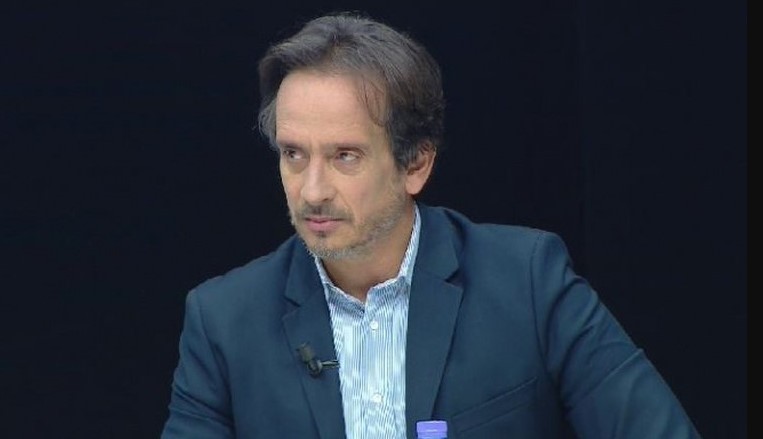
Ben Andoni dissects the political crisis: The flamingos turned into hawks, the opposition comfortable in its role!
We are leaving behind one of those weeks that seem to carry several different political realities at the same time. One of the country’s most sensitive institutions was engulfed in a scandal. Prime Minister Rama delivered his speech at the UN General Assembly, where he spoke about the growing danger of Artificial Intelligence and Albania’s place in a changing world. Parliament once again became part of the political spectacle, while the government opened the debate about the responsibility and the limits of the justice system. All this while outside the institutions a protest continues which, even after whole months, is still failing to articulate what it wants to be.
The stories are different, but together they raise the question of what happens to us when political shocks no longer shock us.
This was one of the topics of the conversation with analyst Ben Andoni on Apostrof. Referring to Slavoj Žižek’s phrase about “enlightened cynicism”, Andoni described a public which, although worried by the scandals, is less and less surprised by them because “today everyone expects the next scandal,” he says.
He also stresses the concern that, although our institutions may function normally, the repetition of such events leads people towards losing trust in them. “We have democracy, but without the demos, without the people,” Andoni says.
The SHISH scandal is one example, but beyond the persons involved, Andoni dwells on what this episode shows about the maturity of our institutions, their protocols and the relationship between the country’s formal commitments — including those towards NATO and European standards — and the way the institutions function in practice.
He was also critical of the current opposition, which he says is extremely comfortable with staying in opposition as long as possible, since according to him it continues to have access, status and influence, without having to take the risk of governing the country. But, although this has driven people away from the political parties, they have not abandoned politics.
The “Flamingo” protests seemed for a moment to offer a solution to this problem. However, 100 days later, Andoni’s verdict on them is harsh: “the flamingos no longer exist”; they have turned into “hawks”. His criticism does not focus on any particular name, but on this protest’s inability to turn into a long-term political organisation. “We find it very hard to organise to bring change,” he says, “but we find it far too easy to organise to complain.”
Andoni closes his argument by returning to the idea that societies often have to face “the bottom” before they can change, although he does not romanticise it. “We must be careful not to go towards this bottom,” he says, while expressing regret that “we are in a period of cynical and contemptuous decadence, which we see every day in our country.”
Can a society spot the signs of institutional fatigue in time to change course, before the crisis becomes the only catalyst?
THE FULL INTERVIEW
We are leaving behind one of those weeks that seem to carry several political realities within themselves. Last weekend we had the scandal with the former head of SHISH, the speech of Prime Minister Rama at the UN General Assembly, which in a way focused on how he wanted to present Albania in the international arena, without mentioning any concrete internal problem or concern. We have a parliament which — this is more of a personal viewpoint — seems ever more theatrical in its behaviour. Most recently we had the changes to the Criminal Procedure Code and, above all these, more than a hundred days of protests. How do you see this political moment we are going through?
Ben Andoni: Really, a chaotic moment. A chaotic moment, and it brings to my mind a definition by Habermas: the system exists, but we cannot trust the system. This is a very big problem. We are in a democratic segment, but in our country, because of the lack of many parameters, the system exists, the structure exists, but this structure is not trustworthy. In our case this is the superstructure, to speak in the language of Marx’s materialism. And the thing that worries me personally, and you put it very rightly, is that the institutions today look like extensions of an abstract power, which finds itself facing individuals who understand it, but cannot interact with it, cannot trust it. And it seems to me this is one of the greatest paradoxes. Mr Rama articulated, in my opinion, very well the part about artificial intelligence at the rostrum of the United Nations. But was that really the biggest problem he could unfold for Albania? We know that the speeches there are routine; there are around 190 representative countries and each country, usually through the prime minister or the president, shows something specific about its own country. Returning to our small part, there is today a very great distance of power and its institutions from the people. In short, we have democracy without demos, without the people. This is the greatest concern at these moments. You said very well that the Albanian parliament with its representatives is almost theatrical, and I believe this metaphor, contrary to what you express, also contains bitterness inside, because it is the country’s main power.
I was struck, at the moment the scandal with Mrs Hyseni and SHISH came out, by the behaviour of a large part of the MPs in Parliament. There was a kind of complete indifference. With the exception of a few who took the floor and debated, almost all the others were involved in personal activities, amusing themselves on social networks, making purchases or looking at products online.
This is truly worrying. Democracy today has a very big problem: we elect people who, the moment they take our vote, no longer represent us. They represent the party leaders. They fail to understand not only the developments, but not even the canons of how the various states function today. In the case of Mrs Hyseni, within the field of the presumption of innocence, action was taken according to some NATO canons: she is dismissed, the president decrees the dismissal and the person is left under house arrest because of the very important remit she holds. Then there is the other part, which is linked to the power of justice, which today is one of the most problematic powers in our country: the most stimulated, the most helped, the most paid, but which turns out to be the most problematic. This power does not know the canons today; the arrest measures have no kind of “hygiene of justice”. It strikes mercilessly even at personages of this remit. The charge is built, there is leakage of the charge — that is another account — it is sent for an arrest measure and ends in arrest. It looks as if two standards are facing each other: the NATO standard and the standard of our justice, which has taken an extraordinary force.
Even when NATO intervened in Kosovo, the planes taking off from Aviano were in Belgrade within a few minutes. You understand what importance we have. Plus, NATO has one of its most important bases, Bondsteel, in Kosovo. In this sense, we have somewhat turned this part of our national security into a fetish. But it has inside a kind of sublimity that people who love the state respect. There are some canons you must respect. And here another problem has emerged for us: besides the remit of NATO and that of justice, we have our institutional immaturity. Every structure of this kind, with this kind of importance, is almost a military structure. Because of the interests of the country it must protect, it must have its organisational matrix buttoned up at every moment. It must have deputy directors, a chief of cabinet, people responsible for specific fields. Just as happens in war: if something happens to the commander, within a few minutes the first deputy automatically takes over the duty. Whereas we have had people for years who are acting officials. Our institutions also lack a protocol framework for such cases. When it comes to institutions of special importance, there must also be a protocol for an arrest. The lady was notified of the measure while she was in a meeting with around 70 of her colleagues. This shows our country as not serious, unprepared and somewhat chaotic.
The meeting of the Security Council was held, called by the President and, according to some media reports, one of the concerns raised, besides the issue of trust in the institutions, was linked to a possible abuse within SHISH, where this institution may have wiretapped SPAK prosecutors linked to the AKSHI case. How problematic is this — that our institutions wiretap each other for interests that are no longer the interests of the state or our interests as citizens?
It is a kind of equation where we have to take something for granted or decide one or two variables ourselves. From the charges that have come out against the lady, for leaking sensitive information and helping a wanted person, and if what is leaking in the media is true, that this service was used for this kind of wiretapping, I cannot say it is the end of our state. But it normally shows that our democracy and the institutions we have raised are very far from that conception Albania has of its own place in the European Union. There is an Albania which de jure is in the process of the European Union. But we both know very well that the chapters part is also a completion of the legal framework, while from inside this state has endless problems. This speed with which the European Union is pushing Albania cannot go with the slow movement of the turtle that our country has towards democracy. When you look at Albania, the famous paradoxes of Zeno come to mind: Achilles cannot catch the turtle. This is Albania’s work. We have a dizzying acceleration in what Mr Rama shows about the European Union, while the reality with the standards is completely different. The standards, especially in recent weeks, are weakening extraordinarily.
There is something that attracts me here: the perception we have inside about our country and the perception we create in the international arena. It seems as if our politicians — certainly the majority and the prime minister with the international successes and integration, but also the opposition on the other hand — seek ever more a kind of international legitimacy and do not worry as much about the lack of legitimacy inside the country. Do you see it this way and, if so, why?
Yes. Into this equation of Albanian democracy there has entered for more than a hundred days a protest which, for the sake of truth, is falling, falling and falling, creating a kind of public disappointment. But it has really taken upon itself a part of the opposition. From my long history in journalism, this present opposition is among the only oppositions in our country that cannot get enough of staying in opposition: they are richer, more valued, they perhaps have more access to power than when they were in power themselves. Mr Rama holds all the lightning bolts with a few people close to him, while they are in the most comfortable position. If you look at the protests, Albania today has people who no longer want the political parties, but want politics, because the protest is political. This opposition together with Mr Rama have done this to the country: they have devalued respect for the political parties. Especially on the platforms where many people communicate, you have political concepts, but you have hatred for the political parties. This is a very big concern, because you must have ideas, but these ideas you must formulate and materialise. The idea is abstract, but it must turn into a material subject, into a construction of state: as a building, as an institution and as rules. These at this moment are missing. Therefore this opposition today is a very satisfied opposition, which has remained outside the interests of the country.
Something we seem to return to constantly in the public debate is the continuous accumulation of scandals. One thing strikes me: we are all shocked when we hear them, but in a way none of us is surprised any more.
I believe it is one of the greatest paradoxes of this part of democracy. Žižek, I think, called it “enlightened cynicism”. The scandal happens, we are amazed for the moment and then it no longer makes an impression, because every individual today expects the next scandal. And, on the other hand, asks: how much will this scandal affect his life? Today scandals no longer make an impression because a part of them do not directly touch our life, although from the moral and ethical side they touch many elements that indirectly touch us too. People today have a kind of pragmatism for survival, to orient themselves in this world. Bear in mind also the entry of artificial intelligence: it has made whole generations or communities feel excluded. Surprisingly, Albania, one of the most backward countries in cybernetics, is entering artificial intelligence with extraordinarily fast steps, but not necessarily in the fields that affect its development. I did my practice in Liverpool, in the Range Rover production chain, and we were amazed by the robots of that time. Ten years later, in England and the United States they talk about completely different things: about the philosophical dimension of artificial intelligence, how much it is entering our life and how much it is touching our mental structure. Here we still see colleagues who simply write with artificial intelligence.
Yes, they are more and more.
More and more philosophers, psychologists, sociologists. And we are using it to highlight a very false protagonism. I thought a time would come when it would at least help our education system, fix some problems that we cannot fix because of the great lacks in formation, in public empathy and, above all, in the vision to build a state. I am sorry to tell you that, 114 years later, we are still in the process of state formation. And this process leaves extraordinarily much to be desired.
Another development linked to the discussion about the institutions is the proposed changes to the Criminal Procedure Code. From what I have read, a good part of them in principle are hard to oppose or to say they are unjust, especially those linked to pre-trial detention. I want to ask you first: how do we build a justice system where taking away someone’s freedom before they are convicted becomes a kind of predetermined response?
I believe our reforms have always lacked something important. This has been felt since the raising of the Albanian state, since the time of the First Republic and then in the time of the Kingdom. Our codes were taken from abroad and, just like today’s reform with foreign influence, they often do not take Albanian anthropology into account. And when I say Albanian anthropology, you must bear in mind the anthropology of the wrongdoer, of the offender, but also of the person who judges over them. Not all are wrongdoers; people can also make mistakes unintentionally. In a part of the people who run our justice you do not find interpretations that link the development of Albanian society with the law. In this sense it is impossible to make reforms just by changing papers. You can make endless reforms, but if you do not bear in mind how the Albanian individual has evolved, you have a handicap. And you cannot blame only this government, because it is a carried-over fault: by damaging the school, the institutions, by having an Academy of Sciences that vegetates, by not raising vital problems such as: what should Albania be like after twenty years? When we move to the justice system, the codes must respond to the problems of a country at a given time. When I saw the representatives of the justice system and, on the other hand, the very declamatory part of Mr Rama, I saw a very great division of the executive with the power of justice. Both of these powers are very far from the Albanian of the 21st century. Real studies of what is happening with the Albanians and with justice today are missing. Nevertheless, I think the intervention, at least of the executive in this case, is right, because some things must be limited. We cannot have those percentages of pre-trial detainees, which in the end also harm the Albanian taxpayer.
There is also a kind of paradox. For years the public has demanded that persons considered untouchable be punished: important politicians, important officials of governments. Now the moment has come when we are seeing that these once untouchable persons are being touched, although we have not necessarily yet seen final convictions or confiscations of wealth gained through corruption. How can we have this conversation without dividing into two camps: one side that considers the changes a blow against SPAK and the other side that sees them as legitimate concerns about human rights? Because both can be true at the same time.
There is a lack of seriousness from both sides. With all the great respect for what SPAK has done, personally I think they are very far from the objectives their leaders showed when they took office. Meanwhile this institution, which deals with corruption and organised crime, has left completely in the shadow the other district prosecutor’s offices, where lower-level corruption continues. The public is no longer blinded by the criminalistic stories of Balluku, Ahmetaj, Beqaj or Veliaj. People really want the wealth placed unjustly to be identified as such and returned, having a public impact. If this is not done and if the cases drag on endlessly, human life does not have the luxury of waiting for the prolongations of politics. Mr Rama may have another two years of mandate, perhaps he may aim for another one, while the life of the simple person, with its deprivations, shrinks every year because of the economic difficulty, the mental difficulty and the lack of hope. Some cases cannot drag on endlessly. Then there must also be the process of identifying and confiscating the wealth, things that are not happening. Therefore the disappointment is great. In my opinion, the justice system in our country is one of the greatest culprits for the great lack of hope, besides the many problems Mr Rama carries with his governing in the fourth mandate.
I also want to ask you about the protest. It has been more than a hundred days, more than 120 days in fact. I am a bit sceptical of the idea that every protest that refuses the traditional parties is automatically progressive or healthy. After so many months, who are the Flamingos politically, if we can give them a definition?
I think the Flamingos no longer exist now. Now the Flamingos have turned into hawks and their protagonism is extraordinarily tiring, first for the protest itself, which failed to become a movement, and secondly because of the unclear political articulation. This division dissolved an energy which I believe will be very difficult to come again in the times ahead. What worries me is that today they show more the public’s fatigue than really the sadness from the politics that follows us. We see that we do not have the power to change it and power is changed only through elections. The Flamingos today are more hawks for the interests of a few people. There are still people who believe this movement can go somewhere, but personally I believe this protest has killed much of people’s trust for change. The first topic, which was the change of the law on protected areas, is being addressed. The part about Mr Rama’s resignation looks ever more impossible, if they do not want to be articulated through a political formation. I do not want to believe the conspiracies about payments and other things, but I regret that this movement was taken hostage. After a hundred and some days, this protest taught us that we find it very hard to organise to change, but very easy to organise to complain. And here the complaint prevails, which leads you nowhere, at a time when Albania really needs change. To raise a consolidated public opinion about Albania’s future, humility is also needed. Change begins with oneself and I do not see this humility in these people. They often take upon themselves the protagonism. And this is another thing that takes hope away from the Albanian.
To close, I want to refer to one of your writings from a few days ago. The writing gives the idea that often you have to touch the bottom in order to be able to change. But what would “bottom” mean in Albania? How would it look: an institutional crisis, an economic shock?
It is a very big question. I want to make only a small historical approach. I came across an interview with an Austrian author, who cited a Swiss writer: “You must face the end in order to have the possibility of change.” Then, in a panel where I was facing Todor Todorov — a Bulgarian writer and philosopher — he took the idea further. Even the end has a kind of perception, but it does not automatically mean change. If it is truly the end, time must pass for you to rise again. Todorov told of an elderly Russian woman who had lived through the war and had told him: “Do you know that the end has a smell. Have you ever touched the end?” I would like us not to touch the end. Because the end is not even the year 1991. It was a very difficult period. The year 1997 was even worse. But even if you add all these together, they still were not the end of the country. The end is something like those medieval periods when the plague broke out in a city and three quarters of it died. In this sense, my idea is that we must not go towards this end, even thinking abstractly. We must think of something before it, so that we orient ourselves in the chaos and raise our country again. But unfortunately, people seem as if they must see the end before their eyes to think about respect for society, for the institutions and for change. Personally I do not see this in the Albanians at this time. Perhaps with this sentence I want to close: we are in the period of a decadence which here is cynical and contemptuous. And we are seeing it every day in our country.

Komentet
Bëhu i pari që komenton!
Lini një Koment të Ri
Për t'u përgjigjur një komenti specifik, kliko butonin 💬 Përgjigju poshtë atij komenti.