
How the New Las Vegas and Seattle Teams Would Look, According to an Imaginary NBA Draft
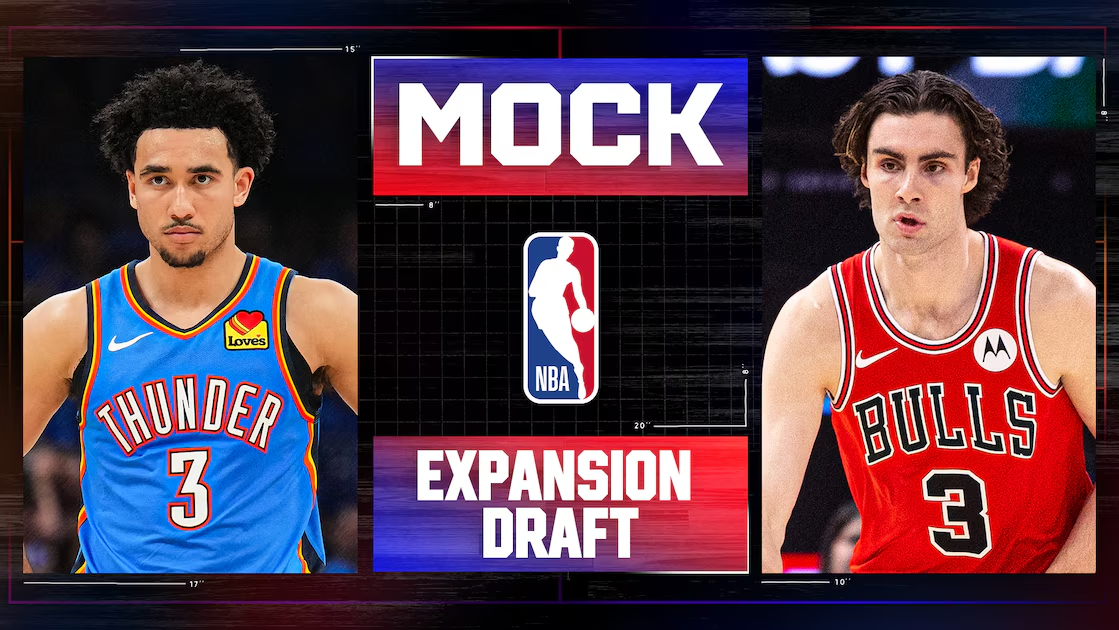
The push to bring new NBA teams to Las Vegas and Seattle is gaining momentum. Reporting by ESPN’s Shams Charania says the process of collecting bids for a Las Vegas team has moved faster than the one for Seattle, while the league has aimed to begin the expansion as soon as possible, potentially for the 2028–29 season.
According to Bleacher Report, analysts Dan Favale and Grant Hughes created an imaginary expansion draft using players who would remain unprotected after a protection process. The simulation followed core rules: expansion teams have only 66⅔% of the normal cap limit in the first year; with the 2026–27 cap at $164,961,000, that places the new teams at a ceiling of about $109,974,000. Each team had to select at least 14 players, and existing teams could lose a maximum of one player in the expansion draft, which shaped the selection tactics.
In their imaginary draft, the Las Vegas Vipers started with Jared McCain, a 22-year-old cheap asset with scoring potential, considered the cornerstone to build around. The Vipers then took Josh Giddey, who posted impressive passing numbers in the 2025–26 season, and Marcus Smart for experience, defensive coverage and half-court aggression. To strengthen the wing and frontcourt, the team also added Allen Graves as a defensive-role forward and Jose Alvarado as an energy source in the second-guard role.
The Seattle SuperSonicBooms focused their early picks on offensive organization and salary flexibility, starting with Ty Jerome as the game’s economical conductor. To add anchoring on defense and rebounding, they took Mitchell Robinson, despite managed-minutes requests, and later secured talents like Rasheer Fleming, a long forward with potential to contribute as an offensive rebounder and long-range scorer, as well as Micah Potter as a stretch big with three-point efficiency.
The imaginary draft also highlighted the different construction dilemmas: some teams focused on cheap, lightly paid players to preserve budget flexibility, while others spent funds on central-role players. It was noted that early picks can block access to players from the same original team, since the rule allowed the departure of only one player from each existing team.
This simulation, adapted to respect cap constraints and expansion rules, shows different ways the Vipers and SuperSonicBooms could take shape in a real-draft scenario. The summary and draft analysis can be found in the original Bleacher Report article.
Komentet
Bëhu i pari që komenton!
Lini një Koment të Ri
Për t'u përgjigjur një komenti specifik, kliko butonin 💬 Përgjigju poshtë atij komenti.