
Swiss neutrality referendum: voters reject proposals for stricter rules
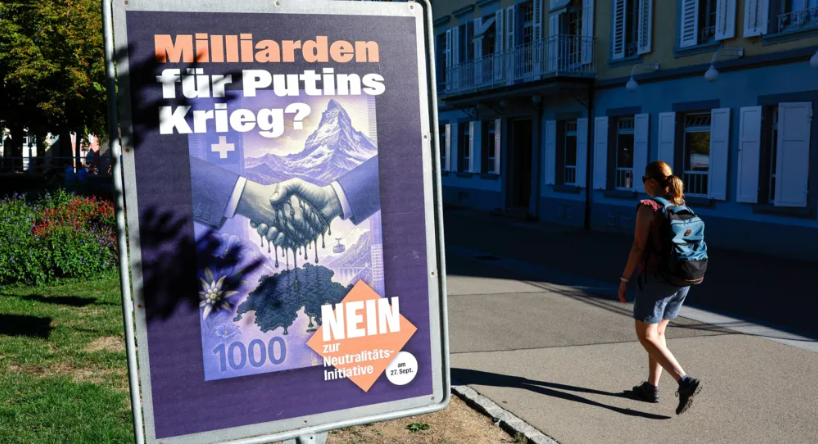
Voters in Switzerland have overwhelmingly rejected proposals for a stricter interpretation of the country’s neutrality tradition.
More than 70% of Swiss voters opposed the proposals that would have barred Switzerland from imposing sanctions without United Nations approval, according to official results.
The changes would also have limited Switzerland’s ability to forge closer ties with the NATO military alliance.
Russia’s full-scale invasion of Ukraine has reopened the debate in Switzerland over its neutrality policy, which dates back centuries.
Moscow openly backed the initiative, which was also supported by the right-wing Swiss People’s Party (SVP). On the other side, it was opposed by the federal government and the other major parties.
Lukas Golder, co-director of the Gfs.bern research institute, told Swiss public broadcaster SRF that voters had not rejected neutrality, but that the result showed support for imposing sanctions on Russia.
“People have a clear idea of what Swiss neutrality is supposed to achieve,” he said.
Swiss Foreign Minister Ignazio Cassis said during a recent televised debate that “neutrality has always been implemented with a degree of flexibility.”
Cassis stressed that, although Switzerland has no plans to lift the ban on arms sales to countries in conflict, including Ukraine, neutrality must not imply indifference.
“Neutrality does not mean indifference,” he said, adding that Switzerland “will not look away when it sees violations of the international rules that allow us to live in peace.”
Switzerland was internationally recognized as a neutral state in 1815, when the Congress of Vienna recognized the country’s “perpetual neutrality,” in a period marked by wars and upheaval in Europe.
The principle of neutrality was further defined in international law through the 1907 Hague Convention, which set out the obligations of neutral states during armed conflicts.
Switzerland continued to apply its neutrality policy in later periods. It remained neutral during World War II, while also holding gold looted by the Nazis during that period. In an effort to deter invasion by Nazi Germany, Swiss authorities also turned back thousands of Jewish refugees.
Switzerland later apologized for the policies pursued during that period.
Switzerland’s system of direct democracy means that major political decisions are often put to voters through referendums.

Komentet
Bëhu i pari që komenton!
Lini një Koment të Ri
Për t'u përgjigjur një komenti specifik, kliko butonin 💬 Përgjigju poshtë atij komenti.