
Parliament Approves Magistrates’ Pay Rise; Rama: “No One Can Set Deadlines for Parliament” (Full Speech)
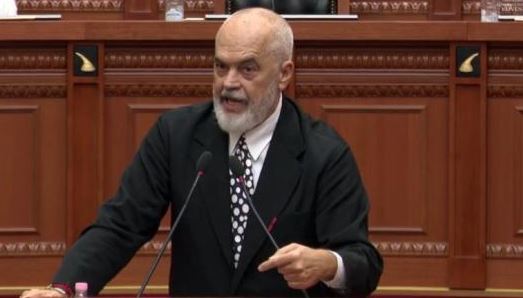
With the 84 votes of the majority, Parliament approved the new formula for magistrates’ salaries. The vote did not end the clash between the government and the justice institutions. The magistrates have opposed the Socialists’ draft law, which foresees an increase of the reference salary by about 8,500 lekë — roughly 2% of the President’s salary — while their demand, also endorsed by the High Judicial Council and the High Prosecutorial Council, is nearly nine times higher, around 80,000 lekë.
The prime minister’s full speech in Parliament:
“I wish someone would pass on my message to Mrs. Tabaku, since she is not present — she spoke with great passion about the 100-and-some-days protest. Tell her that being in government and having people protest against you is called democracy. Being in the opposition and getting driven out of a protest like a contagious disease is called a mule’s send-off — the horses have already left.”
“As for my dear ballist, I have only one word for you. I don’t know how I will be remembered in history, but that you ballists will be remembered as cruel exterminators of chickens is sealed for centuries to come.”
“Now I want to say a few words here not as a party, but as a power — as one present among a group of elected representatives of one of the three independent powers the Constitution has. And it is unbelievable how representatives of an independent power, simply out of spite toward the other side, hand over their power with such ease to another power — and this has nothing to do merely with what we discuss today about judges’ salaries. This is about the balance of independent powers in a parliamentary republic.”
“I want to return to a debate we had here regarding a colleague, Olta Xhaçka, for whose case I have brought a few words from the Venice Commission, which I believe are very accurate to guide our reason as representatives of an independent power, all of us together. ‘The competence of the Constitutional Court, as a judicial and not a political body, must not interfere in the sphere of the constitutional legislator, which has the exclusive competence to create new constitutional norms. The boundary between interpreting an existing norm and creating a new norm is not always easy to determine, but the perception of a government of judges must be avoided, and the competence to create new constitutional norms belongs to the legislative power, while the Constitutional Court holds the competence to interpret norms authoritatively.'”
“In very simple words, the Constitutional Court is the referee. It cannot stop the game; it can note the violation, it can disallow the goal, but it cannot take the ball and say ‘the ball is mine, I’ll take the penalty.’ The Constitutional Court, as another independent power, is independent of us here as the legislative power and independent of us as the executive power, to tell us when we raise our hand wrongly — but if we raise our hand wrongly and the Constitutional Court tells us ‘with this raising of the hand you violated this norm, therefore this norm falls,’ the Constitutional Court can never, in any case and for any reason, tell an independent power like the Parliament how it should raise its hand. That doesn’t happen. And now — raise your hand for the text I wrote for you, for the formula I chose, for the amount I set — the Constitutional Court cannot say that to the Parliament of Albania, and here there are MPs who have spent many years in this Parliament.”
“Today has a peculiarity, because today in this hall there are the 84 votes needed to approve this norm — but if you were not hypocrites, you would have to admit that without these 84 votes it would have been entirely impossible to reach a result based on a specific order of another power. The Constitutional Court can strike down a tax that unconstitutionally discriminates against a category of citizens. But it cannot set the tax rate. It can strike down a pension provision that violates equality or legal certainty, but it can never draft the pension scheme itself and determine how many lekë this or that pensioner will receive. The Constitutional Court can annul an unclear criminal provision, but it cannot write the new criminal offence and the sentence itself. These are choices that require a law, public debate, financial assessment and a parliamentary vote. And the case I brought reminds us, via Venice, that an MP is individually unmandatable and that parliament can and must vote on matters within its competence.”
“Now let’s come to the magistrates’ salaries, because here I heard everything. First: did the Constitutional Court have the right to review the formula approved by Parliament? Absolutely yes. To find a certain incompatibility, in its view? Certainly yes. To annul the relevant provisions and demand the approval of amendments? Nobody disputes that — but on the other hand, the Constitutional Court cannot tell legislators how the solution should look within the norm inside which they must move.”
“Now, don’t think about today and don’t look at today. This is not at all, zero percent, my or our issue for any of the reasons mentioned. This is a very simple matter of principle regarding your children — all of ours. I mean tomorrow. In the year we carried out the Justice Reform, we took it upon ourselves to do something ‘unfair,’ in quotation marks. We raised magistrates’ salaries in a stratospheric way by the norms and levels of our salaries, with full will and with the reasoning that a root-and-branch reform in justice and the need to place a motivated group of magistrates on the barricade of a new justice made it necessary — and so we broke the salary pyramid. So if the salary pyramid is like this in every state, we lifted judges up here.”
“Now, by what logic do you — and anyone else — demand that every time salaries rise here, they must also rise here? According to this logic, it turns out that in all future generations we will build the only republic, the only kingdom, the only empire, the only system the history of the world has seen where judges are above everyone. This is an act of irresponsibility toward tomorrow.”
“Now, to say ‘my salary is being cut because it isn’t being raised, while I am at this level here above the pyramid as a magistrate,’ and to say ‘every time others get a raise I must get one too because my quality of life is harmed,’ is missing the object entirely. On the other hand, precisely because the legislative power is an independent power, every democratic constitution has a provision that ours has too. Judges’ salaries cannot be lowered. It’s specific. The Constitution doesn’t say you can’t lower anyone else’s salary. It says judges’ salaries cannot be lowered. Why? Because the Constitution — and all democratic constitutions — have in mind precisely the tension created between powers for the reasons mentioned here, and for that reason they guarantee that judges and prosecutors can act freely without being threatened by a revenge, in quotation marks or not, of another political power that could put them under pressure by lowering their salaries. But are we in a salary-cut situation? To say that it’s a hidden salary cut merely because theirs rises this much while others’ rises that much — while they remain up high — seems unreasonable to me.”
“And here we come to the other point. To say there was a deadline — certainly, I share it; several here said that violating that deadline makes whoever responsible, and let them bear it — but to say that on that date a new power suddenly emerged which determined what in fact only the law can determine, and on the other hand to see an interplay of associations with the judicial corps of Albania and to see coordinated moves — to my knowledge, judges don’t even talk to each other before making a decision, because it’s forbidden; they don’t discuss with each other, within one corps, but they don’t tell the other how they’ll decide in the end. Meanwhile, to see this organisation is extraordinarily worrying, and I think all MPs here, regardless of side, will not take this so lightly, because life goes on and all developments in this direction are developments that harm the Republic of Albania. They are not developments that help it.”
“Of course, here we do not question that we will respect the Constitutional Court’s decision, as we understand it — and the Constitutional Court leaves this discretion to Parliament. Indeed, the Constitutional Court also defines the framework of possibilities available at this point — but I think the entire Parliament will give the Constitutional Court a very clear message with this case. Your duty is to not allow us to raise our hand wrongly, but our duty is to tell you that you can never tell us how we raise our hand. If these two get mixed up, we have a very big problem, which tomorrow could become much bigger — and here there is absolutely no kind of challenge, no kind of war of any nature with the justice system, no kind of pressure, absolutely nothing of the sort. Because let me remind you of something else: if we follow to the end the logic of those who presented this as an attempted pressure, the Special Prosecution has not asked for salary increases. It has neither asked for salary increases nor sent the payroll, except under the old formula. So this logic falls even if we take it, for a moment, in good faith — which it isn’t. Here it is a matter of European state-building.”
“We have entered a new phase. We clearly have a new independent power in this city, and precisely because it is a new independent power we are seeing things unimaginable in a consolidated democracy — with investigators going to the Ministry of Finance, with prosecutors knocking on the Treasury’s doors, with judges threatening Treasury officials. So we are in the situation of a corps that is enjoying its independence. Is this what we want? Is this what we want? Is this what you want? I don’t believe this is what we want. I believe we have the responsibility to strengthen this dynamic of the separation of powers, but at the same time we have the responsibility to show where one power ends and the other begins. The Constitution doesn’t speak of two authorities and one independent power. The Constitution speaks of three independent powers. They are reciprocally independent and reciprocally intertwined.”
“And at the very end I want to tell you one more thing — that on this matter, and here I’ll have to express myself unusually, I fully agree both with the deputy from Vlora and with anyone else here who said there is a need to make a new law, to put an end to this story whose origin lies in that moment when, in making the reform, it was not determined when the pyramid would be balanced, and it was not said clearly and plainly that you will now receive from Albanians’ taxes much more than everyone else because the reform requires you to make an effort — but that this will not be a permanent increase. Every time others get raises, you will get raises too — because then, as I said at the beginning, we would create the first state in the world, and I challenge everyone to bring me, at least from the last 2,000 years, a system where judges have been above everyone in tax terms; it doesn’t happen, it’s nonsense. But on the other hand, when I speak of a new law I don’t speak into the air: we have started contacts with the Council of Europe, with that European Commission for the Efficiency of Justice, and I received all those whom you had in the relevant committee because they asked for a meeting and we organised the meeting. We organised the meeting according to their wishes and conditions, in the sense of giving everyone the opportunity to speak and to tell them that there is a problem here which we will address together — this cannot turn into a conflict of powers. What does this mean? That tomorrow we should act as was once done in democratic Albania, where the police were ordered not to execute prosecutors’ decisions? It happened. We cannot move toward a conflict of powers, and we are ready — not ready, but fully engaged — to make a new law. There are a number of ways to do it, but this story — that every time a salary rises in the Republic, a salary must rise over there — must come to an end. It is absurd. And this other thing — ‘respect the Constitutional Court’s decision…’ — certainly. But a Constitutional Court can never tell a legislator ‘raise your hand this way because I decided so.’ And fortunately, in this case it hasn’t said so; it has left full discretion.”
“As for the violation of the deadline: no one sets deadlines for Parliament — that is another nonsense. Nobody can tell Parliament, except its own members, when it will convene and what it will convene for. Here we spend four hours debating the agenda. How can another power come out and say ‘you will convene by the 31st, because if you don’t convene by the 31st, on the 1st we will storm the Treasury’s doors’? What is this? And why? Because two corps come out there which are, in fact — if the Justice Reform has many reasons to be encouraged, and to clarify for everyone on my part, I see two successes in the justice reform, SPAK and GJKKO with all their problems, which are two successes — but if there is one bankruptcy, it is those two Councils over there, and if there is one reason for the Parliament of Albania to be concerned, it is precisely to reflect on the justice reform, and not on that part of the reform that has become the daily leitmotif, ‘prison, prison,’ but on that part of the reform that is the leitmotif of the lives of those tens of thousands of people who have turned into dusty case files — who speaks for them, who deals with them? But those jobs cannot be solved by those who come here like Mrs. Tabaku, holding ‘protest, protest’ speeches, having been driven out of the protest like a contagious disease.”

Komentet
Bëhu i pari që komenton!
Lini një Koment të Ri
Për t'u përgjigjur një komenti specifik, kliko butonin 💬 Përgjigju poshtë atij komenti.