Tirana protests: Rama tells German newspaper — “I’m better when I’m challenged! Time will tell”
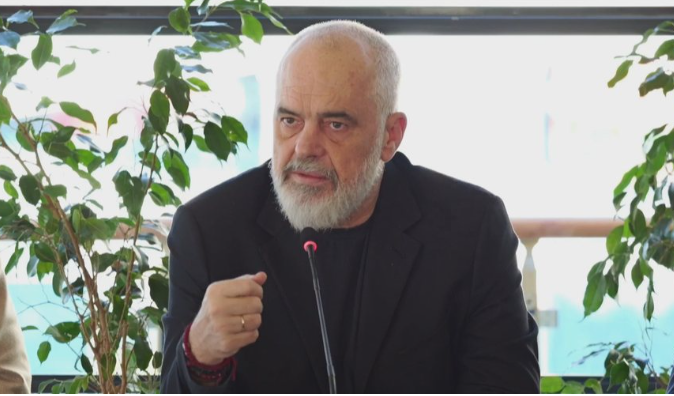
Prime Minister Edi Rama and the civic protests in Tirana have been the focus of the German newspaper Frankfurter Allgemeine Zeitung. According to the German outlet, Rama has described the protests as a challenge for the government. The article notes that the prime minister sees the protests as a test of confidence for his government and an opportunity for reflection.
“For me it is a challenge. But that is a good thing. Throughout my political life, things have never really gone well when I wasn’t challenged. I am usually better when I am challenged. Will I be better this time too? I hope so. I don’t know. Time will tell. The future will prove it,” Rama is quoted as saying.
According to the prime minister, the protests are a positive sign when citizens take to the streets for biodiversity, environmental protection and other issues of public interest.
On the projects in Zvërnec and on Sazan Island, Rama once again dismissed accusations of “selling” Albania, stressing that Sazan remains the property of the Albanian state.
According to him, no agreement has yet been finalized for the development of Sazan’s former military zone by private investors.
“Rama insists that promoting foreign direct investment, especially in the tourism sector, does not make him a tool of Trump. According to him, the prospect of investments worth over four billion euros in the projects planned by Jared Kushner and his partners is not something a prime minister can simply refuse, if he thinks about the country’s interest,” the article writes.
On the impact of the protests on tourism, the article notes that they brought a slight slowdown in the sector’s growth, but the situation appears to have been overcome. Albania is expected to register 14 to 15 million visitors this year, compared with around 12.5 million a year earlier.
The full article:
For more than a hundred days they have gathered every evening. Around 7 p.m. people assemble in the heart of Tirana and walk along the “Dëshmorët e Kombit” boulevard. About halfway along stands the prime minister’s office, whose resignation they demand.
It is right there that the protest gets loudest. At times, in front of the building there are clashes with police officers and arrests, but most of the time the situation remains peaceful.
So it goes, evening after evening. On weekdays, the protesters are noticeably more numerous than on weekends, when even the most persistent protesters sometimes choose the sea instead of always staying on the streets of Tirana. The latter fill up with young people going out to celebrate. They celebrate at least as loudly and as long as the protesters demonstrate. They are two parallel worlds that seem not to intersect.
The self-proclaimed “Flamingo Revolution” in Albania has so far not turned into a mass movement. But it has shown persistence. The head of government, Edi Rama, is doing the same. He has been in power since 2013 and is determined to stay until the end of the legislature in 2029.
Which side will manage to hold out to the end?
The protests in the Albanian capital began at the end of May. The trigger was a harsh intervention by employees of a private security company near a construction-site fence. The fence had been erected at the northern edge of the Zvërnec peninsula, where preliminary work was to begin on a luxury tourism project. Several hundred people had protested on site against the project, which is being pushed forward by Jared Kushner’s Affinity Partners investment company, Donald Trump’s son-in-law.
During the protest there were clashes near the fence. Guards dragged several protesters across the gravel to remove them from the construction fence. Cellphone footage of the intervention, in which no one was seriously hurt, went viral.
But how could a relatively minor incident turn into a national protest movement that even calls itself a revolution?
That has to do with the flamingos, which the movement has chosen as the charming symbol of the change it seeks. Environmentalists fear that the colonies of pink flamingos and other migratory birds could be endangered by the tourism boom in southern Albania — especially by the luxury resorts planned by Arab investors and investors from Qatar linked to Kushner’s group. The pink flamingo’s habitat is precisely the Narta Lagoon, a protected area near Zvërnec.
The “Flamingo Movement” accuses the government of corruption and demands the expansion of protected areas, an end to favoritism toward large investors and new democratic elections.
Initially Rama, who has led the Socialist Party since 2005 and the government since 2013, tried to let the protests burn themselves out. Protesters were told they could not simply show up one fine day and topple the elected prime minister and his government.
“That’s not how it works. You have to wait until the next elections.” It was an argument that was hard to refute. In the May 2025 parliamentary elections, Rama and his socialists had won more than 52% of the vote. It was the socialists’ fourth consecutive election victory, while Rama and his party had steadily increased their vote share.
Yet, just as he had received the strongest mandate from voters, Rama was suddenly confronted with the most serious threat to his power. Less than two months after the protests began, he changed tactics. Instead of continuing to show protesters “the fist” through rhetoric, he is now trying to pat them on the back. The protests, he now says, are a sign of the vitality and stability of Albanian democracy. He distinguishes between those who present legitimate demands and must be heard, and those who, in his view, are being used by his opponents inside and outside the country for political purposes.
In a forceful speech before the socialists’ parliamentary group at the end of July, Rama presented the government’s new strategy. He spoke of a deep crisis of public trust. Before figures of his party, accustomed to electoral victories, Rama complained about the “paradox of success”: the more a society develops and prospers, the less it judges what has been achieved and works, and the more it focuses on what is missing and doesn’t work.
Poor societies, he said, are more tolerant of shortcomings, because the prevailing mindset is that “it could have been worse.” Albania, according to Rama, has left this phase behind and entered another, where the idea prevails that “it could have been better.”
Therefore, in his view, what is now needed is a “caring state” that listens to and takes seriously citizens’ experiences, improves the quality of services and investments, and in this way strengthens citizens’ trust in the state.
Rama’s speech was received positively by Socialist Party deputies and officials. Representatives of the Flamingo Movement dismissed it as a rhetorical maneuver to divert attention from the fundamental problems: corruption, lack of transparency and environmental destruction.
Sali Berisha, the head of the conservative opposition from the Democratic Party, raised the suspicion that Rama had used artificial intelligence to draft the 40-page document, which he described as content-free and poorly written.
Rama himself does not give the impression of feeling defensive about the “Flamingo Revolution.” He receives you in his office at the Prime Ministry. His white sneakers are under the desk. With his wide black trousers, black sweater and black socks. On a clothes rack hang basketball jerseys that the former Albanian national player received as gifts. The cabinets and shelves are filled with various art objects.
Rama does not believe the country is at a turning point, let alone a breaking point. “But it is undoubtedly a test of confidence.” He says he tries to see the glass as half full and half empty at the same time.
“If someone else sees the glass as half empty, that’s fine. He sees less of what we have achieved and demands more. While he who sees the glass as half full sees exactly what we have achieved.”
In principle, in his view, it is a positive sign when people take to the streets — for biodiversity, for environmental protection and for other issues.
“For me it is a challenge. But that is a good thing. Throughout my political life things have never really gone well when I wasn’t challenged. I am usually better when I am challenged. Will I be better this time too? I hope so. I don’t know. Time will tell. The future will prove it.”
As for the direct cause of the protests on the Albanian riviera, Rama recalls that the first contact with Jared Kushner and Ivanka Trump about a possible investment in Zvërnec and Sazan Island happened at a time when Donald Trump was not yet president again.
“Trump’s life at that time oscillated between prison and the White House.”
Rama insists that the fact that, as Albanian prime minister, he promotes foreign direct investment in his country, especially in the key tourism sector, does not make him a tool of Trump.
And the prospect of more than four billion euros of investment in the projects planned by Kushner and his partners, Rama says, is not something he as prime minister can simply refuse, if he thinks about the country’s interest.
Still, in his view, there can be no talk of a “sale” of Albania. Sazan Island remains the property of the Albanian state and will remain so. No agreement has yet been reached on the possible development of the former closed military zone by private investors into a luxury resort.
In June, the protests brought a small slowdown in the growth of Albanian tourism. Now that appears to have been overcome. This year Albania is expected to register 14 to 15 million visitors, compared with around 12.5 million a year earlier.
Komentet
Bëhu i pari që komenton!
Lini një Koment të Ri
Për t'u përgjigjur një komenti specifik, kliko butonin 💬 Përgjigju poshtë atij komenti.